


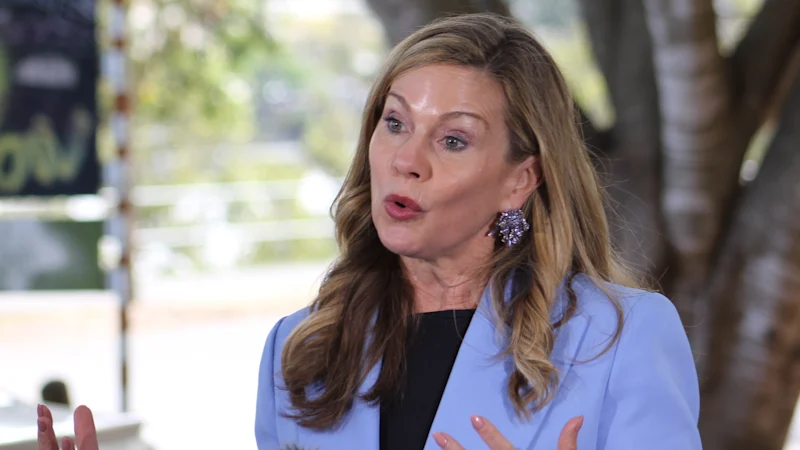
Australia’s eSafety Commissioner, Julie Inman Grant, has suggested she may leave the role when her term ends at the beginning of 2027, saying a change of leadership could be beneficial as the country enters a new era of digital regulation.
Inman Grant made the remarks in Brisbane on Wednesday while announcing funding for projects aimed at tackling abuse carried out through digital technology.
“I think 10 years is a long time,” she told reporters. “With this new digital duty of care and this new era coming about, I think it will be great to have new leadership.”
She added: “My focus now is to achieve as much as I can with the runway I have, and to make sure I leave the eSafety Commission team and office in the best-possible hands for the next leader.”
Inman Grant began her first five-year term in early 2017, under then-prime minister Malcolm Turnbull, and was reappointed in 2022.
She said the international environment surrounding technology regulation was becoming increasingly complex, with large technology companies holding significantly greater power and wealth than smaller regulators such as Australia’s eSafety Commission.
“It’s becoming geopolitical,” she said. “The asymmetries between the power, wealth and stealth the technology companies have versus small regulators like ours in Australia is unbalanced, but that doesn’t mean we won’t take a swing.”
Inman Grant also said AI companies had shown they were not able or willing to regulate themselves. She confirmed there was no plan to include AI chatbots in Australia’s social media ban for under-16s, although the existing regulatory framework could be strengthened by the Albanese government.
Federal ministers Tanya Plibersek and Anika Wells joined the commissioner to announce 12 projects receiving a total of 3.5 million Australian dollars to help women and girls recognise, prevent and respond to technology-facilitated abuse.
Funding was also confirmed for projects intended to create more positive online experiences for boys and young men. Plibersek said young men could be exposed to misogynistic material online within minutes, warning that such content was spilling over into real-world harm.
