


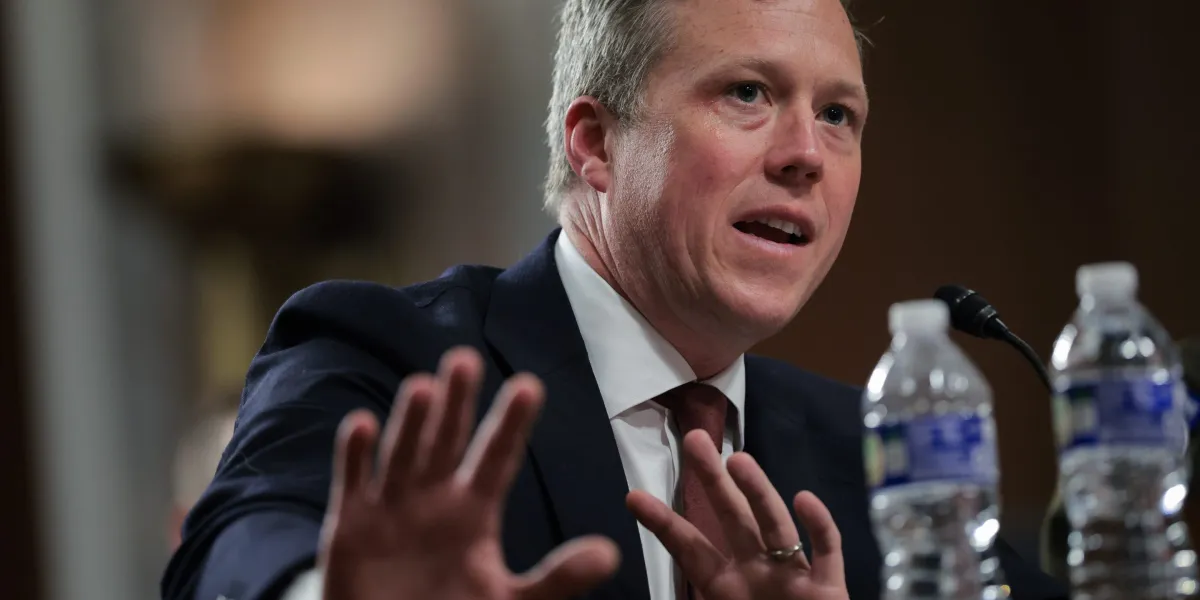
OpenAI has hired former US Army secretary Dan Driscoll as a senior counsellor for national security modernisation, strengthening the artificial intelligence company’s links with the US defence establishment.
Driscoll will advise OpenAI’s public and private-sector partners on updating policy and strategy to support national security through AI, with a focus on responsible use by the United States and its allies.
The appointment comes two months after Driscoll left the Trump administration following reported tensions with defence secretary Pete Hegseth. He stepped down from the Pentagon in September after about 18 months in the role.
Gwanhoo Lee, chair of the Department of Information Technology and Analytics at American University’s Kogod School of Business, said the hire reflected OpenAI’s growing investment in defence and its efforts to build relationships with government agencies.
“This hire is a continuation of their trend to see the opportunity in hiring significant government officials to strengthen their relationship with the government and strengthen their business in dealing with the government agencies,” Lee said.
Driscoll previously backed modernisation measures including low-cost battlefield drones, reducing regulatory obstacles for defence contractors developing drones and moving the Pentagon towards commercial software rather than systems built exclusively for military use.
He also took part in diplomatic efforts aimed at ending the war between Russia and Ukraine, travelling across Europe to hold talks with Ukrainian and European officials. He separately made a secret trip to the Middle East to meet Russian officials.
OpenAI chief executive Sam Altman said the United States had “an extraordinary opportunity to work with other countries to spread the adoption of democratic AI” following Driscoll’s appointment.
Driscoll said the technology could help public authorities process paperwork, analyse more information and deliver answers more quickly.
“I’m joining OpenAI to help the United States and our allies put this technology to work responsibly, for the people who keep us safe,” he said.
OpenAI’s growing defence links
The company appointed retired US Army general Paul Nakasone, a former director of the National Security Agency, to its board in June 2024. Later that year, it partnered with defence firm Anduril to combine OpenAI’s systems with Anduril’s database of unmanned drone threats.
OpenAI was awarded a 200 million US dollar contract by the Department of Defense in June 2025 to develop AI tools addressing national security challenges. In February, it also agreed a deal to deploy its models on the Pentagon’s secure networks.
That agreement included an “all lawful use” clause, allowing broader use of the technology within legal limits while retaining restrictions. OpenAI said its systems would not intentionally be used for domestic surveillance and that the Pentagon understood the limits on deliberately tracking US citizens or nationals.
The deal nevertheless prompted concerns among technology policy experts about safety, privacy and the possibility of legal loopholes around the analysis of data obtained from commercial sources.
Concerns over the Pentagon revolving door
Lee said Driscoll’s move into the private sector could raise questions about a “revolving door problem” involving senior government officials and companies seeking public contracts.
He warned that conflicts of interest could affect procurement decisions if relationships were given greater weight than the effectiveness or value of competing technologies.
“If that procurement is based upon relationships rather than merits and strengths of technology, that puts us at risk,” Lee said. “As AI companies take on national security risks, we need clearer rules on oversight and conflict interest, so I think there is some governance concern.”
OpenAI said all parties were aware of post-employment restrictions and would comply with them.
Before joining the Trump administration, Driscoll worked in investment and advisory firms, including as chief operating officer at venture capital firm Flex Capital and as a partner at private equity firm 100watt. He served in the US military from 2007 to 2011 and was deployed to Baghdad in 2009.
