


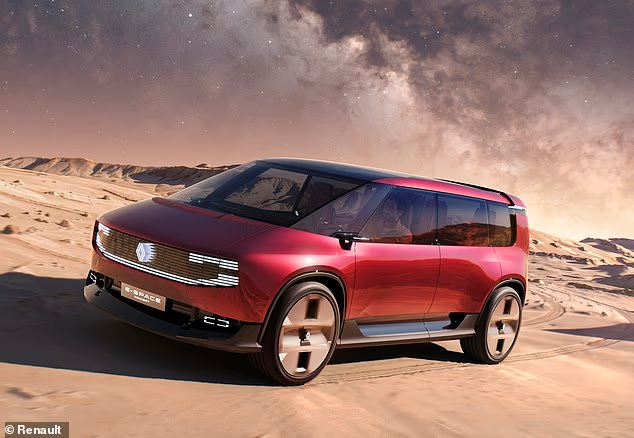
Renault has unveiled an electric Espace concept at the Paris Motor Show, raising the possibility that one of Britain’s best-known people carriers could return to UK showrooms.
The E-Space is a seven-seat design study inspired by the original Espace, which arrived in Britain in 1985 and helped establish the large family MPV as a practical alternative to conventional cars.
Its appearance comes as SUVs continue to dominate the family-car market. Renault’s concept takes a lower, more aerodynamic approach than the increasingly tall and rugged-looking crossovers that have replaced many people carriers.
Measuring 4.7 metres in length, the E-Space has a broad glasshouse intended to maximise visibility and create a light, spacious cabin. Its proportions, including a low waistline and cab-forward layout, deliberately recall the first-generation Espace.
The concept also features coach-style doors that open in opposite directions, allowing easier access to the interior. Renault says the vehicle was developed from the inside out, with passenger space and comfort taking priority over the exterior design.
Alexandre Malval, Renault’s design boss, said the E-Space showed the company could still “make its mark with intelligence and appeal” despite the dominance of SUVs and crossovers.
Inside, six individual seats are arranged over three rows on a flat floor. The middle-row seats can rotate by 180 degrees, allowing occupants to face those behind them in an arrangement Renault compares with a TGV train seating square.
A sliding central console includes an air purifier, a mini fridge, video-game controllers and a Connect 4 game. Renault’s designers say they drew inspiration from furniture, using slim seats to make the cabin feel more open.
The interior is finished in deep red materials, with thick carpets and fabric trim intended to give it the atmosphere of a sitting room rather than a conventional car.
At the front is a large, curved, double-stacked screen extending across much of the dashboard. Renault calls the display OpenR Panorama and says it previews technology that could feature in future production vehicles.
Steering is operated using by-wire technology. Renault says removing traditional mechanical components allows the cabin to sit further forward over the front wheels, creating a longer wheelbase and more room for passengers.
Could the Renault E-Space enter production?
Renault has not confirmed that the E-Space will become a production model. The company describes it as a concept intended to signal its future design direction, and has released few details about the electric powertrain.
That leaves the concept’s prospects unclear, although a strong public response could encourage Renault to consider putting the model into production.
The Espace name has not been used in Renault’s UK showrooms since 2013, although it remains available in mainland Europe. There, the current model is sold as a five- or seven-seat hybrid SUV rather than as a traditional MPV.
The original Espace used a largely plastic body and a 2.0-litre engine. A second-generation version followed in 1991 with smoother styling and a range-topping 2.9-litre V6 petrol engine, while a turbo diesel was added in 1993.
Sales reached their peak with the third-generation Espace, launched in 1996, before the popularity of people carriers declined as SUVs began taking a larger share of the family-car market.
