


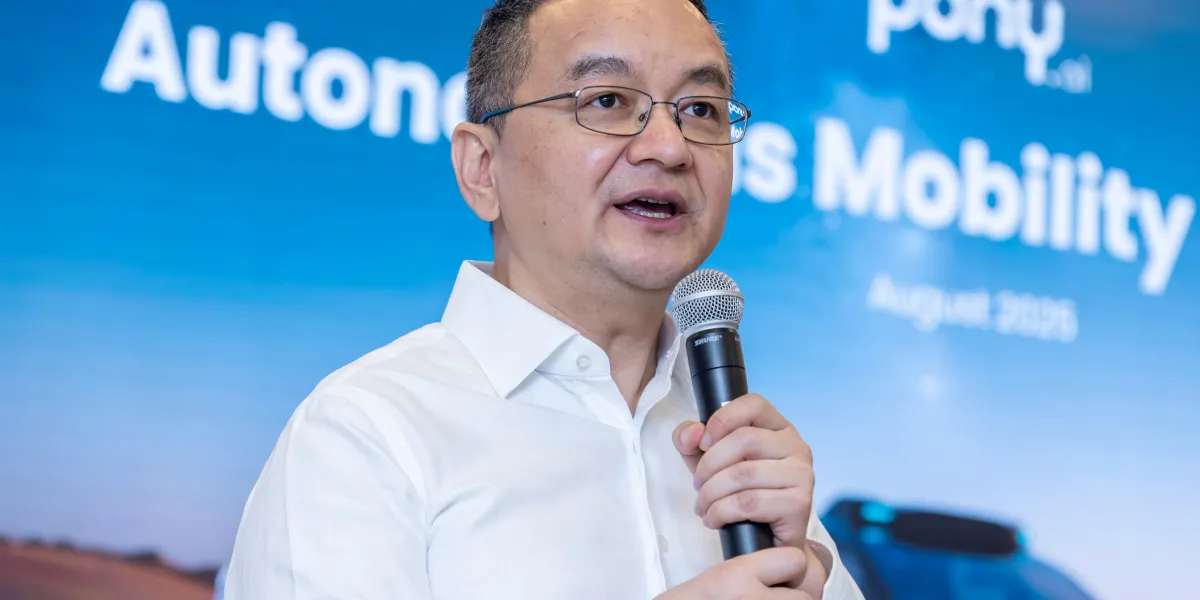
Robotaxis could become a familiar sight on streets around the world within five years, according to James Peng, founder and chief executive of Chinese autonomous-driving company Pony.ai.
Speaking at the Fortune Leaders Forum in Macau on Tuesday, September 8, Mr Peng said advances in self-driving technology had reached a point where passengers would soon be able to summon driverless cars in the same way as conventional taxis.
“I think the technology problem is pretty much already solved,” he said. “You’ll be able to hail a robotaxi just like a normal taxi.”
Pony.ai already operates commercial robotaxi services in Beijing, Guangzhou, Shenzhen and Shanghai, with its vehicles completing about 25 rides a day on average. The company said its fleet had grown to 1,975 vehicles by the end of June and is expected to exceed 3,500 by the end of 2026.
Mr Peng said passengers came from a broad range of age groups and professions, rather than being limited to technology enthusiasts. The company has also reported more than 1.5 million registered PonyPilot users in China.
Pony.ai expands robotaxi ambitions overseas
The firm is seeking to build an international presence through partnerships with established mobility companies. In August, it announced plans with Uber to deploy more than 2,000 robotaxis across five European cities, expanding on a commercial service launched in Zagreb, Croatia.
Pony.ai has also agreed to work with South Korean mobility company FutureLink to introduce 200 of its seventh-generation robotaxis in South Korea by 2028, subject to local certification. It has separate partnerships and projects in the Middle East and Singapore.
Mr Peng said the company prioritised cities with relatively expensive taxi markets and regulations that were supportive of autonomous vehicles. Partnerships with firms such as Uber, he added, could help build public confidence and make it easier for governments to accept driverless transport.
Other Chinese autonomous-driving companies, including WeRide and Baidu, are pursuing similar expansion in Europe and south-east Asia, increasing competition with US-based Waymo.
Mr Peng credited China’s regulatory framework and industrial base with helping the country advance in autonomous driving, saying the technology required close coordination between hardware, software and specialist talent.
He argued that widespread robotaxis could have consequences extending well beyond the taxi industry. As most privately owned cars are used for only a small part of the day, replacing some journeys with shared autonomous vehicles could reduce demand for parking and alter the way cities are designed.
“The implications will be profound,” he said. “It will change the whole urban planning and change the way of our life.”
Pony.ai’s robotaxi revenue rose to 12.1 million US dollars in the second quarter of 2026, a 691% increase on the same period a year earlier. However, the company recorded an operating loss of 65.7 million dollars as it continued to invest in research, development and fleet expansion.
The company has also observed changes in how passengers use its vehicles. Mr Peng said some riders had occasionally forgotten to shut the door when leaving, forcing Pony.ai to ask nearby delivery workers to close it.
He added that the proportion of female passengers increased during evening hours, with some saying they felt safer and more comfortable travelling without a human driver.
