


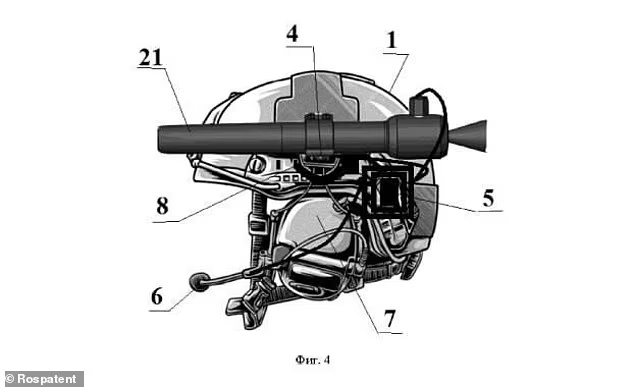
Russia has patented an anti-drone helmet that could allow soldiers to fire at incoming aircraft by biting a mouthpiece or issuing a voice command.
The helmet-mounted weapon is designed to bring down drones using either ammunition or a net. It would be fitted with laser and electronic controls to help the wearer aim and fire without using their hands.
The system was developed by Russian inventors Yuri Ladyagin and Yuri Gabliia, who have previously worked together on an electroshock weapon and a method intended to counter Ukrainian fibre-optic drones.
Cameras capable of detecting drones could also be added to the helmet, although it is unclear whether the system would be able to identify an approaching drone and intercept it quickly enough.
The patent does not provide evidence that the weapon has undergone practical testing, entered serial production or been formally adopted by Russia’s armed forces.
Several challenges would also need to be addressed before it could become an effective battlefield device, including the weight and strain placed on the wearer’s head and neck, the danger of accidental firing and the accuracy of the weapon.
The proposed system is not Russia’s first attempt to mount anti-drone technology on a helmet. In September 2024, the governor of the Donetsk region offered a helmet-mounted device designed to detect and intercept signals from approaching drones.
That system differed from the newly patented weapon, which is intended to physically destroy drones with ammunition or a net rather than simply target their signals.
The development follows earlier problems with Russian camouflage garments designed to hide soldiers from thermal and night-vision sensors. Faults in the coats and blankets, combined with a lack of training in their use, reportedly made some troops easier to detect.
Instead of concealing body heat, the garments created cold patches against a warmer background. Ukrainian drones using thermal imaging could then identify Russian activity and carry out strikes at night.
