


Schools are moving to curb classroom screen time as student anxiety rises and maths and reading results decline, with New South Wales preparing to follow Victoria’s lead while education experts warn against rushed bans.
Federal Education Minister Jason Clare has called for a “digital detox” after Australian teenagers recorded their lowest maths and reading scores since international testing began more than two decades ago.
In Victoria, state primary schools will next year be barred from asking parents to buy devices for their children. Pupils in years 3 to 6 will also face a daily limit of 90 minutes of screen time, while children from prep to year 2 will have minimal exposure to devices.
Secondary teachers will be required to plan device-free learning, although fixed time limits will not apply. Mobile phone restrictions will also be extended to smartwatches and wireless earphones in Victorian state schools, with private schools adopting the same ban.
Victoria’s Education Minister Gabrielle Williams said digital learning remained useful, but classrooms “should be run by our teachers – not screens”.
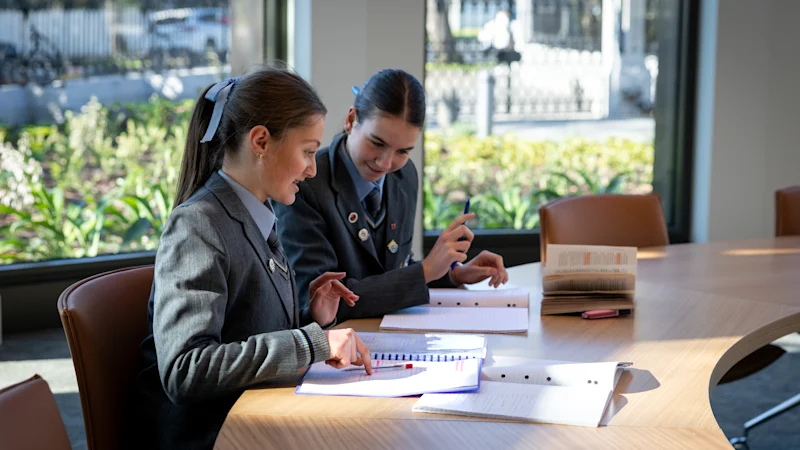
At St Catherine’s School in Toorak, principal Natalie Charles kept year 7 pupils off laptops for the first six weeks of term one. She said the trial had produced “extraordinary” results and created a period of intensive relationship-building between pupils and teachers.
“We know that students flourish when they’re in relationship with each other, and they’re in relationships with the teacher,” Ms Charles said. “And that six weeks was this premium nirvana of relationship building.”
The school plans to delay laptop use for year 8 pupils next year. The initiative was developed with the University of Queensland after concerns about anxiety during the transition to secondary school, rather than in response to declining academic performance.
Ms Charles said she would consider extending the trial beyond six weeks, but online NAPLAN testing in March was a constraint. Mr Clare has indicated that the assessment could return to paper.
Neuroscientist Dr Jared Cooney Cooney Horvath, author of The Digital Delusion, said secondary schools should consider removing personal devices and returning to computer laboratories so technology was used more deliberately.
Dr Horvath, who met Mr Clare during a visit to Australia, said people learned most effectively through interaction with other people. “I can watch somebody do something and learn as though I was doing that thing,” he said. “You cannot, unfortunately, resonate with tech.”
He argued that screens could interrupt the connection between teachers and pupils, while reading from paper and writing by hand could support memory. He also criticised “gamified” learning, saying pupils could become focused on the game rather than the lesson.
Several schools have already restricted device use. Sydney Grammar, Toorak College, Castlemaine Secondary College and Traralgon College have all taken steps to curb screens, while pupils at the independent Alice Miller and Candlebark schools are not permitted to bring smartphones onto campus.
Sarita Ryan, principal of both schools, said most primary learning took place through books, pens and paper. Younger pupils used desktop computers in a laboratory about once a week, while older students had access to laptops but did not use them routinely.
“The really critical aspect is that they don’t have their own devices,” Ms Ryan said. She said the schools increasingly assigned work that involved “no-tech or low-tech means”, with an emphasis on pupils learning from teachers rather than devices.
Experts warn against rushed screen-time bans
Professor Therese Hopfenbeck, head of the University of Melbourne’s School of Learning Science and international chair of PISA 2025, said there was not enough evidence to conclude that classroom device bans would improve learning.
“There are results also suggesting that if you’re able to use the device in a very productive way, at the right time, students can actually learn from them,” she said.
Professor Hopfenbeck said policymakers needed to examine when and how technology was being used before making decisions. “From a research perspective, we are very concerned that policymakers will make hasty decisions based upon results without actually asking themselves how and when are teachers and students using a device in a productive way.”
She said researchers needed to carry out more classroom-based studies in Australia, rather than relying on evidence from countries including England and Norway.
Norway announced in June that state school funding would be redirected from personal devices to textbooks, following a similar move in Sweden. Dr Horvath said the number of US states proposing legislation to limit classroom screen time had risen from three to 31 since his book was published last December.
Victoria was the first Australian state to ban mobile phones in public school classrooms, introducing the policy in 2020. State schools have since also provided access to a broad range of software, including Minecraft: Education Edition, under a deal with Microsoft.
