


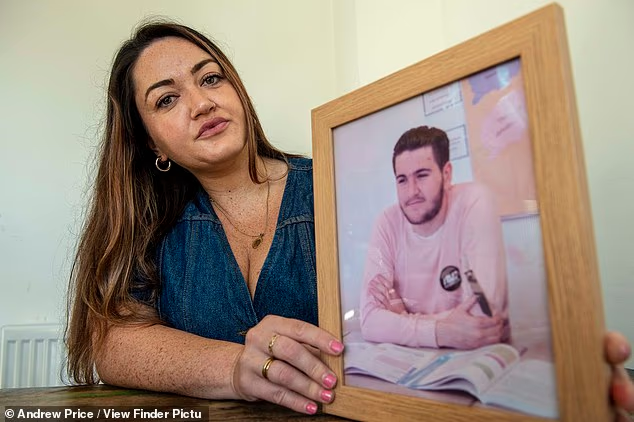
The sister of an 18-year-old student who died from meningitis B has urged young people to check whether they are vaccinated before starting university.
Nicole Zographou said her brother George had felt mildly unwell before travelling from Bristol to the Boardmasters festival in Newquay in 2017. Within days, he had suffered a cardiac arrest, sustained a catastrophic brain injury and was placed on life support.
His family later learned that he had meningitis B. Five days after he was admitted to hospital, they made the decision to turn off the machine keeping him alive.
“George felt a little unwell. Five days later he was dead,” said Ms Zographou, 38. “That is how quickly this disease can take hold.”
She said her brother, a student at St Brendan’s Sixth Form College in Bristol, had been excited about his first festival and had driven to Cornwall with a friend, despite telling her that he did not feel well.
After arriving in Newquay, he developed pain in his foot and became increasingly woozy. He began vomiting uncontrollably overnight and could not walk by the following morning.
His sister was in Ibiza when the family received news that he had gone into cardiac arrest and stopped breathing for 12 minutes. She took the first flight home and arrived at the hospital 10 hours later.
Doctors initially questioned whether he had taken drugs, but his family said he was not a risk-taker. They were told after three days that he had meningitis B and that scans showed he would not recover.
“The coroner’s report said the only thing that would have saved him was a vaccination,” Ms Zographou said. “That’s what it said on his death report.”
She said George had not been vaccinated because the required jab was not available in 2017. His school had been affected by meningitis the previous year, with two girls infected and one of them dying.
“His death has bled into every part of my life,” she said. “We were really close, and I miss him incredibly. I’d give the world to have him back.”
Meningitis B vaccination plea
Ms Zographou, a senior public health practitioner, is now calling on students to get protected before the return to university later this month.
“Please check. Please ask. Please have the jabs and get protected,” she said. “Please don’t make the mistake of thinking this won’t happen to you.”
She added: “You just don’t know whether you’re going to be one of those people who gets it or not. And in one in 10 cases it can be fatal, just like it was for George.”
A free NHS MenB catch-up programme is available to teenagers and young adults ahead of the 2026/27 university year. It includes people born between September 1 2007 and August 31 2008, the current Year 13 age group, as well as eligible first-time students starting university or certain residential further-education colleges in autumn 2026.
Two doses are needed at least four weeks apart. Wendy Lee, deputy superintendent pharmacist at Well Pharmacy, urged anyone who had received a first injection to make sure they returned for the second.
“Starting university means youngsters are meeting lots of new people and often living in close-contact settings such as halls of residence, where infections can spread more easily,” she said.
MenB can cause meningitis and sepsis, and the infection can become life-threatening within hours. Ms Lee said around one in four 15 to 19-year-olds carry meningococcal bacteria in the back of their throat without knowing it.
Symptoms can initially resemble flu and include a high temperature, headache, vomiting, muscle and joint pain and a general feeling of illness. More serious warning signs include a stiff neck, a dislike of bright lights, confusion, rapid breathing, cold hands and feet, seizures, or becoming very sleepy and difficult to wake.
A rash that does not fade when pressed can be a warning sign, but waiting for one to appear is dangerous because it may not develop early, or at all.
Anyone who suspects meningitis or meningococcal disease should seek emergency medical help immediately by calling 999 or going to A&E.
“Don’t think you’re invincible,” Ms Zographou said. “Get the jabs and stay safe.”
