


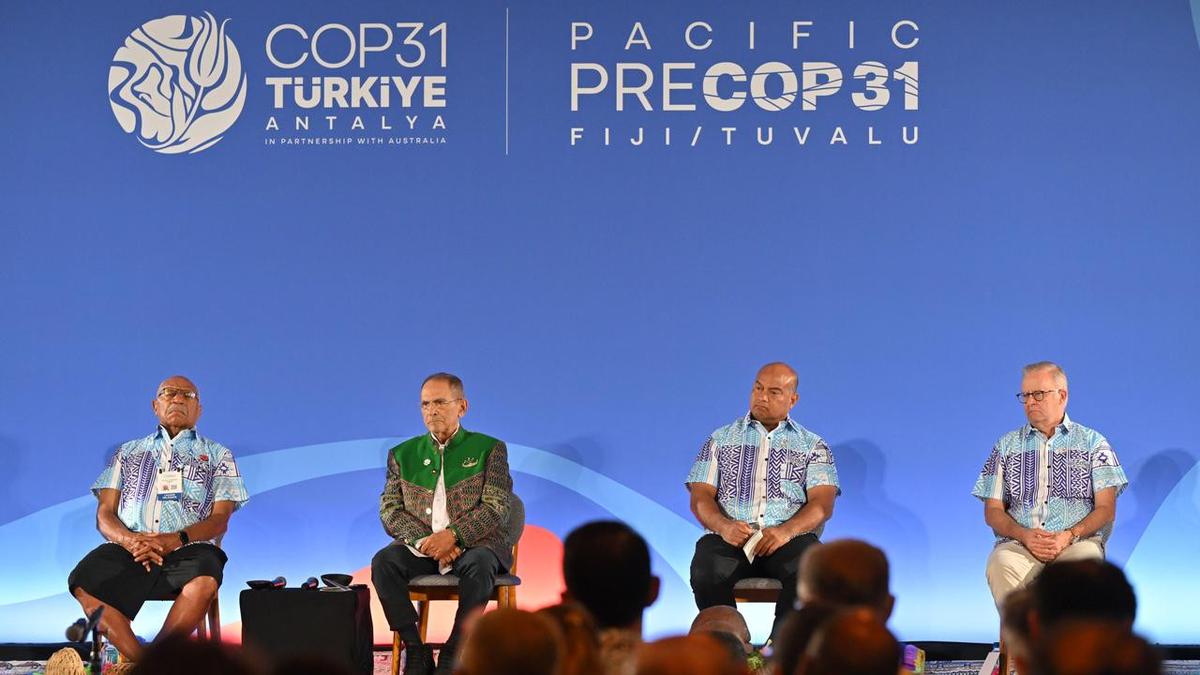
The pre-COP31 climate summit in Tuvalu will give Anthony Albanese and leaders from 13 countries a firsthand view of the impact of rising sea levels, although only one national leader from outside the Pacific is expected to attend.
The delegation will travel more than 1,000km from Fiji to the low-lying island nation on Tuesday, where the land sits an average of two metres above sea level.
The visit comes on the second day of the climate gathering, held a month before the United Nations’ Conference of the Parties in Turkey, where Australia will host negotiations.
Leaders from Mauritius, Tonga, Papua New Guinea, Vanuatu and the Cook Islands are due to attend the Tuvalu event. Ministers from a further 16 countries, including France, India, Singapore and New Zealand, are also expected, alongside representatives of the European Union and the United Nations.
Climate Change Minister Chris Bowen said the attendance would be unprecedented for a pre-COP meeting, which had traditionally been a “much more sedate” affair.
“This is the first pre-COP where … world leaders have been invited at all,” he said.
“As the president of Palau said, if you get one prime minister, you’re doing well because prime ministers and presidents don’t go to pre-COP.”
Tuvalu visit to highlight rising seas
Communities on Tuvalu’s main island are expected to demonstrate projects designed to protect coastlines from rising seas, erosion and storm surges.
One scheme could reclaim 20 hectares of land by the end of 2026, as Pacific nations showcase efforts to adapt to the effects of climate change.
The Pacific secured the right to host the pre-COP meeting as part of a compromise after Australia’s bid to hold COP31 in Adelaide was unsuccessful.
Speaking to attendees, Fiji Prime Minister Sitiveni Rabuka said the gathering would show the world the most severe consequences of climate change.
“We ask you to come to the Pacific because some things cannot be understood from a distance,” he said.
“In the days ahead, you will stand on Tuvalu soils. There, the climate crisis is not a forecast, it is a king tide at the door … and the hardest of questions: how long can we continue to stay?”
Mr Albanese said after arriving in Nadi on Monday that the summit would offer important context to countries outside the region.
“It is important that Pacific voices are heard because the Pacific is the front line of action on climate change,” he said.
“For many of the nations represented by leaders here, it is literally a threat to their very existence, which is why the world must act.”
