


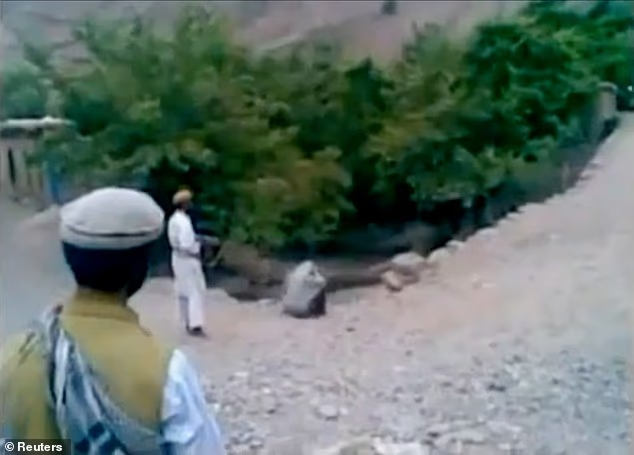
The Taliban execution of Najiba, a 22-year-old Afghan woman accused of adultery, has resurfaced as a warning of the dangers facing women under the group’s renewed rule. She was shot in front of villagers in Qōl-e Hir, Parwan province, after what officials described as a sham hearing lasting less than an hour.
Footage of the 2012 killing showed Najiba kneeling beside a ditch as verses from the Qur’an concerning adultery were read to a crowd of men. A gunman, believed to have been her husband, then approached with an AK-47 and shot her.
The allegation against her has never been fully established. It was suggested at the time that the accusation may have been fabricated to protect her husband’s reputation, while Afghan officials said the Taliban had staged a court to determine her fate.
Najiba had reportedly fled her husband Juma Khan’s home, around two and a half hours north of Kabul, three months before she was found at the house of a local Taliban commander, Mullah Qader-e Lang.
It remains unclear whether she was staying there voluntarily or was being held against her will. Parwan’s governor at the time, Abdul Basir Salangi, claimed she had some form of sexual relationship with the commander, describing it as either romantic or abusive.
Qader-e Lang was killed in June 2012. Members of a rival Taliban faction then reportedly entered his home and found Najiba alongside his pregnant wife.
Najiba was returned to her family, but her husband allegedly took her to Mirza Muhammad, the Taliban’s shadow district governor, to settle the dispute over her alleged flight from his home.
She was said to have been tortured before being charged with leaving her husband. Qader-e Lang’s wife was accused of sheltering her. Both offences were reportedly treated as punishable by death.
“Within one hour they decided that she was guilty and sentenced her to death. They shot her in front of villagers
