


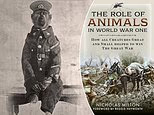
Animals were not merely mascots or companions during the First World War. They carried messages, hauled ammunition through terrain vehicles could not cross, warned of enemy movements and, in some theatres, became part of the struggle against disease.
Among the most unusual examples was Jackie, a chacma baboon who accompanied South African troops to war after his owner, Albert Marr, joined the 3rd South African Infantry Regiment.
Marr had raised Jackie on his farm near Pretoria and refused to leave him behind when he was called up. Permission was granted for the animal to join the unit, where he was given a specially made uniform, a pay book and his own rations.
Jackie was taught to salute senior officers and took part in military drills alongside the men. But his role was not confined to parade-ground amusement. His sharp hearing and eyesight were considered useful during night guard duties, when he could react to movement or sounds before they were detected by human sentries.
The baboon followed the regiment to Egypt and later to the Western Front. In the trenches, he was said to warn Marr of approaching danger by making noises and tugging at his clothing.
Jackie’s luck eventually ran out during heavy shelling in Belgium in 1918. Accounts describe him trying to shelter behind a small wall of stones before shrapnel struck him in the arm and badly damaged one of his legs. He was taken for treatment and survived the war, later becoming remembered as Corporal Jackie.
His story was extraordinary, but the wider contribution of animals was far more extensive. The British Army relied on horses, mules and donkeys on a vast scale, particularly when mud, shell holes and broken roads made motor transport unreliable.
By 1918, the Army had acquired almost half a million horses. They moved food, ammunition and equipment, pulled artillery and ambulances, and carried supplies across ground that was often impassable to lorries. On the Macedonian Front, where Allied troops fought in mountainous country, mules were indispensable to the movement of stores and the evacuation of casualties.
Dogs were used for an equally practical purpose. They acted as messengers, scouts and sentries, helped search for wounded men and carried medical supplies into no man’s land.
A message dog could move more quickly than a human runner and presented a smaller target. This mattered greatly on the Western Front, where snipers watched exposed routes between trenches and communication lines were repeatedly destroyed by artillery. Messages were commonly placed in small containers attached to the dogs’ collars.
The animals faced many of the same dangers as the soldiers they served beside. They were exposed to shellfire, machine-gun fire, hunger, exhaustion and disease. Some were deliberately targeted because their movements could reveal communications between units.
Carrier pigeons offered another means of passing information when telephones failed. Their speed and ability to fly above the battlefield made them difficult to intercept, although they too were vulnerable to enemy fire and the hazardous conditions of war.
On the Balkan Front, the enemy was often harder to see. At Salonika, malaria carried by mosquitoes became one of the most serious threats faced by Allied troops.
Records held by The National Archives show that malaria affected more than a quarter of the force on the Macedonian Front during one year of the campaign. More than two-thirds of admissions to field ambulances were attributed to the disease, while hospital records show malaria occurring far more frequently than gunshot wounds in the sample examined.
Military authorities responded with quinine, mosquito-proof shelters and attempts to reduce mosquito breeding grounds. Officials even considered importing fish from Egypt that fed on mosquito larvae.
The campaign demonstrated that animals could be both essential allies and part of the natural dangers confronting the armies. Mules carried supplies through the mountains, while mosquitoes inflicted casualties without firing a shot.
Across the conflict, animals occupied an uneasy position: sometimes treated as equipment, sometimes as comrades and often as sources of morale in conditions where death and destruction were routine. Their contribution was seldom decisive on its own, but the war effort depended on them in ways that modern technology had not yet replaced.
From a baboon standing guard beside a South African soldier to dogs running messages beneath the gaze of snipers, their presence formed an often overlooked part of the history of the Great War.
