


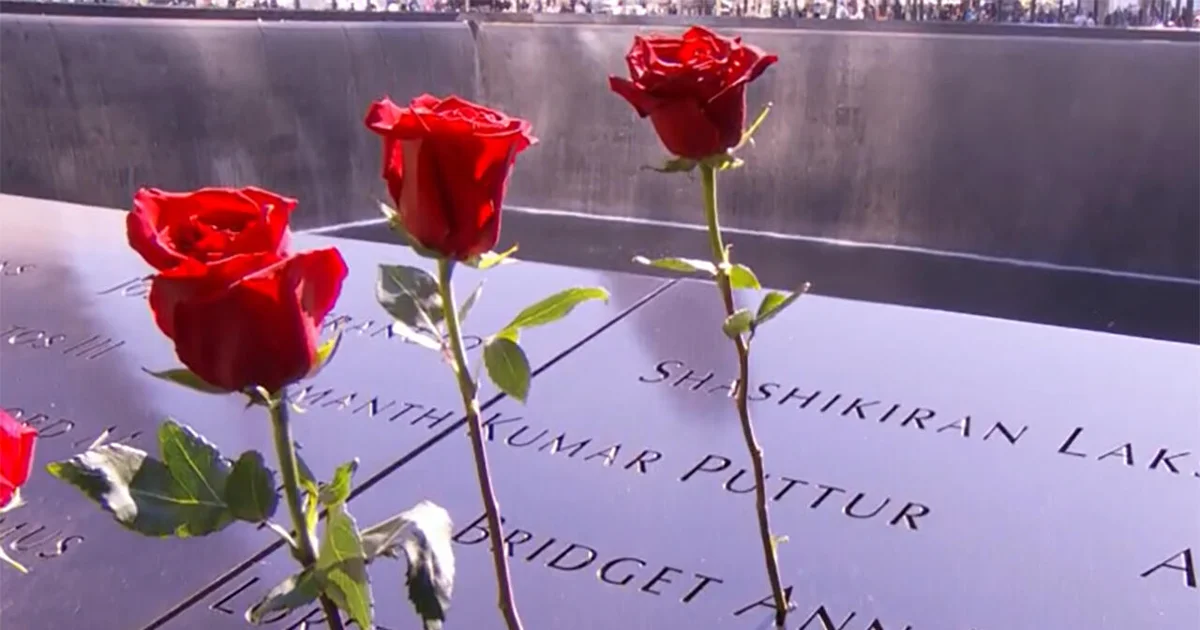
As the United States approaches the 25th anniversary of the 11 September attacks, survivors, rescuers and relatives of those killed are confronting memories that have never entirely receded.
At Ground Zero, the Pentagon and the Flight 93 crash site in rural Pennsylvania, the passage of time has brought memorials and ceremonies — but not closure for everyone who lived through the attacks or lost someone that day.
Memories of 9/11 remain vivid 25 years on
Harry Handler was on the 67th floor of Two World Trade Centre when he saw flames erupting from the North Tower. An announcement told workers in his building to return to their desks after the first plane struck.
Seventeen minutes later, a second aircraft hit his tower. Handler began racing down the stairwell, taking 12 steps at a time, until he encountered a woman suffering an asthma attack.
He stopped to help her. Although she was struggling to breathe, they descended slowly together before reaching the street.
Handler took the woman, Vonnie Johnson, to an ambulance and promised to remain with her. But rescuers told him he had to leave. Minutes later, Two World Trade Centre collapsed on top of the vehicle.
He later searched for Johnson’s family, fearing the worst. At a company gathering weeks after the attacks, he discovered that she had survived.
For years, Johnson sent Handler an email every 11 September. The messages stopped about a decade ago, and despite searching for her, he has never learned what became of her.
“Sometimes I don’t sleep well, and think, ‘Oh right, it’s September. People are thinking about it again,’” Handler said.
At the Pentagon, Marine Major Dan Pantaleo arrived to help amid scenes he described as unlike anything he had expected. Furniture had been thrown into walls and parts of desks were embedded in the ceiling.
For four days, Pantaleo helped recover more than 100 sets of remains from the still-smouldering building. During the operation, he saw a scarlet-and-gold Marine Corps flag still standing on the fourth floor, surrounded by destruction and covered in the smell of jet fuel.
He used a lift to reach it and brought it down to safety.
“It felt like we just couldn’t let that flag be another victim,” Pantaleo said.
The flag now has a place of honour at the National Museum of the Marine Corps in Virginia. For Pantaleo, it represents resilience and the determination to continue despite devastation.
He said the anniversary brought a mixture of emotions, from memories of American flags appearing outside homes across the country to recollections of the destruction he witnessed.
“There’s a flood of emotions,” he said. “I remember things like all of the American flags on people’s houses just popping up all over the place. So, I go back to that, and I’m hopeful, but then I also recall the incredible devastation and destruction, and that’s a different experience for me.”
Flight 93 families carry the loss forward
In Shanksville, Pennsylvania, the families of the 40 passengers and crew of United Flight 93 continue to remember a final act of resistance.
The aircraft crashed into a field after passengers, having learned about the attacks in New York and at the Pentagon, stormed the cockpit. It is believed to have been heading towards Washington.
Tim Lambert’s family had owned the land where the plane came down since the 1930s. He later donated six acres of the property to the Flight 93 families, refusing to accept payment for the land.
He recalled how the trees absorbed much of the force of the crash, before grass and wildlife gradually returned to the area.
“The reminders of what happened there were always constant,” he said.
Laurel Homer was 10 months old when her father, First Officer LeRoy Homer Jr, died aboard Flight 93. She grew up attending summer camps for children connected to the attacks, but those children are now adults.
Homer said she had struggled to understand her grief from an early age. She recalled being bullied at school after another child wrote “DD” on a piece of paper and said it stood for “dead dad”.
“Ever since then, I don’t think I really had a great place to grieve in a healthy way,” she said.
Homer has spent much of her life in therapy and said the loss still shapes even her happiest moments.
“I don’t even know that I’ve ever been fully happy,” she said. “I feel like, even on the days that I’m supposed to be the happiest, I still am thinking about who I’ve lost and what I don’t have.”
Each year brings another round of memorial services, readings of names and public tributes. For survivors and relatives, however, the anniversary is not simply a date on the calendar.
Handler said every observance remained difficult. Pantaleo questioned whether the country still gave the attacks the attention they deserved as people focused on current events.
“Probably not, probably not, because we’re so focused on what happens right now, today,” he said. “And I think sometimes we forget to look back.”
The consequences of 9/11 extended far beyond the sites struck that morning. The subsequent wars in Iraq and Afghanistan cost the lives of more than 7,000 US service personnel and ran into trillions of dollars for American taxpayers.
But for those closest to the attacks, the story remains personal: a stranger helped down a stairwell, a flag recovered from a ruined building, a daughter growing up without knowing the father she lost.
“It has been almost 25 years,” Homer said. “Maybe I need to move forward a bit more. But it’s still really hard, so I don’t know, I really don’t know.”
