


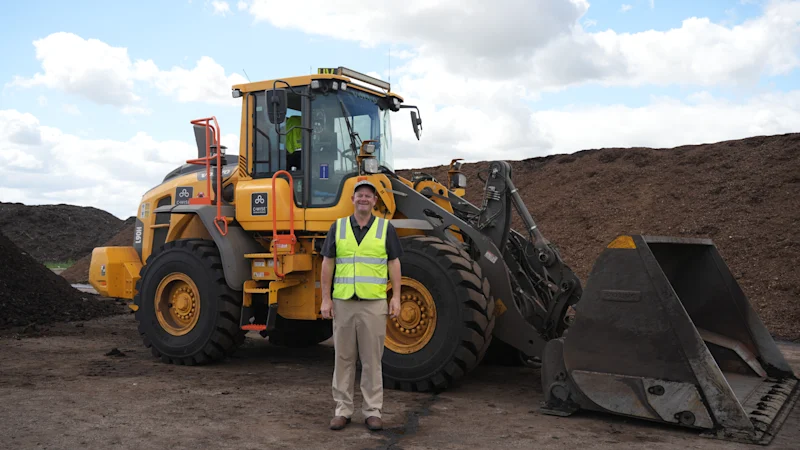
Western Australia should impose tougher restrictions on landfill to stop valuable organic waste being buried, an organic recycling company has said, as farmers use compost made from discarded food, garden material and agricultural products.
Greg Watts, chief executive of Nambeelup-based C-Wise, said the state was losing nutrients that could be returned to farms while growers faced high fertiliser costs. He accused the government of being “in love with landfill”.
Figures from the WA Waste Authority show that 2.7 million tonnes of waste went to landfill in 2024-25, with 27.5 per cent of waste in the Perth and Peel region sent for disposal.
“The figures are high because landfill is still the easy option in WA,” Mr Watts said. “Instead of burying this waste, we should be recovering the nutrients in it and putting them back into our farms.”
C-Wise collects organic waste from other industries and sections of the community before processing it into compost and mulch. The company wants more material recovered for use on farmland, vegetable crops and orchards.
Calls for more organic waste recovery
Only two-thirds of metropolitan councils in Perth have introduced food organics and garden organics, or FOGO, bins. Rules changed in August so that food scraps, garden waste and certified compostable caddy liners bearing the AS 4736 seedling logo could be placed in the green-lid bins.
Tissues, paper towels, tea bags and compostable takeaway packaging, which had previously been accepted, must now go into red-lid general waste bins.
Mr Watts said the changes highlighted how much potentially useful organic material was still being lost. He said garden prunings, coffee grounds, kitchen waste and organic material from events could be collected separately rather than sent to landfill or waste-to-energy facilities.
He also pointed to unsaleable grain and dead chickens as resources that could be processed rather than buried. “That grain could be processed through a composting facility into a fertiliser replacement, but there’s no legislation to make that happen,” he said.
Narrogin farmer Ash Wiese has used C-Wise compost across his farm for the past three years, after initially trialling it on more than 100 hectares. He said it had become part of his farm nutrition programme and was as effective and cost-effective as other fertilisers he had used.
Much of the compost used by Mr Wiese is made with waste left after oats are dehulled. “I love the idea that they’re pulling nutrition from waste sources, and we’re burying it in the soil and growing food from it again,” he said.
Mr Wiese said compost had helped build soil nutrition and organic matter. He estimated that material collected from 50,000 households could support the production of about 10,000 tonnes of oats, equivalent to about 10 million bags of porridge.
Mr Watts said landfill charges should be increased to encourage investment in alternatives. “If we make it more expensive to drop it in a hole, then people are going to invest in innovations to reduce that cost,” he said.
A state government spokesperson said the government was committed to reducing landfill and increasing resource recovery across WA. The state said it supported a waste hierarchy prioritising avoidance, reuse and recycling, including the recovery of nutrients and organic matter through composting.
The government said it had invested $850,000 in five organics-processing projects in 2023 and a further $3.66 million in three projects in 2025 to expand capacity.
