


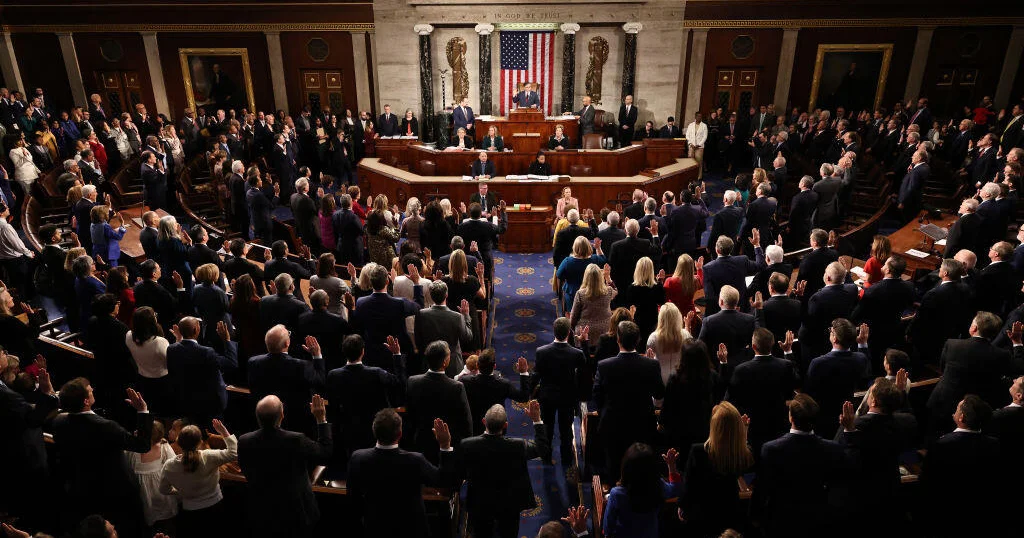
The 2026 midterm elections are increasingly being viewed as a referendum on Donald Trump, with Democrats currently projected to take control of the US House of Representatives, according to a new poll and seat model.
The model estimates that Democrats would win 228 of the House’s 435 seats, giving them a majority over the 218 required. The projected range extends into the high 230s, although the lower end falls to 215 seats, leaving Republicans with a possible route to retain their narrow majority.
Trump is weighing heavily on voters’ choices, with Republicans and Democrats alike treating his presidency as a central issue in the contest. If that remains the case until polling day, his influence would exceed the effect recorded for a president during the 2018 midterms.
Economic pressure is another major factor. Inflation and higher prices are driving opposition to the party in power, although most voters do not believe either party would necessarily improve their personal finances.
Voters generally favour congressional candidates who oppose new tariffs and the conflict with Iran, which many see as contributing to higher prices. Most also say the so-called One Big Beautiful Bill has not improved their financial position.
Democrats hold an advantage in House projections
Democratic support is strongest among voters who say rising prices have made their lives difficult or worse. Much of that support appears to be motivated by a desire to block Trump’s policies rather than enthusiasm for the Democrats’ own agenda.
At the same time, many of Trump’s 2024 voters remain with the Republican Party, even when they acknowledge the strain caused by higher prices. Their continued opposition to Democrats, particularly over cultural issues and what they see as their way of life, is helping to keep the race competitive.
Republicans also retain strong support for Trump, especially among MAGA voters. Most Republicans say his endorsement would make them more likely to support a candidate, while the party’s voters broadly favour his approach to immigration enforcement, tariffs and the Iran conflict.
Turnout could prove decisive. More Democrats describe themselves as highly enthusiastic about voting than Republicans, while Trump appears to be helping energise MAGA supporters despite not being on the ballot.
Most MAGA Republicans say they are as interested in voting as they were in 2024. However, non-MAGA Republicans are less likely to say they will definitely vote, creating uncertainty over whether the party can mobilise its entire coalition.
Democrats are also showing signs of improvement among Hispanic voters compared with the 2024 election. Most Hispanic voters surveyed prefer candidates who oppose the administration’s approach to Immigration and Customs Enforcement.
The poll found that neither party has a clear advantage in persuading voters that it can make them financially better off, although Democrats have a relative edge. Democratic backing for a democratic socialist endorsement is limited beyond the party’s base and mixed even among its core supporters.
Voters are also divided over the impact of artificial intelligence. Democrats and Republicans are more likely to believe AI will reduce the number of jobs than increase it, while voters overall prefer candidates who oppose new data centres in their area.
The CBS News/YouGov survey questioned 2,460 US adults between 8 and 11 September 2026. It was weighted to reflect the national adult population and has a margin of error of plus or minus 2.3 percentage points.
The House figures are statistical estimates based on the poll, previous voting patterns, district characteristics, demographics and historical trends. They represent the current balance of opinion and may change as further data becomes available before the election.
