


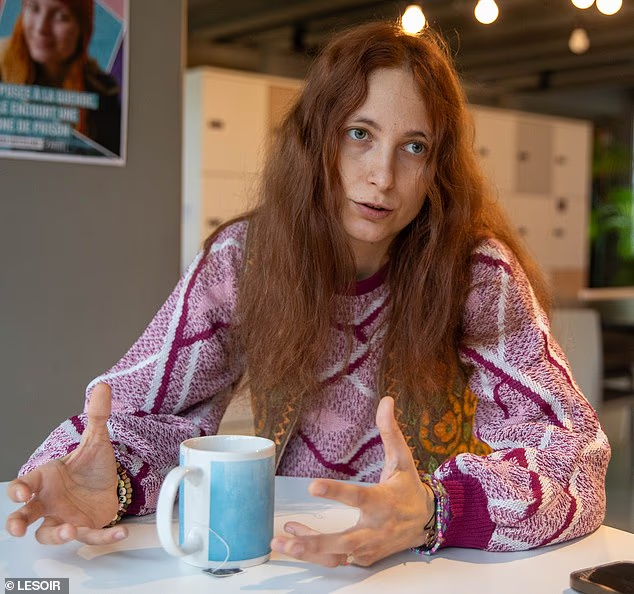
Russian artist Aleksandra ‘Sasha’ Skochilenko has described being detained, starved and subjected to psychological abuse after replacing supermarket price tags with anti-war messages, an act that led to a seven-year prison sentence.
The 36-year-old was eventually freed in a multinational prisoner exchange and now lives in Berlin with her wife, Sofya Subbotina. She continues to oppose Russia’s war in Ukraine through her artwork and music.
Skochilenko carried out the protest in St Petersburg in April 2022, shortly after Russia launched its full-scale invasion. She removed five ordinary price labels and replaced them with printed messages urging shoppers to reject state propaganda and oppose the war.
One message read: “Putin has been lying to us from television screens for 20 years: the result of these lies is our readiness to justify the war and the senseless deaths.” Prosecutors later claimed the stickers amounted to the spreading of false information about the Russian military.
Her actions were reported by an elderly shopper, who later defended the decision in an interview, saying: “I am proud of what I’ve done.”
Authorities used CCTV to track Skochilenko to a friend’s home. When she was not there, officers allegedly forced the friend to telephone and ask her to return.
“They ambushed my friend and made him invite me over,” Skochilenko said. “They didn’t introduce themselves, they just grabbed me. I screamed ‘help, save me’ and fought them because I thought they were going to rape me.”
She was interrogated for hours as investigators questioned whether she had acted alone or belonged to an organised activist group. She was then held while the authorities investigated the case.
Conditions in detention
Skochilenko said her physical and mental health deteriorated during years in St Petersburg’s Detention Centre No 5. She was denied medicines and other necessities needed to manage coeliac disease, bipolar disorder and a heart condition, according to her account.
Her coeliac disease meant she could not safely eat gluten. She said prisoners were given contaminated tap water, while she was forced to choose between eating unsuitable food and going hungry.
“I could only eat dinner, which was either cabbage or potato,” she said. “I couldn’t eat the breakfast of porridge with water nor the lunch of a 300ml measure of soup.”
She said she was kept in a cramped cell with 17 other prisoners under constant camera surveillance. Skochilenko alleged that inmates co-operating with prison officials were encouraged to target her psychologically.
“They would gaslight me by repeatedly saying ‘Sasha stinks’ and make me go and wash my clothes by hand,” she said. “I would then dry the clothes in the freezing cold and put them on. They would then say I smelt again and I would have to do it all over again.”
She also described being shouted at if her belongings were not placed in precisely the right position, calling the treatment “collective bullying”. Television programmes about the war were allegedly played repeatedly, despite her having friends in Ukraine and having worked at a children’s camp there.
“That is the reason I protested, I couldn’t keep silent as these children were hiding from shrapnel caused by my country,” she said.
Skochilenko said she was given a thin, scratchy blanket and a mattress so poor that her spine touched the metal bed frame. She recalled shivering through winter and said anaemia and naturally low blood pressure made the cold particularly difficult.
She also claimed prisoners were sometimes left for hours in a small exercise yard or shower room because of staff shortages. With around 800 prisoners and about eight members of staff on a shift, she said, detainees could be forgotten during their limited time outside.
Her wife and human rights groups helped secure a move to a room shared with only one other prisoner and obtain medical attention. Skochilenko said exercise also helped her survive, and that she would repeatedly walk around the courtyard.
“I would be dead because of my depression if I wasn’t able to exercise,” she said.
Seven-year sentence and prisoner exchange
Skochilenko spent more than a year on trial and was kept in a cage at court for up to eight or nine hours at a time, without being able to drink water or use the bathroom.
In November 2023, she was convicted under laws introduced after the invasion and sentenced to seven years for discrediting the Russian army and spreading false information. The case became one of the early trials involving anti-war activism under the legislation.
She said she had expected to receive a prison sentence, although she had hoped it would be four or five years. Once the sentence was handed down, she began counting the days until her release.
A year later, she was unexpectedly taken from prison without being told where she was going. After spending four days in another prison, she was ordered to pack her belongings and was told she was a “free” woman.
Men wearing balaclavas then took her to a bus carrying other prisoners. She said they were warned that anyone who spoke would have a bag placed over their head and be handcuffed.
“One man then said that we were part of a political exchange,” she recalled. “But I didn’t believe him, I thought he was telling us this because he didn’t want us to panic and we were rather being taken to a forest to be shot.”
The group was flown first to Ankara and then to Cologne, where a 16-person multinational prisoner exchange took place. Those released included Wall Street Journal reporter Evan Gershkovich, US Marine Paul Whelan and Russian assassin Vadim Krasikov.
Skochilenko was not legally recognised as a couple with Subbotina under Russia’s anti-LGBTQ legislation. During her detention, she was prevented from seeing or speaking to her then-girlfriend for a year while authorities called Subbotina as a witness, although a judge later allowed them to speak for two hours each month.
Skochilenko said she does not regret replacing the price tags.
“Nope,” she said. “This was a journey of my life. But it is years of turmoil all over a sticker.”
