


British companies that comply with the UK’s planned ban on trade with Israeli settlements in the occupied West Bank could face boycotts and the loss of public-sector business in parts of the United States.
The warning follows the Government’s decision to prohibit imports from the settlements and prevent firms from providing services including finance, construction, infrastructure, property and advertising. The measures are expected to come into force within six to nine months.
Foreign Secretary Ed Miliband said the policy was necessary because of what he described as the “ethnic cleansing” of Palestinians by settlers in parts of the West Bank.
“I do not believe the British people want us supporting the occupation by accepting products from settlements in our shops and supermarkets,” he said.
US states threaten action against British firms
US activists have established a whistleblower hotline encouraging employees to report British companies that refuse to work with Israelis or Israel. They argue that businesses complying with the British restrictions could fall foul of American anti-boycott, divestment and sanctions laws.
Those laws can prevent states from awarding contracts to companies found to be boycotting Israel or territories under its control. Several US congressmen have suggested that British firms following the new UK rules could face similar penalties.
Sarah Huckabee Sanders, the governor of Arkansas, wrote on X: “It’s simple: boycotting the world’s only Jewish state is anti-Semitism.”
She added: “Arkansas law makes clear that we won’t do business with any company that deliberately chooses to engage in BDS activities. Period.”
Randy Fine, a Republican representative for Florida, said a law he had passed while serving in the state legislature could bar any British company forced to comply with the UK policy from doing business with Florida’s state or local government.
He said the legislation could also prevent a British business taking part in the boycott from operating in Florida if it required official dealings involving permits or tax collection.
“Florida is one of Britain’s largest trading partners,” Mr Fine said. He claimed the policy could cost British companies billions of dollars and referred to Airbnb’s decision in 2019 to boycott parts of Israel.
Mark Goldfeder, director of the National Jewish Advocacy Centre in the US, said: “Britain has ordered its companies into a trap it never mapped.”
He said states including Texas and Florida barred public contracts with companies that restricted commercial relations with Israelis or Israel, adding that state authorities would not necessarily use the same definitions as the UK Government.
Britain tightens stance towards Israel
The economic impact of the UK ban is expected to be limited because the settlements produce only a small volume of mainly agricultural exports. Its principal significance is likely to be political, marking a further deterioration in relations between Israel and some of its closest allies after the Gaza war.
Mr Miliband said he felt “a deep sense of shame about what has unfolded in Palestine under the eyes of the international community”.
“We will not acquiesce in the destruction of the two-state solution,” he said.
He said Denmark, Finland, Iceland, Poland, Portugal and Sweden had pledged to support further action. The Netherlands, Ireland, Belgium, Spain and Norway have either banned settlement goods or are taking steps to do so, he added.
Britain has also expanded its restrictions on weapons sales to Israel for use in Gaza to include arms that “materially contribute to the occupation” of Palestinian territories.
Israel’s Foreign Minister Gideon Sa’ar condemned the British measures as “despicable”. He said Israel would remove UK representatives from a joint military centre monitoring the Gaza ceasefire and end British training for Palestinian Authority security forces in the West Bank.
Israel has also barred a dozen British lawmakers and other UK citizens from entering the country, with Mr Sa’ar accusing them of involvement in “antisemitic and anti-Israel activity”.
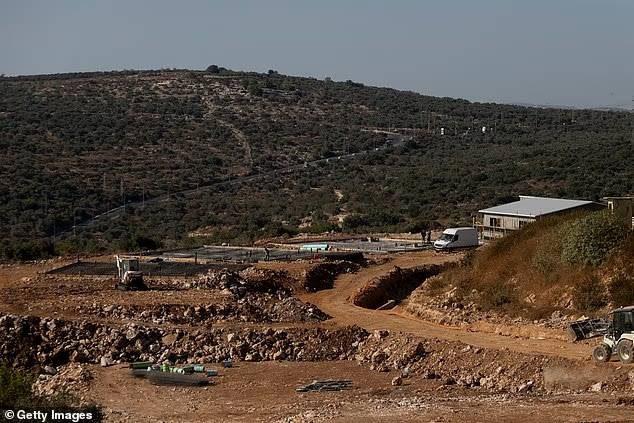
Settlement construction in the West Bank, which Israel seized during the 1967 Middle East war, has increased under Prime Minister Benjamin Netanyahu’s ultranationalist government. Israel regards the territory as the biblical and historical homeland of the Jewish people, while opposing the creation of a Palestinian state.
The international community overwhelmingly regards the settlements as illegal. Britain and other countries have expressed particular concern about the E1 project, which would effectively divide the West Bank in two.
Mr Miliband said homes had been bulldozed, roads and public infrastructure destroyed, and families displaced. He also pointed to increased settler attacks, evictions, Israeli military operations and checkpoints, alongside Palestinian attacks on Israelis.
