


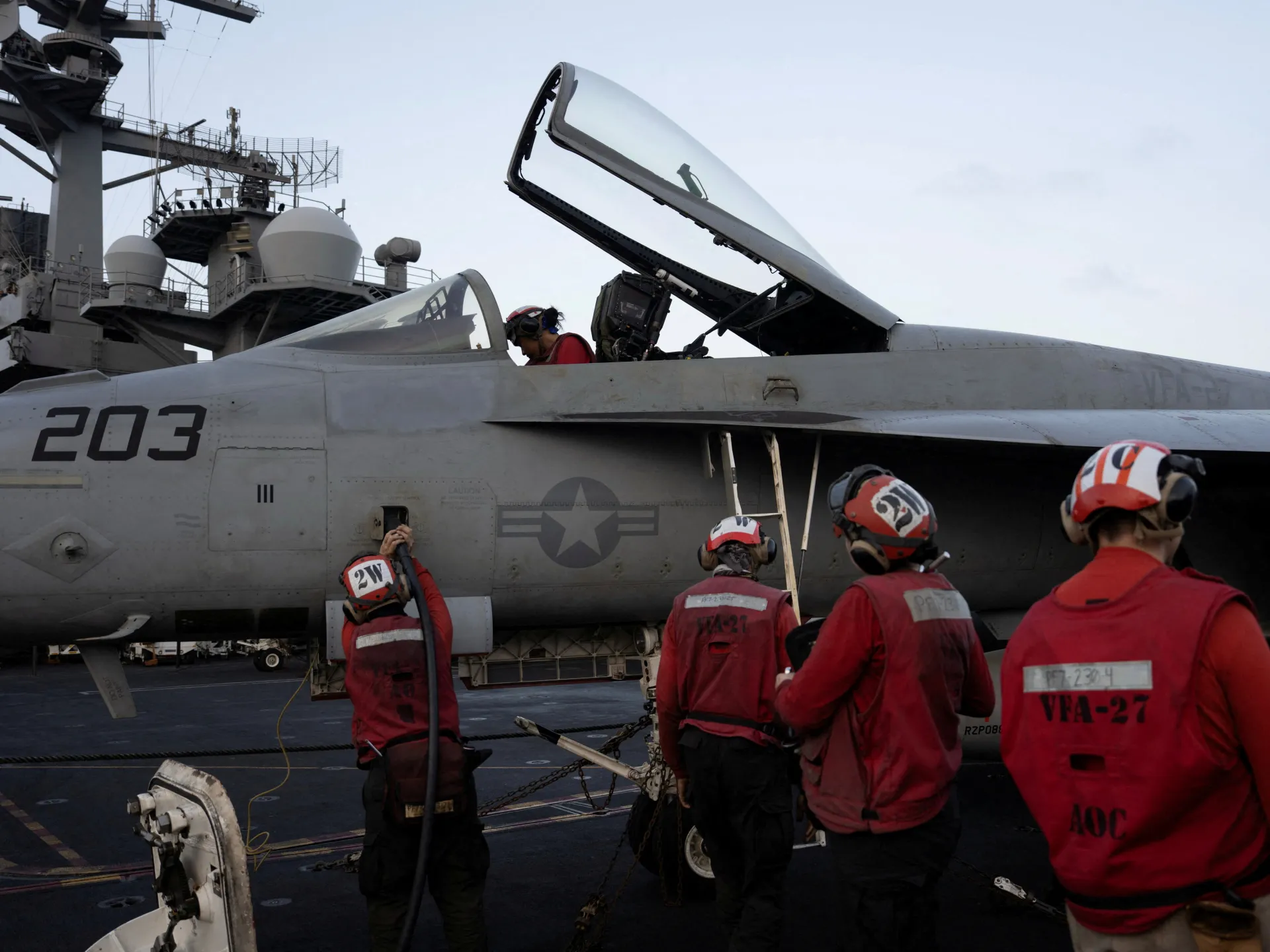
The United States is deploying a third aircraft carrier strike group to waters near Iran, alongside thousands of additional troops, as the conflict enters its eighth month and Washington weighs military escalation against faltering diplomatic efforts.
The USS Theodore Roosevelt carrier strike group left its base in San Diego on Sunday, according to a US official, followed a day later by the Makin Island Marine Expeditionary Unit, carrying more than 2,000 Marines.
The naval deployments could bring between 9,000 and 10,000 additional US troops to the region, including sailors and Marines assigned to the carrier group and accompanying vessels. By the end of November, three aircraft carriers and two amphibious landing groups are expected to be positioned near Iran.
The latest force will include F-35 fighter jets and add to the roughly 50,000 US service members already stationed across the Middle East. The concentration of military power is intended to give President Donald Trump a wider range of options should he order further action.
US military presence in the Middle East
The Pentagon is not currently planning to withdraw its assets even if an agreement with Iran is reached. Defence Secretary Pete Hegseth has said US forces are “ready to go” if Mr Trump orders new attacks.
The United States operates from a network of military sites across at least 19 locations in the region, including permanent bases in Bahrain, Egypt, Iraq, Jordan, Kuwait, Qatar, Saudi Arabia and the United Arab Emirates.
Since the start of the year, Mr Trump has increased the US military presence in the Middle East, initially sending warships including the USS Abraham Lincoln aircraft carrier to the Arabian Sea.
More than 120 US aircraft have also been deployed to the region since early February, according to open-source intelligence analysts and military flight-tracking data. The aircraft include F-35 stealth fighters, F-22 air-superiority jets, F-15 and F-16 fighters, and E-3 Sentry airborne warning and control aircraft.
Additional forces ordered to the Gulf in March included the Tripoli Amphibious Ready Group, centred on the USS Tripoli and the 31st Marine Expeditionary Unit, and the Boxer Amphibious Ready Group, built around the USS Boxer and the 11th Marine Expeditionary Unit.
Together, those formations added about 4,500 Marines and sailors. A further 2,000 soldiers from the 82nd Airborne Division’s Immediate Response Force were also sent to the region, taking the number of additional US troops deployed since the war began to nearly 7,000 before the latest move.
Escalation and diplomatic efforts
It remains unclear whether the new deployment signals an imminent escalation. In an interview published on Thursday, Mr Trump said it was “possible” he could intensify bombing in Iran after the US midterm elections in November.
Asked for more details, he said: “I can’t tell you that because look, you know, you’re asking, where are you going to bomb?”
Some analysts have described the military build-up as a negotiating tactic. Indirect talks between Washington and Tehran, mediated by other countries, have continued without a breakthrough, with the future of the Strait of Hormuz remaining a central dispute.
Iran has proposed reopening the strait within seven days, subject to the lifting of sanctions, the unfreezing of Iranian assets and guarantees that US strikes would end. Tehran has also sought a regional ceasefire covering Lebanon and Yemen and a resumption of nuclear negotiations.
The Trump administration rejected the proposal. US ambassador to the United Nations Mike Waltz said demands for frozen funds and sanctions relief were non-negotiable, while Iran’s Foreign Minister Abbas Araghchi said Tehran was “fully prepared” to resume the war before adding: “We did not come to New York to sell a war. We came to forge peace.”
Washington has continued to apply economic pressure, imposing sanctions on Iranian rail and automotive conglomerates this week. Late on Thursday, Mr Trump warned that the confrontation would end “very soon”, saying Iran would either “do something very proper and smart, or they won’t be around very long”.
