


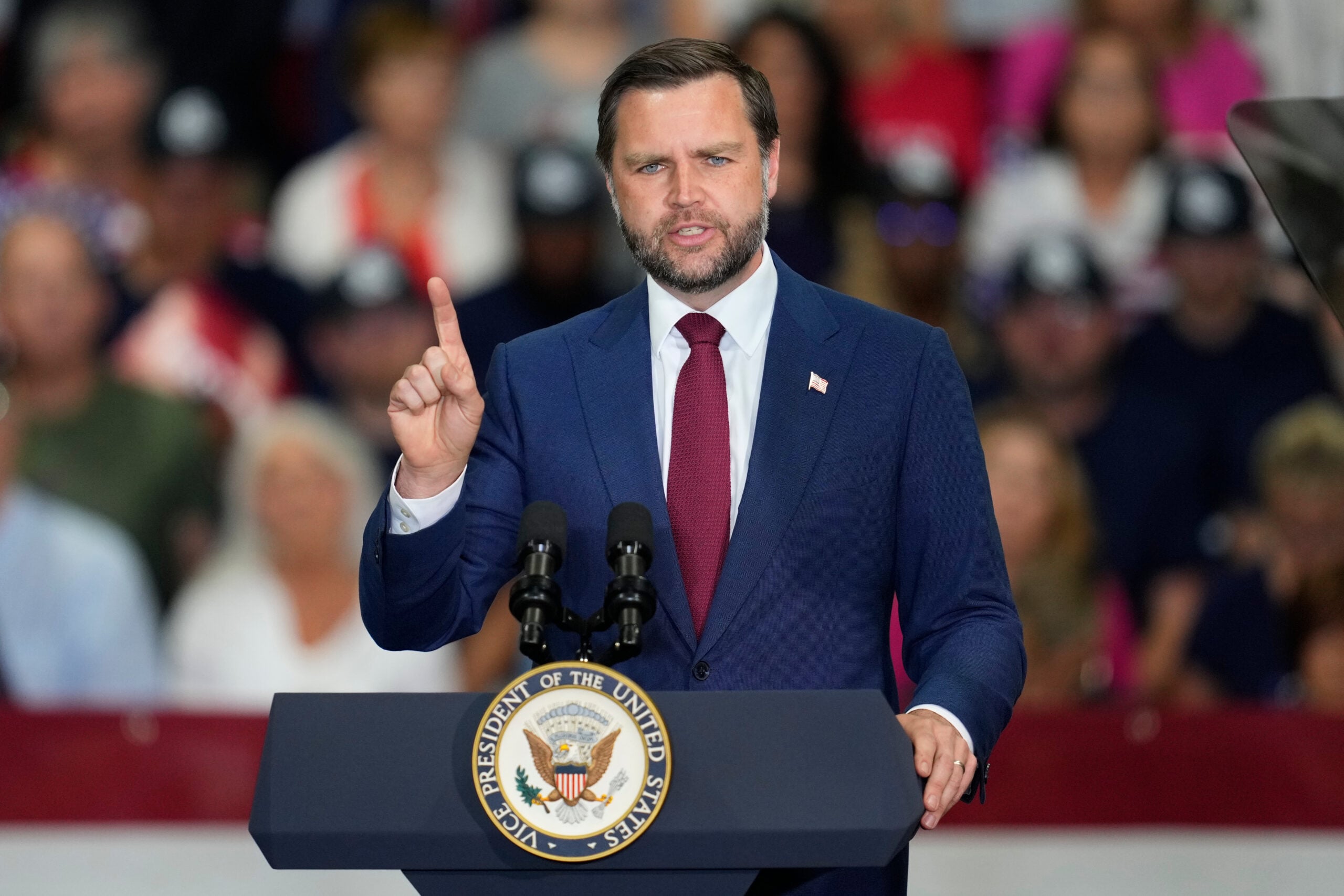
JD Vance eased some concerns about his commitment to Israel and Jewish Americans during a closed-door address to the Republican Jewish Coalition in Las Vegas, but left a key question unanswered: why he continues to associate with Tucker Carlson.
The vice-president told the organisation’s annual leadership summit on Monday night, 31 August, that the US-Israel relationship was vital to American national security and that antisemitism was “corrosive to the soul”. His remarks won repeated ovations and reassured several influential pro-Israel donors.
But when former senator Norm Coleman, the RJC’s board chairman, asked how Republicans should deal with podcasters including Carlson, Megyn Kelly, Joe Rogan and Nick Fuentes, Mr Vance did not directly condemn Carlson or explain their relationship.
“I recognise a lot of people in this room may disagree with things that Tucker Carlson or Megyn Kelly or Joe Rogan have said,” Mr Vance said, before focusing on Mr Rogan and Mr Fuentes. He described them as “two very, very different categories of people”, arguing that some controversial figures should be engaged with rather than dismissed.
Mr Fuentes, a Holocaust denier and neo-Nazi sympathiser, had been hosted by Carlson for a lengthy podcast interview last year. The appearance provoked anger among Republican Jewish leaders and intensified a wider dispute within the party over antisemitism and criticism of Israel.
JD Vance and the Tucker Carlson question
Josh Katzen, a property developer and RJC board member, said Mr Vance had addressed many of the concerns in the room but had failed to deal with his association with Carlson.
“He allayed a lot of concern, but he failed to address his relationship with Tucker Carlson, and that left a lot of people wondering why,” Mr Katzen said, speaking in a personal capacity.
Mr Vance has appeared regularly on Carlson’s programmes and has credited the broadcaster with helping him win the Republican Senate primary in Ohio in 2022. Carlson also backed Mr Vance as Donald Trump’s running mate in 2024.
Shabbos Kestenbaum, a pro-Israel campus activist who spoke at the 2024 Republican National Convention, said the vice-president’s continued association with Carlson could make it harder for Jewish conservatives to support a potential 2028 presidential campaign.
“JD Vance allying himself with an individual who has called for Trump’s immediate removal from office will make it harder for many of us Jewish conservatives to consider his candidacy,” Mr Kestenbaum said. “We hope this issue is resolved quickly so we can focus on policy, not personality.”
Eric Levine, a major Republican donor and RJC board member, said Mr Vance had missed an opportunity to make a decisive break with Carlson.
“He could’ve had an incredible Sister Souljah moment,” Mr Levine said, referring to the political tactic of publicly rejecting an ally or faction in order to reassure a wider audience.
Radio host Sid Rosenberg, who had urged delegates earlier in the day to “give Vance a chance”, was also critical of the response. He said Mr Vance had been given the opportunity to challenge Carlson and Ms Kelly but had instead spent his time defending Mr Rogan and attacking Mr Fuentes.
“He’s still better than any Democrat candidate but I don’t think he wowed the STRONG Jews in the room tonight,” Mr Rosenberg wrote on X.
Carlson, responding by text, accused the RJC of defending Israel against allegations of genocide in Gaza. Human rights groups have made that accusation over Israel’s conduct during the war, while Israeli leaders have repeatedly denied it.
Mr Vance’s office did not respond to a request for comment.
Despite the unresolved dispute, the speech appeared to improve the vice-president’s standing with several attendees. Ari Fleischer, a former White House press secretary and RJC board member, said Mr Vance had answered many questions about his views and described the event as a step forward with the Jewish community.
“Today was not primary day, but I think today was progress day for JD Vance with the Jewish community,” Mr Fleischer said.
Mr Vance also argued that Republicans needed to make a stronger case for the alliance with Israel among younger Americans, saying there was a growing suspicion of the relationship among people under 40. He pointed to areas such as missile-defence technology as examples of shared interests between the two countries.
He attributed much of the rise in antisemitism to immigration and the arrival of groups carrying ethnic rivalries, rather than to a fundamental change in American attitudes. He also said the administration “love” the Jewish community and that it would remain “on the team” while he had influence.
Sam Markstein, an RJC spokesman, said the organisation was a coalition containing a range of opinions, but praised Mr Vance for attending and said he had received “thunderous applause” and several standing ovations.
The vice-president is widely regarded as an early favourite for the Republican nomination in 2028, although he faces competition for the support of pro-Israel Republicans. Secretary of State Marco Rubio and senator Ted Cruz have built relationships with Jewish and evangelical conservatives over many years, while Mr Cruz has publicly criticised Carlson over antisemitism.
Mr Rubio remains popular among RJC members. Mr Katzen said his name was repeatedly met with spontaneous applause at the Las Vegas summit, while Mr Levine predicted that Mr Cruz would win about 90 per cent of the room in a contest against Mr Vance.
Mr Vance’s appearance was his first at an RJC leadership summit as vice-president, and the first time since 2019 that a sitting president or vice-president had attended the conference. The meeting, held at the Venetian resort, attracts some of the Republican Party’s most influential donors.
For now, the address has helped reduce doubts about Mr Vance’s support for Israel, but his refusal to separate himself clearly from Carlson means the issue remains a potential obstacle as he prepares for a possible White House campaign.
