


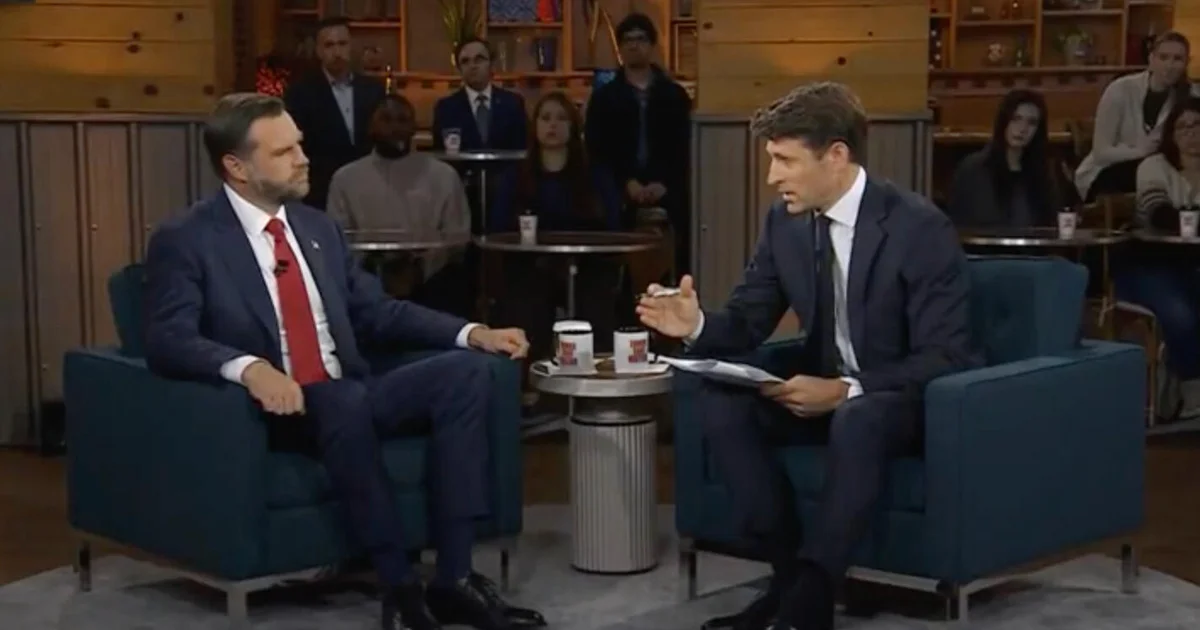
JD Vance used a televised town hall in Michigan to defend the Trump administration’s record on the economy, its strategy towards Iran and its immigration policies, while saying he had not decided whether to seek the presidency in 2028.
The vice-president faced questions from voters during the hour-long event, including concerns over the cost of living, high petrol prices, immigration enforcement, data centres and alleged corruption in Washington.
Michigan, a swing state which helped return Donald Trump and Mr Vance to office in 2024, is also the scene of a closely fought Senate race that could influence control of the chamber in the upcoming midterm elections.
JD Vance says 2028 presidential bid is undecided
Mr Vance, widely regarded as an early Republican contender for 2028, was asked whether there was any possibility that he would not run.
“Of course there’s a chance,” he said, adding that he was a “procrastinator” when it came to major decisions and would “have to think about it”.
He said he and his wife, Usha Vance, had four young children. Mrs Vance, he added, had “never loved politics”, although “she loves public service”.
Cost of living remains a challenge
Sandy Johnson, who owns a family entertainment centre, said her business was “barely making ends meet” and asked when ordinary Americans would have more money to spend at small businesses.
Mr Vance acknowledged that improvements would take time. He blamed what he described as a “bipartisan, multi-generational failure” to invest in American workers and manufacturing, as well as the movement of jobs overseas.
“We are turning the tide on this,” he said, pointing to promised foreign investment and expansion plans by General Motors, Ford and Stellantis.
But he added: “Just as this country wasn’t broken in one presidential term, it’s gonna take more than 18 months to fix things and turn them around.”
Unemployment has remained low since Mr Trump returned to office, according to the information discussed at the event, but inflation has stayed above the Federal Reserve’s 2 per cent annual target and manufacturing employment has remained roughly flat.
Asked about Mr Trump’s description of the economy as “A+”, Mr Vance said the president was referring to new investment. He added that factories had to be built before workers could be employed in them.
Vance defends Iran strategy as petrol prices rise
High petrol prices were another major concern for voters. Keshon Wheatley, a Detroit barber who said he had voted for Mr Trump in 2020 and 2024, told Mr Vance that he now planned to support Democratic Senate candidate Abdul El-Sayed rather than Republican Mike Rogers.
Mr Wheatley said low petrol prices during Mr Trump’s first term had been an important reason for his support, but prices were now far higher.
Mr Vance attributed the pressure to attacks by Iran on oil tankers and argued that abandoning the region would have led to even higher prices.
“When this conflict is over, we are going to see gas prices come down,” he said, adding that US military efforts had allowed ships to continue passing through the Strait of Hormuz.
He said the administration was seeking a “final firm commitment from the Iranians that they’re not going to rebuild their nuclear programme”. Asked why the conflict had not been decisively won, Mr Vance said the US had “in some ways” won decisively, but that “the enemy gets a vote here”.
Joey Amor, whose wife, Master Sergeant Nicole Amor, was among six US Army Reserve soldiers killed in an Iranian strike on a site in Kuwait, questioned Mr Vance about reports that the facility had not been properly secured.
Mr Amor said the drone had killed his wife, but that “a lot of mistakes and a lot of fundamental failures” had contributed to her death. Mr Vance said he did not doubt there had been failures and pledged to take them seriously.
Immigration enforcement questioned
Sister Nancy Sylvester, a Catholic nun, challenged Mr Vance over Immigration and Customs Enforcement tactics and asked how he could justify them to people of faith.
Mr Vance said the administration was trying to balance effective law enforcement with humane treatment. He described most ICE agents as “amazing people who are patriots”, but acknowledged that some made mistakes and said investigations, further training and disciplinary action were necessary where appropriate.
He was also questioned about previous comments comparing some employment-based H-1B visa holders with “foreign indentured servants”.
“To the extent that my rhetoric has been imperfect here, that’s on me,” he said, insisting that his criticism was directed at employers rather than visa holders.
Mr Vance said his aim was not to “dehumanise any immigrant”, but to preserve what he called a baseline of social cohesion and community.
Data centres should benefit local communities
A Michigan resident living opposite a data centre said its constant noise had made opening the windows a “luxury that we could no longer enjoy”.
Mr Vance said data centres could bring benefits but also create serious problems. He argued that they should be “good community citizens”, contribute more tax revenue and not force up household electricity bills.
“Some of the economic benefits they’re generating, they can’t just go to a few tech billionaires,” he said. “It has to go to the community writ large.”
On concerns about corruption, Mr Vance said Washington was “a corrupt town”, but claimed he had seen no evidence that Mr Trump participated in or approved of corrupt activity.
He said that anyone selling access to the White House should face consequences, and promised to “follow the law” if a Democratic Congress launched investigations or issued subpoenas.
