


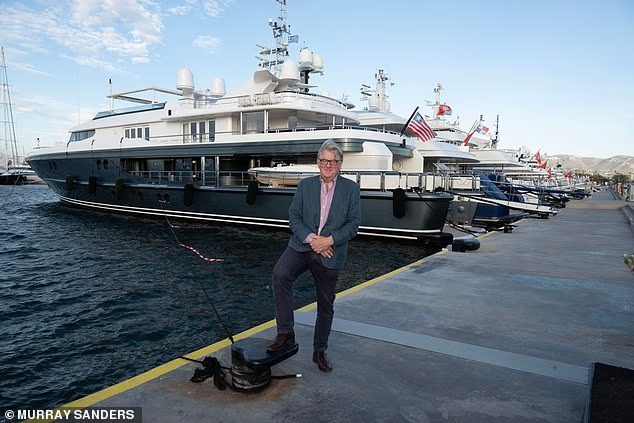
Hedge fund billionaire Chris Rokos has moved his personal life and business from Britain to Greece, in a decision expected to deprive the Treasury of up to £330 million a year in tax revenue.
The 55-year-old financier has previously ranked among the UK’s highest taxpayers. His departure could represent a loss approaching £2 billion over the course of a five-year Parliament, based on previous estimates of his annual contribution.
Mr Rokos is also a major philanthropist. He has funded scholarships at Oxford University, donated £190 million to Cambridge, and supported cancer research at the London Institute of Cancer Research and orthopaedic research at Imperial College London.
The former state-school pupil from Hammersmith has also financed a scholarship programme sending four boys from modest backgrounds to Eton each year. In Wiltshire, he is funding the restoration of Tottenham House, a project supporting hundreds of local jobs.
It is understood that Mr Rokos intends to complete the restoration work, although he has not said whether he will continue making philanthropic donations in Britain after relocating.
People familiar with the move said it was not an exercise in rearranging his tax affairs. Mr Rokos is moving his business as well as his home, meaning a wider group of highly paid employees and taxpayers is expected to follow him.
The development was followed by reports that a UK-based senior portfolio manager at the global hedge fund Millennium, together with his team, also plans to leave Britain.
Why Greece is attracting wealthy British residents
Greece has become an increasingly prominent destination for wealthy Britons seeking residency, helped by new arrangements and tax incentives introduced under Law 5313.
A renewable five-year golden visa is available to those buying a property costing more than €250,000. For people with global income sourced outside Greece, another scheme offers a flat annual tax charge of €100,000 for up to 15 years.
Greek-sourced income remains subject to income tax, while dividends and bank bonuses are taxed at 5 per cent. UK pensioners can spend up to 15 years in Greece under an arrangement involving a flat 7 per cent tax rate on their income.
Relocation firm Henley & Partners has ranked Greece as its leading global residency destination for 2026. It said wealthy applicants were particularly interested in the country’s combination of warmer weather, space, schools, access to Britain and the ability to maintain a second home.
Stuart Wakeling, the firm’s UK boss, said prospective expatriates generally had different priorities, but that many applications involved entire families rather than individuals.
Thanassis Drogossis, of Athens stockbroker Pantelakis Securities, said Mr Rokos’s decision had generated interest among London-based traders. “Let’s be realistic. We are not about to see the entire hedge fund community move from London,” he said. “But Chris Rokos has stirred a lot of interest and it is a signal that there are great opportunities.”
Mr Drogossis said Greece’s stock market had experienced a substantial recovery, with daily trading volumes increasing tenfold over the past seven years. He also pointed to stronger banks and a change in public attitudes following the country’s financial crisis.
Greece’s centre-right government, led by Kyriakos Mitsotakis, recorded economic growth of 2.1 per cent last year, compared with 1.3 per cent in Britain. The Greek government is also making additional payments towards its national debt.
Vassilis Karatzas, a senior adviser to finance minister Kyriakos Pierrakakis, said the aim was not simply to attract wealthy individuals but to create highly skilled employment. “We want to create high-level jobs,” he said. “We want the well-schooled graduate of the Athens School of Economics to stay and work in Greece.”
He added that Greece needed to assure investors that it would not return to its previous economic difficulties, describing the country’s current position as based on “ability and predictability”.
Investment and property boom in Athens
The recovery is visible in areas of Athens that have become popular with international investors. Flisvos Marina, on the southern edge of the city, now has about 300 superyachts with a combined value of £2.5 billion, while a further 60 owners are reportedly waiting for berths.
Dimitris Angelakos, whose companies specialise in superyachts and property, said the proportion of his British clients had increased from 20 per cent to 30 per cent over the past two years.
“Greece is rebranding itself. Our people have evolved,” Mr Angelakos said. “The levels of service and efficiency you used to see in the UK and Germany and the US – well now people are finding that here.”
One of the country’s largest developments is Ellinikon, a £9 billion waterside project being built on the site of Athens’s former airport. It is planned to contain 10,000 homes, ranging from about £500,000 to £70 million, as well as Greece’s tallest building, the 48-storey Riviera Tower.
Other wealthy buyers are looking to northern Athens suburbs such as Ekali, where property is close to international schools including St Catherine’s. A modern villa in the area, with pools, a gym, cinema, library and staff accommodation, is on the market for £7 million.
Estate agents and relocation specialists said Greece’s relatively straightforward paperwork was another attraction. One investment banker who had already secured residency said he planned to rent first while considering properties in Athens and on the islands.
Mr Rokos’s move comes as wealthy residents consider alternatives to Britain, including the United Arab Emirates, Italy, Switzerland and Monaco. The decision has intensified debate over whether higher taxes on wealth risk encouraging the departure of people whose earnings, investments and philanthropy contribute substantially to the UK economy.
