


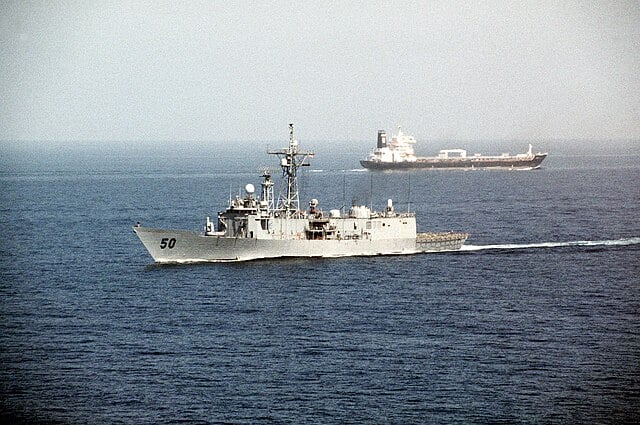
The threat hanging over the Strait of Hormuz is no longer theoretical. With President Donald Trump ordering a naval blockade of Iran after the collapse of weekend negotiations in Islamabad, and Tehran refusing to cede control of the world’s single most important oil artery, the possibility that the strait could be shut — by Iranian mines, by military confrontation, or by the sheer risk premium driving shipping away — has moved to the centre of every finance ministry, central bank and energy desk on the planet.
If it happens, the consequences will not be confined to the Gulf. They will reach petrol forecourts in Birmingham, factory floors in Guangdong, household budgets in Lagos and bond markets in New York. This is an analysis, drawn from the facts currently on the table, of what a closed Hormuz would mean for the global economy.
Why Hormuz Is the Pressure Point the World Cannot Avoid
The Strait of Hormuz is the narrow corridor through which a substantial share of the world’s seaborne crude passes every single day. It is the outlet for Saudi Arabia, the United Arab Emirates, Kuwait, Iraq, Qatar and Iran itself. There is no genuine alternative. Pipelines bypassing the strait exist, but their combined capacity is a fraction of what flows through the waterway. When Hormuz moves, the oil market moves with it.
That is why Trump’s decision to impose a blockade — announced on Truth Social with the warning that “no one who pays an illegal toll will have safe passage on the high seas” — is not simply a diplomatic escalation. It is an economic detonator with a very short fuse. The President himself acknowledged on Fox News that oil prices “might be the same or higher in the months ahead”, while insisting the US economy would hold up. That, as even sympathetic commentators have observed, is a gamble of historic proportions.
Trump Orders Naval Blockade of Iran as Diplomatic Push Falters
What a Shutdown Would Actually Do to Oil Prices
Markets price fear before they price reality. The mere credible threat of a closure has historically been enough to send Brent crude sharply higher. An actual disruption — mines in the channel, tankers avoiding the route, insurance premiums spiking, US warships engaging Iranian vessels — would produce something qualitatively different: a supply shock of the kind the world has not experienced since the 1970s.
The mechanics are straightforward. Take a meaningful share of global crude off the market overnight and buyers will bid frantically for whatever remains. Spot prices would surge. Futures curves would invert. Strategic petroleum reserves in the United States, Europe and Asia would be tapped, but reserves are finite and their release is a palliative, not a cure. The longer the strait stays closed, the steeper the climb.
Trump’s blockade strategy is explicitly designed to choke off Iran’s main source of revenue. But the tool he has chosen cuts in every direction. You cannot strangle Iranian exports through Hormuz without also disrupting the flows of every other Gulf producer that uses the same water.
The Inflation Shock Central Banks Dread
For the world’s central banks, an oil spike arriving now is close to a worst-case scenario. Inflation has only recently been brought under uneasy control after the post-pandemic surge. Interest rates in the United States, the United Kingdom and the eurozone have been edging down on the assumption that price pressures were fading. A Hormuz closure would blow that assumption apart.
Energy prices feed directly into headline inflation through fuel and heating costs, and indirectly into almost everything else through transport, manufacturing and food production. A sustained rise in crude forces central banks into an impossible choice: tolerate the inflation and risk losing credibility, or raise rates again and risk tipping fragile economies into recession. Neither option is painless. Both carry political costs that governments facing elections — including Trump’s own Republican Party, with November’s midterms approaching — would struggle to absorb.
Why China Is the Wild Card Nobody Can Ignore
The country with the most to lose from a closed Hormuz is not the United States. It is China. Beijing is by far the largest buyer of Iranian crude and one of the biggest customers for Gulf oil generally. A blockade that asks the US Navy to determine which ships have “paid an illegal toll” to Iran places Washington on a direct collision course with Chinese commercial interests — and potentially with Chinese-flagged vessels.
How Beijing responds is one of the great unknowns. It could quietly reroute purchases, absorb the costs and wait out the crisis. It could protest diplomatically while continuing to buy. Or it could escalate, using the moment to deepen its strategic alignment with Tehran and challenge the legitimacy of the American blockade in international forums. Each path carries different consequences for the global economy, but none of them are benign. A US-China confrontation layered on top of an oil crisis would turn a regional war into a systemic shock.
The Countries That Will Feel It First
The pain from a Hormuz closure is not evenly distributed. Developing economies that import most of their energy — across South Asia, sub-Saharan Africa and parts of Latin America — would be hit hardest and fastest. Currencies would weaken as dollar-denominated oil bills ballooned. Food prices, already sensitive to fuel costs, would climb. Governments running thin fiscal margins would face the choice of subsidising energy at ruinous cost or letting households absorb the shock directly.
Europe, still recovering from the energy dislocation that followed the war in Ukraine, would face a second round of pressure on industrial competitiveness. Germany’s manufacturing base, Italy’s energy-intensive sectors and the United Kingdom’s already strained household finances would all come under renewed strain. The United States, as a major oil producer in its own right, would be better insulated — but not immune. American drivers would see it at the pump within weeks, and Trump’s claim that the economy “would hold up” would be tested in real time.
The Longer-Term Damage No One Is Talking About Yet
Even if the strait reopens quickly, the aftershocks persist. Insurance markets reprice Gulf shipping. Oil majors reassess the risk of Middle Eastern investment. Energy-importing countries accelerate diversification — more renewables, more nuclear, more domestic production, more strategic stockpiling. Some of this is healthy. Much of it is expensive and takes years to deliver.
The war has already become, in the words used about it during the past week, a test of wills. Iran’s capacity to endure sustained American and Israeli pressure is being weighed against Trump’s tolerance for the economic and political pain his own strategy is generating. A CBS News poll cited in recent coverage found that 59 per cent of Americans believe the war is going somewhat or very badly, and majorities across party lines say Washington’s key objectives — keeping Hormuz open, ending Iran’s nuclear programme, improving conditions for the Iranian people — remain unmet.
A Crisis That Will Not End With a Bell
Unlike the cage fights Trump watched in Miami on Saturday night as his vice-president negotiated in Islamabad, this confrontation has no referee, no time limit and no guaranteed winner. The blockade introduces new risks — to American sailors clearing mines, to foreign-flagged tankers, to the oil price, to the global recovery — without resolving any of the original ones. Iran has not abandoned its nuclear ambitions. It has not loosened its grip on Hormuz. It has not withdrawn support from its regional proxies.
If the strait closes, the world will discover very quickly how thin the margins of the post-pandemic recovery really are. Oil at levels not seen in years. Inflation rebounding just as central banks thought the fight was won. Developing economies pushed towards crisis. A US-China standoff at sea. And a president who has staked his political future on the bet that the American economy can absorb whatever comes next.
It is, to borrow the phrase used of Trump himself, a gamble — and the stakes now extend far beyond Washington and Tehran. In the end, as the assessment of this conflict has increasingly suggested, all the participants may find themselves diminished. The difference is that if Hormuz closes, so will much of the world.
