


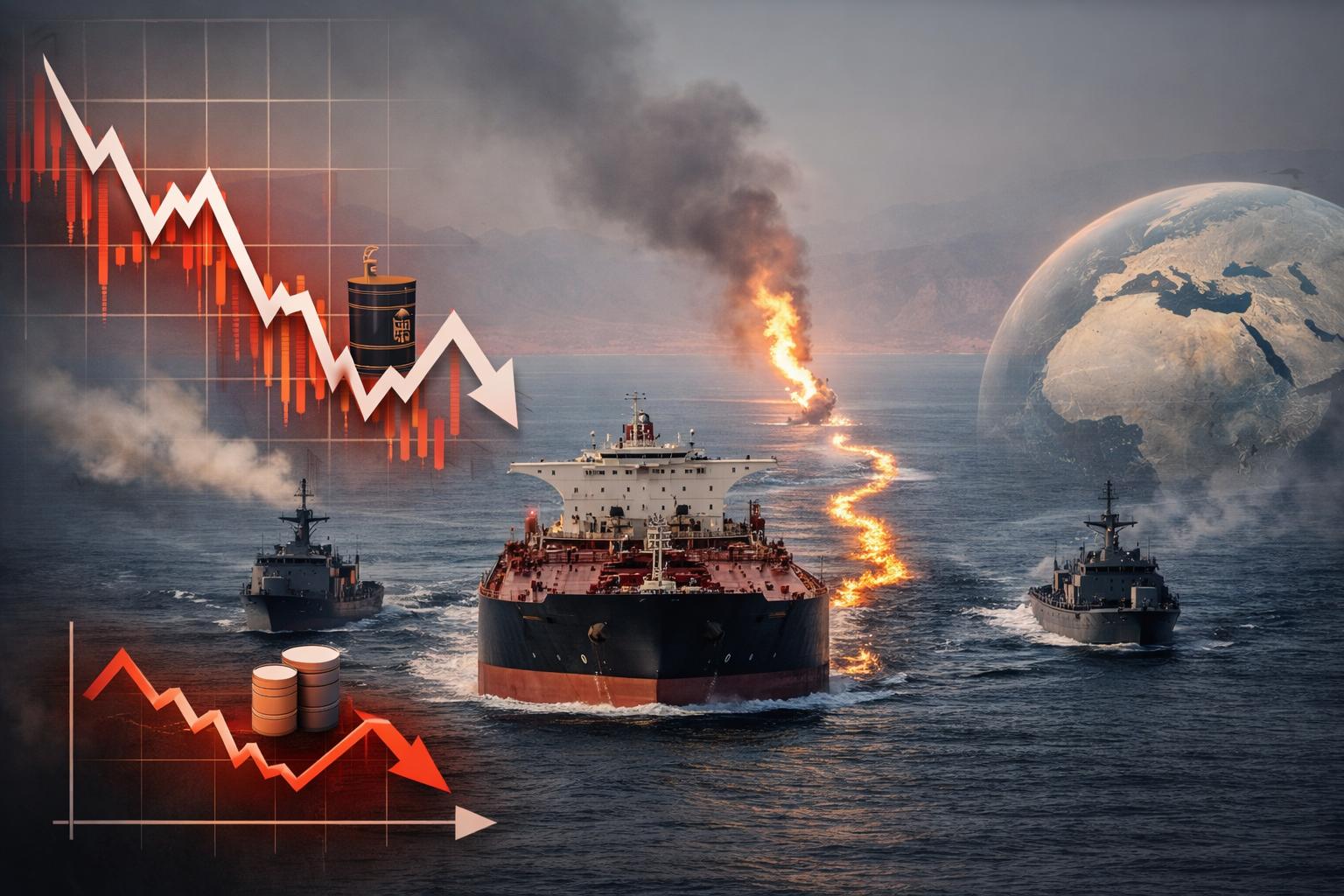
Seven weeks into the Iran war, the Strait of Hormuz — the narrow passage through which roughly a fifth of the world’s seaborne oil and a significant share of its liquefied natural gas flows — has become the centrepiece of a high-stakes standoff whose consequences reach far beyond the Middle East. What began as a military campaign has mutated into something more corrosive: an economic weapon wielded by multiple parties, none of whom appear able to agree on whether the waterway is open, closed, or something uncertainly in between.
On Friday, Iran’s foreign minister declared the strait “completely open” to commercial vessels for the duration of the ceasefire. Within hours, President Trump hailed “a great and brilliant day for the world.” Oil prices duly collapsed — US crude plunged 11.4 per cent to $83.85 a barrel, while international Brent crude fell 9 per cent to $90.38. The S&P 500 and Nasdaq both hit record highs.
Then came the caveat. Iran’s parliamentary speaker, Mohammad Bagher Ghalibaf — a member of the delegation that negotiated face-to-face with the Americans in Islamabad — posted on X that with the continuation of the US naval blockade, the strait “will not remain open.” Maritime tracking data showed very few vessels actually transiting the strait on Friday. The gap between rhetoric and reality could hardly have been wider.
What two months of disruption have cost the global economy
The damage done since Iran began restricting passage on 4 March has been severe and far-reaching. The International Energy Agency has characterised the disruption as the largest supply shock in the history of the global oil market — between two and three times the scale of the biggest previous geopolitical supply crises in 1973.
The consequences have cascaded through the global system. Oil production from Kuwait, Iraq, Saudi Arabia and the UAE collectively dropped by at least 10 million barrels per day by mid-March. US petrol prices hit $4 per gallon by the end of March, a surge of 30 per cent, while the war more than doubled the price of kerosene-based products like diesel and jet fuel.
Europe has been hit especially hard. The crisis coincided with historically low gas storage levels — estimated at just 30 per cent capacity following a harsh winter — causing Dutch TTF gas benchmarks to nearly double to over €60 per megawatt hour by mid-March. The European Central Bank postponed planned interest rate reductions, raising its 2026 inflation forecast and cutting GDP growth projections. UK inflation is expected to breach 5 per cent this year.
Beyond energy, the blockade has disrupted supply chains that most consumers never think about. The Gulf region produces nearly half of the world’s urea and 30 per cent of ammonia, with about a third of global fertiliser passing through the strait. Urea prices have risen by 50 per cent since the start of the war. The shortage of fertiliser during the spring planting season could reduce corn yields in the United States and potentially increase global food prices into 2027. Helium supplies — critical for semiconductor manufacturing — have also been rationed.
For the Gulf states themselves, the picture is even grimmer. The maritime blockade triggered what has been described as a grocery supply emergency across GCC nations, which rely on the strait for over 80 per cent of their caloric intake. By mid-March, 70 per cent of food imports were disrupted and consumer prices had spiked by 40 to 120 per cent.
Wall Street’s winners and losers
The financial markets have been a study in contradictions. Despite the war, the blockade and forecasts of stunted growth, US stocks climbed to record highs, with the S&P 500 closing above 7,000 for the first time on 15 April. By Friday the index stood at 7,126, up more than 12 per cent since its March low. The Nasdaq was on track for a 13th consecutive winning day.
The rally has confounded expectations. Investors are essentially betting on a quick resolution, partly because they have been conditioned to believe Trump will back off if economic pain intensifies — a trade analysts have dubbed “TACO”, shorthand for “Trump always chickens out.” Enthusiasm for artificial intelligence stocks, which account for almost half of the S&P 500’s market capitalisation, has also insulated the index. As one economist put it, those stocks “run on their own dynamic independent of anything, including the war in Iran.”
Yet Friday’s session illustrated how quickly winners and losers can swap places. Energy was the biggest-losing sector on the S&P 500 as oil prices crashed, with ExxonMobil falling 3.9 per cent and Chevron dropping 2.5 per cent. Consumer discretionary stocks were the day’s biggest gainers, with cruise operators Carnival and Norwegian Cruise Line rising more than 8 and 7 per cent respectively, while United Airlines climbed nearly 7 per cent.
On London’s AIM market, the pattern over the wider conflict has been clearer. Oil producers like PetroTal have surged almost 35 per cent since the war began, and North Sea operator Serica Energy has risen more than 10 per cent. The FTSE AIM All Share index as a whole, however, fell 11.2 per cent in the first three weeks of fighting.
Gold, traditionally the ultimate safe haven, has had a turbulent ride of its own. Having hit an all-time high of $5,602 an ounce at the end of January, the metal dropped nearly 25 per cent to a low of $4,100 by late March as surging oil prices and inflation fears drove investors towards higher-yielding assets. By Friday it had recovered to around $4,880.
Why nobody can agree on whether the strait is open
The confusion stems from the fact that the Hormuz question is now inseparable from the wider diplomatic negotiation — and both sides are using it as leverage. Trump insists the blockade of Iranian ports will remain until a comprehensive deal is “100 per cent complete”, and has suggested the ceasefire could end unless a long-term agreement is reached by Wednesday. Iran’s foreign minister opened the strait; Iran’s parliament speaker threatened to close it again. Trump told CBS that Iran had “agreed to everything”, including handing over its enriched uranium. Tehran said the matter had never been raised in negotiations. Ghalibaf accused the President of making “seven claims in one hour, all seven of which were false.”
On the water, the picture is no less muddled. Ship operators still face enormous war-risk insurance premiums, potential mine hazards, and deep uncertainty about enforcement. Shipping insurers and charterers are likely to remain cautious, meaning commercial normalisation may lag well behind any political announcements. Maersk, one of the world’s largest shipping companies, said it had been advised to avoid transiting the strait entirely. An analyst at the Atlantic Council noted that logistics through the waterway are complicated even in peacetime, and that operators would be reluctant to pay tolls Iran may impose while the conflict could resume at any moment.
The result is a situation in which oil prices can swing 10 per cent on a single social media post, markets are pricing in a peace that has not been agreed, and the global economy is hostage to a negotiation in which both sides publicly accuse the other of lying. The ceasefire expires on Tuesday. What happens next — to the strait, to the talks, and to the billions of dollars riding on the outcome — remains anyone’s guess.
