


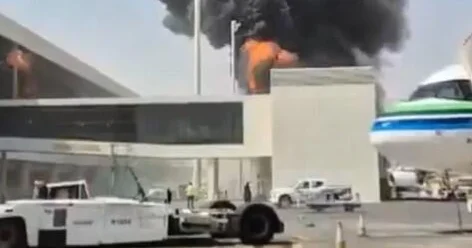
Saudi Arabia is struggling to halt a sustained barrage of Houthi missiles and drones despite spending $83 billion on defence last year and deploying a sophisticated, multi-layered air defence system.
The Iranian-backed group has struck energy infrastructure and civilian airports in recent weeks, killing at least 20 people. One attack on 10 October killed 13 people at Riyadh’s King Khalid International Airport, including a US citizen.
The Houthis have also targeted the headquarters of Saudi Aramco, the world’s largest oil company, while fighting Saudi-backed government forces for control of Yemen’s Red Sea coastline. The conflict has added pressure to oil and gas prices as Iran and the United States confront one another over the nearby Strait of Hormuz.
Saudi authorities regularly announce that ballistic missiles and drones have been intercepted. Five were said to have been destroyed on Wednesday, although a number of weapons have penetrated the kingdom’s defences.
“No country can ever have a 100% interception rating, that just doesn’t really exist,” Elizabeth Dent, a senior fellow at the Washington Institute for Near East Policy, said. But of the missile that struck the airport, she added: “That was a hell of a one to miss.”
Saudi Arabia’s geography leaves it exposed
The kingdom’s size and location make protecting every potential target extremely difficult. Its oil fields in the east lie beside the Persian Gulf, with Iran on the opposite shore, while its northern border with Iraq brings it close to Iran-backed militia groups.
Saudi Arabia also shares a border of more than 800 miles with Yemen. Much of Yemen is controlled by the Houthis, who are also contesting control of the Red Sea’s vital shipping lanes to the west.
“Over the last eight months, they have been facing threats from every direction,” Ms Dent said.
Thomas Juneau, an associate fellow at Chatham House’s Middle East and North Africa programme, said the kingdom had to protect multiple airports, pipelines, oil production and export facilities, military bases, government buildings and royal palaces.
“It is simply extremely difficult to provide air defenses for all these sites over such a large area,” he said.
The Houthis do not need to penetrate Saudi defences consistently to claim an advantage, Mr Juneau said. If they hit infrastructure with only a minority of their attempted attacks, “it counts as a success for them and an embarrassment and a loss for Saudi Arabia”.
Shortage of missile interceptors
Saudi Arabia’s difficulties have been compounded by a global shortage of the interceptors used against ballistic missiles and other weapons. The Patriot system, made in the United States and used by Saudi Arabia and other American allies, is in particularly high demand amid the wars in Ukraine and the Middle East.
US Secretary of State Marco Rubio said that “every other country in the world” wanted Patriot interceptors, describing them as “probably the most in-demand product right now in the defense field”.
Tim Cahill, president of missiles and fire control at Lockheed Martin, which makes the Patriot interceptor, said demand from the international market was “stronger than ever”.
Saudi Arabia is reported to have bought 730 Patriot interceptors from Washington since 2020. However, each missile can cost as much as $4 million, creating pressure to conserve supplies while attacks continue.
“If there’s fear over utilizing or drawing down your resources,” Ms Dent said, “are you more reticent to pull the trigger?”
The kingdom has sought emergency supplies and has reportedly explored air defence systems from Japan, South Korea, France, Britain, Pakistan and Egypt. But relying on multiple partners can create its own difficulties, particularly when different radar, aircraft, troops and interception systems must work together.
Houthi tactics are evolving
Patriot batteries were designed to intercept ballistic missiles, several of which have been launched at Saudi Arabia. But the Houthis also use relatively cheap drones, including Iranian-supplied weapons and locally produced versions of Iranian attack drones.
Those drones can be launched in swarms, according to Allison Minor, a senior fellow in the Middle East programme at the Center for Strategic and International Studies.
The Houthis “combine an overwhelming number of relatively cheap systems, namely drones, to distract and disrupt and exhaust, and then amid that, also weave in these more catastrophic missile attacks,” she said.
Ms Dent said drones and cruise missiles could alter their trajectory, making them harder to track. If one part of the layered defence system failed, she said, it could create a gap in coverage such as the one that may have allowed the airport strike.
“This is a whole new ballgame,” she said. “It’s a tactic that requires some adjustments.”
One potential response is the use of Ukrainian-developed drone interceptors, which cost thousands of dollars to make and are produced in the tens of thousands each year. Saudi Arabia and some of its neighbours have already struck deals to acquire such systems, but Ms Dent said they would not provide an immediate solution because they required skilled operators and training.
Defence spending has not guaranteed readiness
Analysts also question whether Saudi Arabia’s large defence budget has translated into the operational readiness needed to manage a complex and sustained air campaign.
Saudi Arabia’s armed forces have a reputation for being “structured and run according to the interests of its royal leadership, with an emphasis on regime security”, according to Aaron MacLean, a national security analyst.
“You can spend all the money you want on your military and your missile defenses, but you also have to have a culture of readiness and excellence among the troops responsible,” he said.
He added that fighting opponents who were creative and willing to persist meant that “some shots are going to get through”.
In response to the attacks, Riyadh has sought wider military assistance. Pakistan has confirmed a troop deployment under a mutual defence pact signed with Saudi Arabia and Turkey, while Turkey is working towards sending forces.
France has agreed to send military support to help protect the Yanbu oil terminal on the Red Sea and has announced a separate agreement covering other Saudi oil facilities.
The UK Government said it would fly defensive counter-air missions to protect Saudi cities and critical infrastructure, but that British aircraft would not take part in strikes against the Houthis in Yemen. Egypt has also said it is prepared to provide military assistance.
Greece has operated a Patriot battery in Yanbu since 2021, while Italy has troops in Saudi Arabia and has supplied radar and anti-missile batteries. Italy has also indicated that it could strengthen the European Union mission protecting Red Sea shipping if other member states increase their involvement.
Ms Minor said Saudi Arabia was “aggressively seeking out air defense support from a variety of partners”. But she questioned whether the arrangement could become difficult to manage.
“Do you eventually get to a point where that patchwork is too patchy?” she asked. “The interoperability of different troops and aircraft and radar and interception systems — does that become too much to manage at some point?”
The longer-term outcome may depend on how much weaponry the Houthis have available. Ms Minor said the group had maintained a steady rate of attacks in recent weeks, but it remained unclear whether it could sustain the campaign for years or was mounting an intense, shorter-term salvo aimed at returning to negotiations on better terms.
