


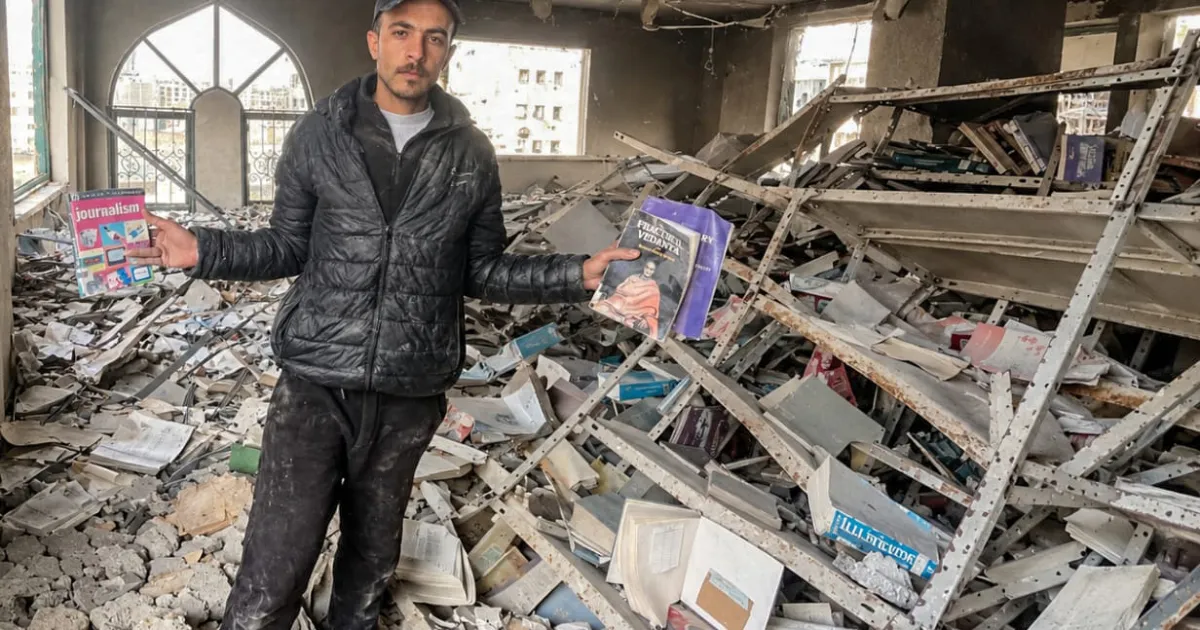
Books rescued and restored in Gaza are giving children a way back to reading after the destruction of schools, libraries and homes across the territory. Among them is a copy of Sir Arthur Conan Doyle’s The Adventure of the Empty House, now in the hands of 10-year-old Aya al-Shawa.
Aya received the book at her school in northern Gaza, where she is in sixth grade. It had previously been buried beneath the remains of a building destroyed in an Israeli attack.
Someone later retrieved it from the rubble, cleaned away the dust, repaired its damaged pages and passed it on to a new reader.
Books have become scarce as the war has damaged or destroyed much of Gaza’s educational and cultural infrastructure. UNICEF says about 98 per cent of school buildings in the territory have been damaged or destroyed, while roughly 700,000 children have been without regular in-person education since the war began in October 2023.
UNESCO has also recorded extensive damage to cultural sites and institutions, including libraries. Since a ceasefire began in October 2025, during a relative reduction in Israeli bombing, some of the books buried in the destruction have begun to find a second life.
Books rescued from Gaza’s rubble
Mohammed Saad, 54, spent more than 35 years building a personal collection in Beit Lahiya. Before the war, he estimated that his library contained between 50,000 and 100,000 titles.
The collection was destroyed on December 7, 2023. After being displaced 16 times, Saad returned to Beit Lahiya and began searching through the remains of his home.
“I risked my life to save these books from beneath the rubble,” he said.
Saad recovered about 12,000 books and moved them to Deir el-Balah. There, he set up a tent and established the Athar library — a name meaning “impact” and also associated with antiquities or historical relics.
Working with his son, Mohammed, he cleans and sorts the books, repairs their pages and prepares them for readers. The aim is not simply to preserve the collection, but to put it back into circulation, particularly among children.
Children visit the tent each day in search of stories and an escape from the hardships around them. Some books are sold for symbolic prices of between five and 15 shekels, as many families can no longer afford them.
But the collection remains exposed to the weather. The tent offers little protection from sunlight, heat, humidity and rain.
“I saved them from beneath the rubble and from the fire. Today, I cannot save them from the rain,” Saad said.
Repairing damaged books
Omar Hamad, 30, who was displaced from Beit Hanoon in northern Gaza, has also been searching for books in destroyed libraries. He mapped the locations of libraries in northern Gaza and Gaza City and contacted their owners.
Hamad says his team has so far recovered about 3,000 books. Some were taken from rubble, while others were donated by families of people who were killed and had private libraries. The group has also bought or reprinted books.
One of the rescued titles was The Catastrophe of Palestine, printed in 1956 and found among the debris of the destroyed Islamic University of Gaza library.
Hamad and his friend Ibrahim removed dust and rubble, organised the pages and repaired what they could. Books needing more specialist work were taken to Jameel Mikdad, 71, at the Shati refugee camp in Gaza City.
Mikdad has worked in bookbinding and repair for more than 45 years. His own library and printing shop were destroyed during the war, but he continued working with limited materials, gluing torn sections, sewing pages and rebinding damaged volumes.
The price of repair materials has risen sharply. Mikdad said a 3kg container of white glue, which cost between 30 and 35 shekels before the war, now costs between 450 and 500 shekels because of the siege and the damage caused by the conflict.
Restoring a book can take from two days to a week, depending on its condition. Some are too badly damaged to save, while others are kept despite being unreadable because bullet holes or fire damage have turned them into records of what happened.
“We took them with us so they could remain witnesses to this crime,” Hamad said.
Returning books to readers
Hamad founded the Phoenix Library, where books are lent rather than sold. Readers can borrow one or two books a week by paying a refundable deposit of 50 shekels.
The collection includes works of literature, medicine, law, history, economics and science, along with children’s books and specialist texts for students. Hamad also arranges for books to be delivered to schools so they can be used for reading and learning.
For children attending lessons in crowded tents, the books provide one of the few ways to continue their education while schools struggle to resume their normal role.
Aya’s copy of The Adventure of the Empty House followed that route. It began on a shelf in a Gaza home or library, was buried when the building around it was destroyed, and was later recovered, cleaned and repaired.
Now, in the hands of a young reader, the book has returned to its original purpose: to be opened and read.
