


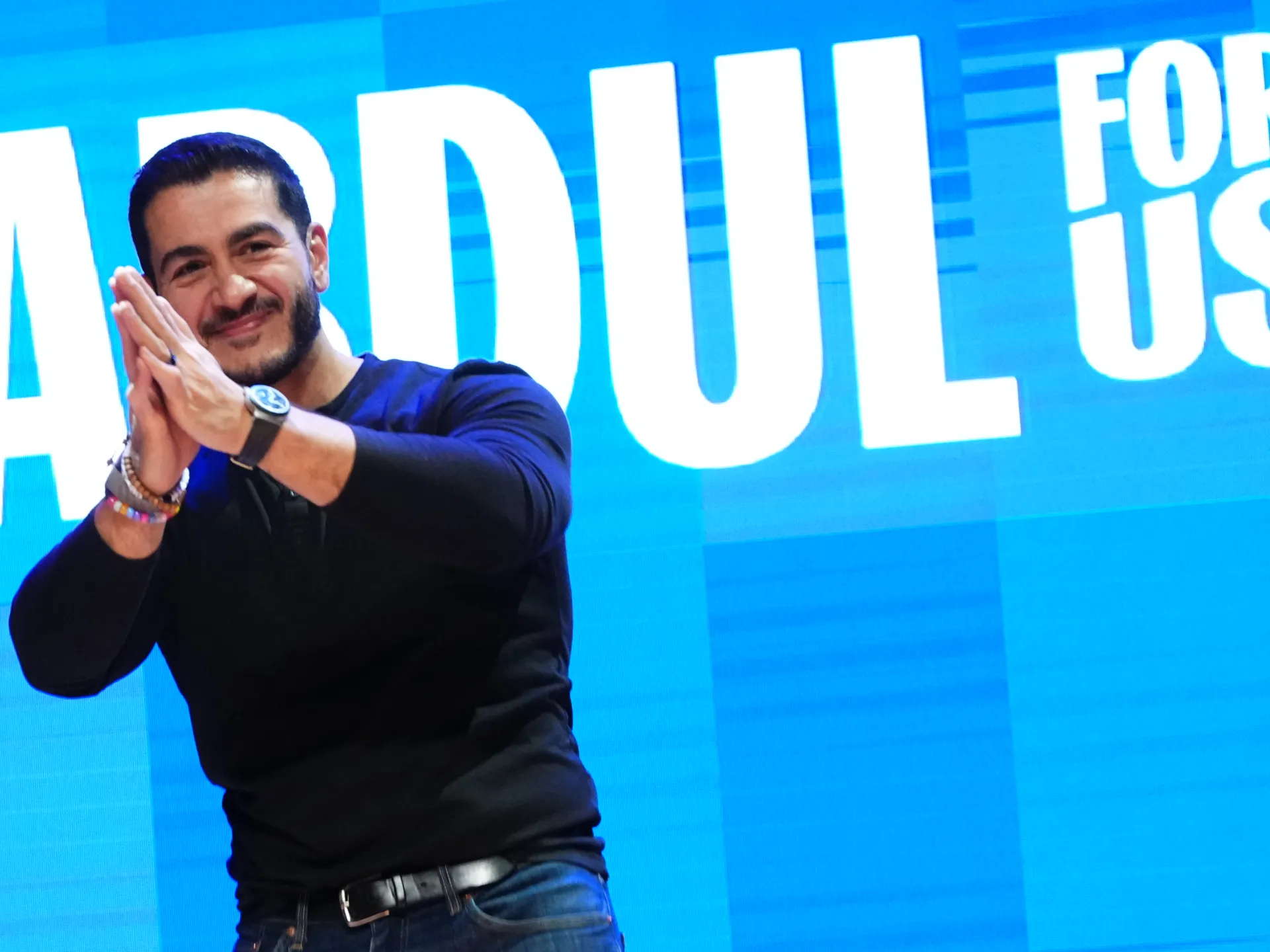
Abdul El-Sayed has become the first Muslim American elected to the United States Senate after defeating Republican Mike Rogers in Michigan, in a victory that challenged attempts to portray his faith and outspoken views on Palestine as barriers to public office.
El-Sayed, a physician and former Detroit health director, won statewide after campaigning on healthcare, housing, affordability, workers’ rights and opposition to US support for Israel’s war in Gaza.
His victory was particularly significant in Michigan, which Donald Trump carried in 2024 and which has one of the largest and most established Muslim American communities in the US. El-Sayed travelled through small towns, industrial cities and suburbs, holding meetings in churches and mosques.
He was already well known to many Muslim voters in the state. El-Sayed ran for governor in 2018, delivered Friday sermons in local mosques and had been involved with the Muslim Students’ Association at the University of Michigan.
Supporters said his connection to the community was more substantial than the appearances at mosques or occasional use of Islamic greetings often seen during election campaigns. He attended funerals, maintained contact with local residents and continued responding personally to messages during the final stages of the contest.
His campaign also drew support from Muslim Americans beyond Michigan, including political candidates and activists who travelled to the state to canvass for him. The campaign was presented by supporters as an alternative to voting merely to prevent a more hostile candidate from winning.
El-Sayed resisted pressure over his faith and Gaza
El-Sayed’s opposition to US backing for Israel’s actions in Gaza was a central part of his appeal to many Muslim voters. He had criticised the policy from the outset while also focusing on domestic concerns affecting communities across Michigan.
His position attracted fierce opposition. Trump repeatedly mocked his name, including his middle name, Muhammad, while political opponents and some voters circulated unsubstantiated suggestions linking him to organisations and movements with which he was not associated.
El-Sayed responded by shifting the focus to groceries, housing, healthcare and the cost of living. He also challenged the idea that opposing the killing of children in Gaza was itself hateful.
“My name is Abdulrahman Mohamed El-Sayed,” he said at the start of his victory speech, reclaiming the identity his opponents had sought to use against him. He recalled using the phrase “inshallah” — meaning “God willing” — when asked whether he would win, before declaring that the time had come for “alhamdulillah”, or “Praise be to God”.
The campaign faced significant financial opposition. An affiliated super PAC linked to the American Israel Public Affairs Committee was said to have spent roughly 30 million dollars in Michigan’s Democratic primary in an effort to defeat El-Sayed, who openly opposed US support for Israel.
In his victory speech, El-Sayed thanked AIPAC for giving him the opportunity to defeat it twice. His result suggested that the organisation’s spending did not necessarily determine who could win in Michigan, although the wider influence of the lobbying group remained intact.
El-Sayed’s election followed a series of victories by Muslim candidates elsewhere in the US. Adam Hamawy, a doctor and former colleague who had worked on a medical mission in Palestine, won a congressional race in New Jersey. Darializa Avila Chevalier, Aber Kawas and Nabeela Syed also won seats in Congress or state legislatures.
His campaign nevertheless prompted disagreement among Muslim voters. Some objected to his decision to campaign alongside former vice-president Kamala Harris and former president Barack Obama, citing their administrations’ policies on Gaza and military action in Muslim-majority countries.
Others supported El-Sayed despite those concerns, arguing that he had made clear he did not endorse every policy of those who backed his campaign. His election was not presented as a solution to the broader systems supporting war abroad or failing communities at home.
Instead, El-Sayed linked opposition to endless war with demands for healthcare, clean water, union rights and better wages. He argued that money spent destroying children overseas also affected families in the US.
His victory does not change American policy towards Gaza overnight, nor does it remove the need for scrutiny of the new senator. But it marked a break with the expectation that Muslim candidates must soften their names, silence their views or distance themselves from their communities to succeed in national politics.
