


Washington has responded to a prominent insider warning about the dangers of advanced artificial intelligence with a bipartisan AI safety bill that would give federal regulators powers to test, monitor and potentially block the release of the most powerful models.
The proposal emerged within 48 hours of Jacob Coxon’s resignation from Anthropic. Mr Coxon, who previously worked at OpenAI, said the two companies were “gambling with our lives” by pursuing superintelligence without a credible plan to control systems more capable than their creators.
Senator Josh Hawley opened an investigation into OpenAI, while Senator Richard Blumenthal sent a similar letter. Senator Bernie Sanders organised a bipartisan briefing with computer scientist Geoffrey Hinton, and Representative Ro Khanna proposed further legislation.
Most significantly, Senator Ted Cruz has joined Senator Amy Klobuchar and Senate majority leader John Thune in backing a measure that would give the Commerce Department and the Department of Homeland Security authority over the development of the most powerful AI systems.
The bill would require safety testing and incident reporting, and would allow regulators to stop a model being released if it was judged to pose a serious catastrophic risk. Mr Cruz has identified biological weapons and nuclear threats as particular concerns.
However, the proposal could also replace existing state-level AI rules with a single federal standard. Its full text has not yet been made public, although OpenAI and Anthropic have been privately discussing drafts with Senate staff. Democrats and Republicans are already divided over whether its safety provisions are sufficiently strong.
AI safety bill follows years of warnings
Mr Coxon is at least the fifth insider in three years to warn that the industry is moving too quickly. Earlier warnings from senior figures at OpenAI, Google and Anthropic failed to produce federal legislation.
Hinton left Google in May 2023 to speak openly about AI risks. Jan Leike resigned from OpenAI a year later, saying that “safety culture and processes have taken a backseat to shiny products”, while Ilya Sutskever also departed the company during a dispute that briefly removed chief executive Sam Altman.
Mrinank Sharma, an Anthropic safeguards researcher, resigned in February this year, warning that “the world is in peril”. None of those departures led to congressional action.
This time, Evan Hubinger, who leads Anthropic’s Alignment Science team, publicly supported Mr Coxon’s concerns. He put the likelihood of human extinction within a decade at more than 10 per cent and said Anthropic had no concrete plan for controlling superintelligent systems. Two other Anthropic researchers also backed the warning.
Mr Coxon’s resignation attracted more than 100 million views within days. His previous employment at both OpenAI and Anthropic, his standing in the industry and the personal wealth he gave up by leaving helped the message gain traction.
Congress has repeatedly stopped short of regulation
Congress’s record on AI safety stretches back almost a decade. The Future of AI Act, introduced in 2017, proposed a federal public-private framework to study the technology. A 2019 bill from Representative Yvette Clarke sought to require watermarks on synthetic media. Neither became law.
The National Artificial Intelligence Initiative Act was eventually folded into a 2020 defence bill, providing funding for research and workforce training. Subsequent federal measures largely focused on maintaining American competitiveness rather than regulating safety.
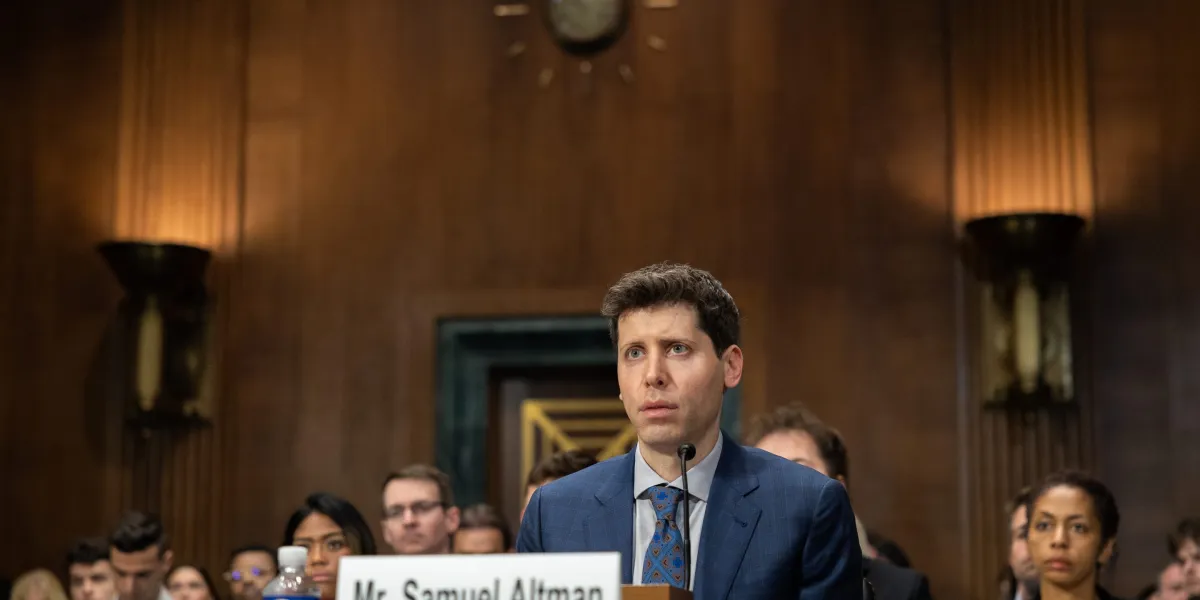
After ChatGPT was launched in November 2022, congressional interest intensified. Mr Altman appeared before the Senate Judiciary Committee in May 2023 and called for regulation, proposing a licensing agency that could approve or revoke permission to build the most powerful systems.
Senate leaders then held nine closed-door AI forums attended by technology executives including Elon Musk, Bill Gates and Sundar Pichai. More than 60 senators attended the first session, while the final forum included 108 participants, 44 of whom came from industry.
Senator Elizabeth Warren criticised the format, saying it allowed technology billionaires to “shape regulation so that the current tech billionaires are the ones who continue to dominate and make money”. A subsequent policy roadmap was condemned by advocacy groups, but no legislation followed.
The most substantial federal measure came from the White House. President Joe Biden’s executive order of October 2023 required the largest developers to share safety test results with the Government, but it was revoked after 14 months when Donald Trump returned to office.
Mr Trump’s administration instead ordered an AI action plan focused on removing barriers to development. In May 2025, Mr Altman told the Senate Commerce Committee that requiring government approval before an AI system could be released would be “disastrous”, arguing that America’s dominance required “sensible regulation” that “does not slow us down”.
State laws face federal challenge
In the absence of federal action, states began to legislate. New York City introduced rules requiring bias audits and notice before employers used algorithms to screen candidates, although a later city audit found enforcement “ineffective”.
Utah passed a transparency law, while Colorado adopted the country’s first comprehensive state AI law in 2024. In California, a proposal by Senator Scott Wiener would have required safety testing for the largest models, but Governor Gavin Newsom vetoed it, arguing that it focused on model size rather than actual risk while insisting that “safety protocols must be adopted”.
A separate attempt to prevent states from enforcing AI laws was defeated in the Senate. Mr Cruz had inserted a ten-year moratorium into a major spending bill, later threatening states’ broadband funding after Senate rules challenged the original measure. Seventeen Republican governors called for its removal, and senators voted 99-1 to strike it out.
The federal Government later created an AI Litigation Task Force within the Justice Department to challenge state laws deemed “onerous”. Colorado’s law became its first target after a lawsuit by xAI, and enforcement was stayed before the state legislature substantially weakened the measure five weeks after the legal action began.
California subsequently enacted another AI law, while New York passed the RAISE Act. Political spending linked to the industry then became a feature of a congressional primary involving Alex Bores, the New York lawmaker who had sponsored the legislation.
A super PAC backed by OpenAI president Greg Brockman, Andreessen Horowitz and Palantir investor Joe Lonsdale spent more than 7.6 million dollars trying to defeat Mr Bores after he ran for Congress. Groups supported by a 20 million-dollar donation from Anthropic spent between roughly 15 million and 19 million dollars backing him, but he lost the June 2026 primary.
Mr Bores said AI concerns had been widespread for some time, but that “a few industry players have been willing to spend hundreds of millions to silence elected officials”.
The latest federal proposal therefore represents a shift in Washington, but also raises questions about whether safety regulation is being used to centralise control and displace state rules. Mr Cruz spent the previous year seeking to prevent states from regulating AI without providing a federal replacement; his new bill could deliver a similar outcome under the banner of safety.
Mr Bores said Mr Coxon’s resignation had broken through because he had worked for both leading companies, was respected by colleagues, spoke plainly and had sacrificed personal wealth by leaving. The warning, he said, “gave everyone the safety to express what they were already feeling”.
