


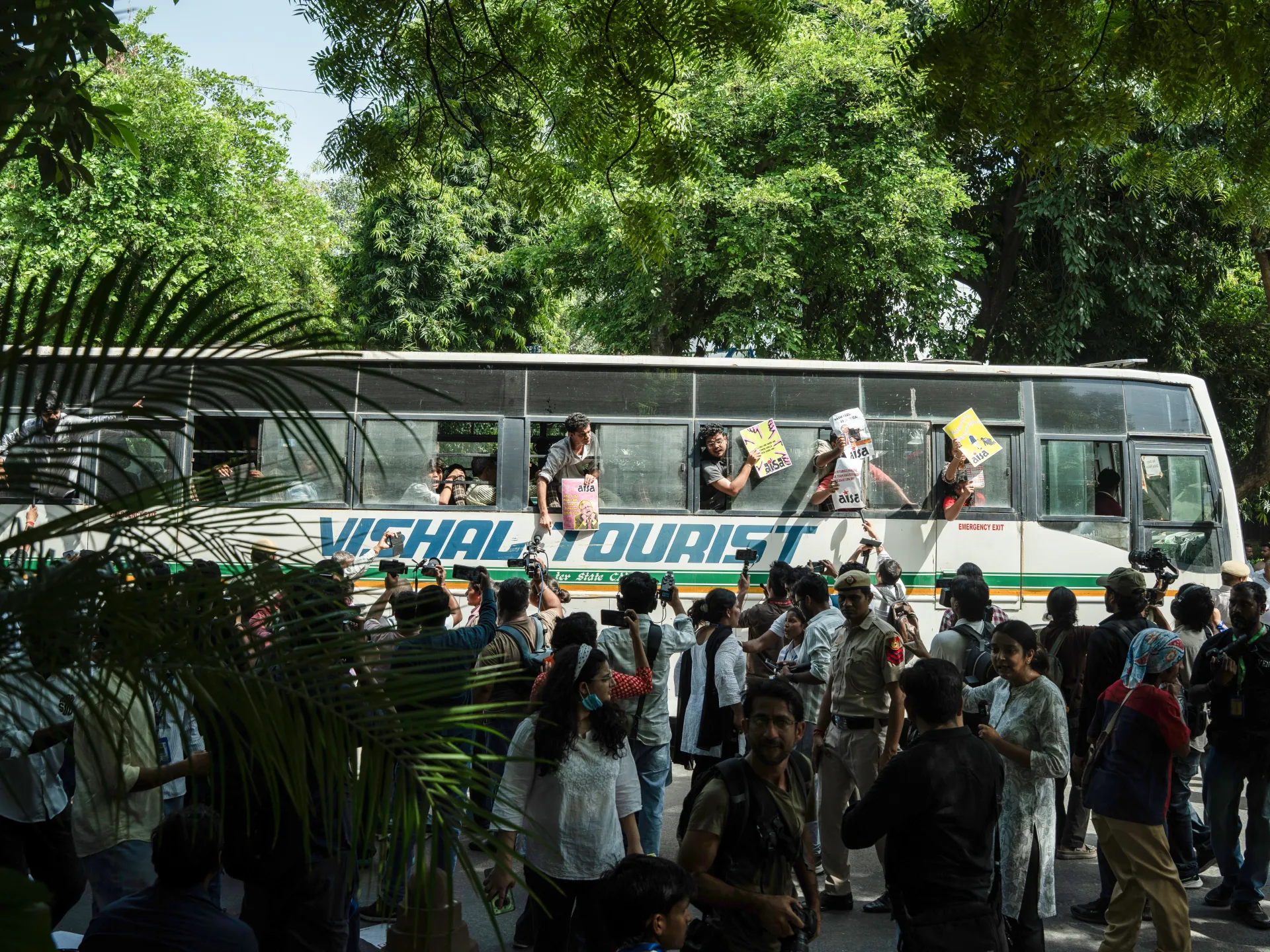
A digital volunteer network has helped stranded protesters find their way home after police detained them during demonstrations in New Delhi and left them far from the capital’s main protest sites.
Among those assisted was a 19-year-old woman who was detained on Sunday as thousands gathered in central New Delhi to demand the resignation of Chief Election Commissioner Gyanesh Kumar. Protesters allege irregularities in electoral rolls, including the removal of 133 million people from voter lists.
She and other demonstrators were taken by police bus to a location about 50km from where they had been detained. Without cash and with her phone battery exhausted, she spent almost an hour walking along a dark road, unsure what to do.
A car eventually stopped and offered help. The woman, who has not been named because she fears further reprisals, said she recognised one of the volunteers from videos he had posted online asking detained protesters whether they needed assistance.
“I was frightened and completely lost. When those volunteers finally helped me get back safely, it felt like a miracle,” she said. “I had never imagined that someone I had never met would come forward to help me like that.”
A digital network for stranded protesters
The rescue was organised through the Detainee Gharwapsi Yojana, an initiative created by 25-year-old Rajiv Choudhary. Its name combines the Hindi words for “return home” and “plan”.
The project uses a private digital dashboard, live mapping and information supplied by volunteers to track police buses and arrange transport for detainees. Details such as bus numbers and locations are shared through WhatsApp, allowing the network to coordinate assistance.
Choudhary said the network prioritised minors, older people, women and first-time protesters. It began with a spreadsheet and has grown from a small group working with journalist Meghnad, who uses one name, to more than 130 volunteers offering transport, legal assistance and medical support.
“For people caught up in these demonstrations, the ordeal doesn’t end with detention,” Choudhary said. “They can be taken far from the protest site and left trying to find their way home from unfamiliar locations, often struggling to contact friends or arrange transport.”
He said the initiative developed after he helped organise supplies and volunteers during an earlier protest called by the satirical Cockroach Janta Party at Jantar Mantar, New Delhi’s designated protest site, which has since been denotified by the authorities.
As demonstrations continued, Choudhary said it became clear that protesters needed more organised support after being detained and released far from the city. On one occasion, he arranged for a nearby female driver to take a woman stranded near a railway station home after metro services had been shut.
“It is heartbreaking to see people left helpless in an unfamiliar city, frightened and unsure of how they will get home,” he said.
The young woman said accepting a lift from strangers in the middle of the night had been particularly difficult in New Delhi, a city she described as dangerous for women. Recognising one of the volunteers helped reassure her that the car was safe.
Since the beginning of the month, protests led by the Cockroach Janta Party, left-leaning student groups and the opposition Congress party have taken place almost daily in New Delhi and other Indian cities.
Authorities have responded by blocking roads, closing metro stations and detaining thousands of people as Prime Minister Narendra Modi’s government faces its biggest challenge to power after 12 years in office.
For now, the Detainee Gharwapsi Yojana operates only in New Delhi, although Choudhary hopes to extend it to other cities. The volunteers and drivers involved have provided their services without charge.
The 19-year-old described the network as “a lifeline for protesters”, saying it offered both a safe journey home and emotional support.
“I cannot thank them enough. As long as we have people like them in our society, no authority can stop us from demanding our rights and protesting peacefully,” she said.
