


NASA is revising its Artemis programme to keep open the possibility of using either SpaceX’s or Blue Origin’s lunar lander for the first American moon landing since the agency’s Apollo missions, now targeted for 2028.
The decision will be delayed for as long as possible while both companies’ spacecraft undergo testing. NASA says the approach is intended to protect the Artemis IV landing from major delays caused by supply problems, technical failures or other setbacks.
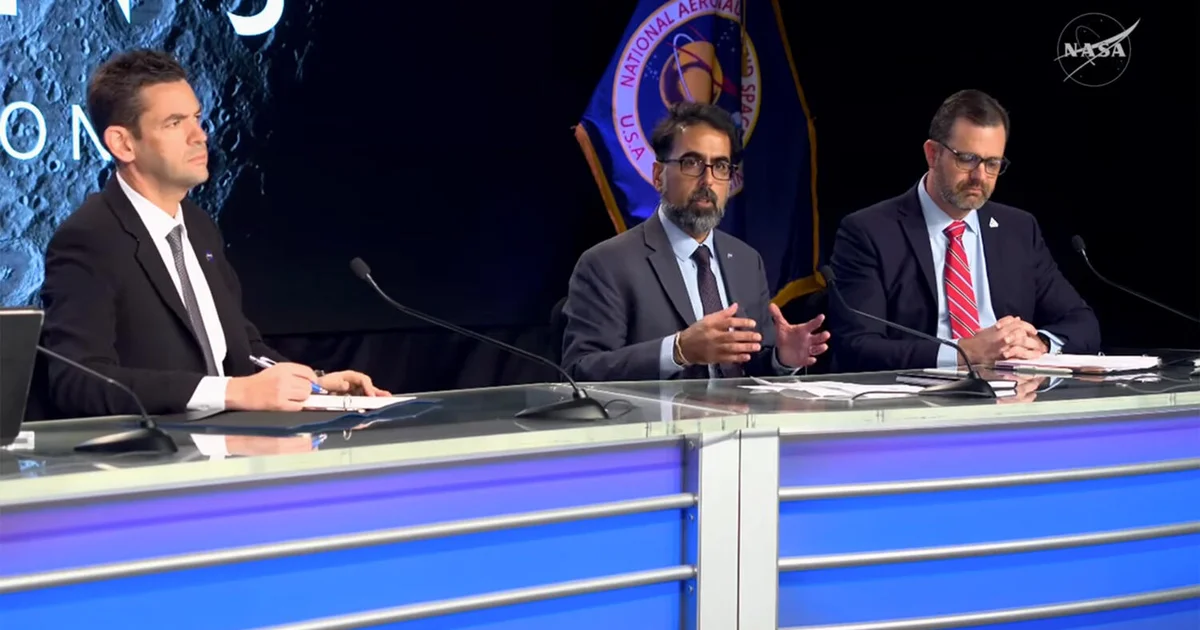
Jeremy Parsons, the Artemis programme manager, said teams were working with both companies and that the agency would use the results of upcoming flights to determine which lander offered the strongest route to the lunar south pole.
“We intend to wait as long as possible to make a decision about which provider is ultimately going to provide (a lander to carry) the first American astronauts back to the moon in 2028,” he said.
“Regardless of who goes first,” Mr Parsons added, “both providers are planning for lunar landing missions in 2028.”
Artemis III will test the technology in Earth orbit
Before astronauts are sent towards the Moon, NASA plans to use Artemis III for a complex test mission in Earth orbit next year. Four astronauts are expected to rendezvous and dock with a Blue Origin test lander before carrying out a separate docking with a SpaceX Starship upper stage.
The mission is designed to test procedures and systems close to Earth, including life support, communications, navigation and the interaction between NASA’s Orion crew capsule and the much larger Starship vehicle.
Artemis III will require launches of three heavy rockets in quick succession: Blue Origin’s New Glenn, SpaceX’s Super Heavy-Starship and NASA’s Space Launch System. Orion will need to complete separate rendezvous manoeuvres with the two test vehicles.
The astronauts will first enter Blue Origin’s Blue Moon Mark 1 spacecraft to examine its systems. After two days, they will return to Orion and dock with a Starship stage using a passive docking mechanism.
The Starship used for the test will not have a crew cabin, meaning the astronauts will not enter it. Mr Parsons said, however, that SpaceX’s experience with life-support systems, communications and navigation through its Crew and Cargo Dragon spacecraft would provide useful preparation.
Both companies must complete successful uncrewed lunar landings before either is allowed to carry astronauts.
Two different routes to the lunar surface
The final architecture for Artemis IV will depend on which lander NASA selects. The astronauts will still travel into space aboard the Space Launch System and Orion, but the journey from Earth orbit to the Moon will differ significantly between SpaceX and Blue Origin.
A SpaceX mission would involve launching a propellant depot, a tanker and the lunar lander, all based on the upper stage used with the Super Heavy booster. Multiple tanker flights would then be needed to fill the depot in low Earth orbit.
Once refuelling was complete, Orion would dock with the waiting Starship lander. The lander would propel both spacecraft towards the Moon, where two astronauts would descend to the surface, conduct several moonwalks and then return to Orion for the journey home.
Blue Origin’s plan would use three transfer stages launched by New Glenn, followed by the Blue Moon Mark 2 lander. The stages would dock with the lander and move it into lunar orbit, while Orion would travel directly to the Moon with the crew.
Two astronauts would then transfer to the lander. A transfer stage would place it into a lower lunar orbit before the descent to the surface. After completing their work, the astronauts would launch from the Moon and rendezvous with Orion.
The 2028 timetable depends on the companies demonstrating reliable launches of heavy rockets, rapid and large-scale refuelling in Earth orbit, and the ability to land safely on the Moon’s difficult terrain and in poor lighting conditions.
SpaceX and Blue Origin face different challenges
SpaceX has conducted 13 suborbital Super Heavy-Starship test flights since 2023, with the most recent flight putting a Starship into orbit. Elon Musk has told investors that the company intends to launch multiple Super Heavy-Starships each week by the end of 2027 from facilities in Texas and Florida.
SpaceX president Gwynne Shotwell has said that the first large-scale in-orbit refuelling demonstration is planned for early next year.
Blue Origin is rebuilding after an explosion at the launch pad of its New Glenn rocket in May destroyed the booster and severely damaged the pad. The company expects to resume flights late this year or early in 2027, and aims to send two uncrewed Blue Moon Mark 1 landers to the lunar surface by the end of next year.
NASA’s longer-term objective is to explore the Moon’s south pole, where ice deposits could potentially provide water, air and rocket fuel, and to establish a lunar base during the 2030s. The agency is competing with China, which plans to land astronauts on the Moon by 2030.
NASA administrator Jared Isaacman acknowledged the scale of the challenge, saying: “What we are undertaking is ambitious. It’s extraordinarily difficult, and years of decisions, both within and beyond the walls of this agency, have cost us time and resources that we never had to spare.”
He said the new vehicles were intended to reduce the cost of transporting material to orbit and the Moon, support longer stays on the surface and allow more frequent crewed missions.
“This will not be a repeat of the flags and footprints (of the Apollo program),” Mr Isaacman said, describing a future in which a small scientific outpost could eventually become something resembling a city on the lunar surface.
