


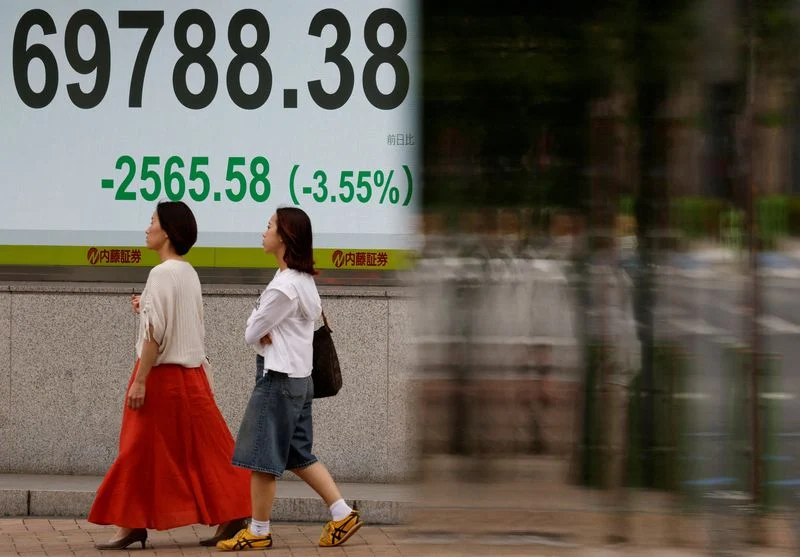
Asian markets tumbled on Wednesday, September 2, after renewed US-Iran fighting sent oil prices higher, pushed up government bond yields and revived fears that inflation could remain stubbornly elevated.
MSCI’s broadest index of Asia-Pacific shares outside Japan fell 0.8% in early trading. South Korea’s KOSPI dropped 3% at the open, while Japan’s Nikkei 225 sank 2.2%.
Brent crude rose for a second day, gaining 0.7% to about 95.34 US dollars (£73) a barrel. Prices had already climbed to a five-week high after the US launched a fresh wave of airstrikes against Iran on Tuesday.
The escalation has raised concerns about further disruption in the Strait of Hormuz, a key route for global energy supplies. Westpac analysts said the threat had renewed anxiety over inflation and contributed to a sell-off in equities and a sharp fall in bond prices.
The US 10-year Treasury yield edged up to 4.798%, while the dollar remained close to its strongest level in two weeks. Higher yields can weigh on shares by increasing borrowing costs and reducing the relative appeal of riskier investments.
US Central Command said its forces had completed strikes against Islamic Revolutionary Guard Corps targets in Iran, including air-defence sites, radar systems, maritime assets, mine-laying capabilities and communications facilities.
It said the attacks followed attempted strikes by the IRGC against commercial shipping in the Strait of Hormuz and against US service personnel. Iranian retaliation has added to concerns that the conflict could further restrict shipping through the waterway.
Markets reassess Federal Reserve rate outlook
Wall Street had already closed lower overnight, with the S&P 500 slipping 0.7% and the Nasdaq Composite losing 1% as rising government bond yields put pressure on equities.
Investors were also assessing weaker US economic data. Figures from the Institute for Supply Management showed manufacturing activity moderated in August as new orders slowed, although the sector remained in expansionary territory.
Despite the softer data, futures markets were pricing in a 67% probability of a 0.25 percentage-point increase in US interest rates at the Federal Reserve’s meeting on September 15 and 16, up from 39.6% a week earlier.
Gold was little changed at about 4,328 dollars an ounce, while bitcoin slipped 0.2% to around 77,247 dollars. S&P 500 futures were broadly flat during early Asian trading.
