


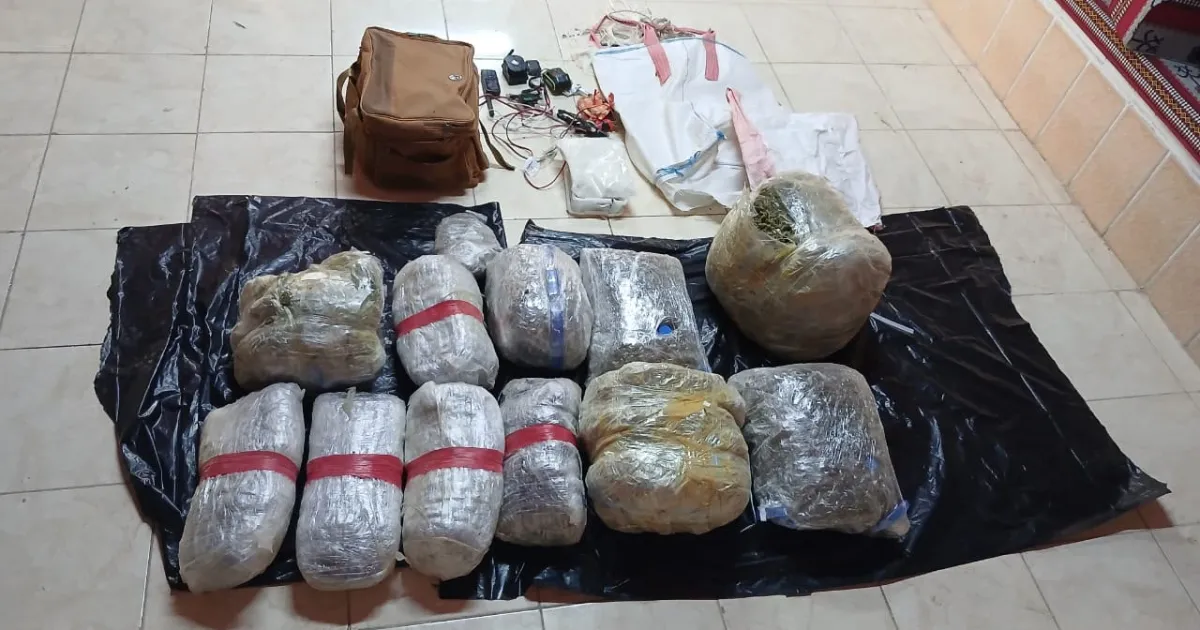
Drug smuggling from Israel to Jordan is becoming an increasingly sophisticated security threat, with gangs using drones and helium-filled balloons to move hashish, crystal meth and amphetamines across the heavily guarded border.
Jordanian authorities say organised networks operating in Israel’s Negev Desert have links to groups in Jordan and Egypt’s Sinai Peninsula. The activity has raised concern that the frontier is developing into a major route for narcotics entering the kingdom and being transported onwards.
Jordan’s Interior Minister, Mazen al-Faraya, said security forces were continuing efforts to stop drugs reaching the country, but were facing increasingly complex tactics.
“There is an increase in drug smuggling operations from Israel to Jordan using drones,” he said. “The number of seized drug cases during the current year reached 15,342 cases. Trafficking cases constituted about 28 percent of them, compared with 72 percent for usage cases.”
High-tech methods used along Jordan-Israel border
Jordanian forces recorded 17 interception operations involving drones in the south-western border area during the first half of 2026. Across the country’s various borders, they recorded 231 smuggling and infiltration attempts and brought down 56 drones during the same period.
Ammar al-Qudah, a Jordanian senator and retired major-general, said criminal networks in the Negev had acquired more than 1,000 drones originally intended for agricultural and security work.
He said some drones could carry about 50kg of narcotics, while helium balloons fitted with GPS devices were also being used to evade security measures. Part of the drugs, he added, was being sold inside Jordan, with the remainder destined for other markets in the region.
Israeli media reports have linked some of the operations to gangs in the Negev, where drugs can command much higher prices in Jordan. Hashish is estimated to sell for about 7,500 pounds per kilogram in Jordan, with Israeli security services believing its price there is roughly 15 times higher than in Israel.
Al-Qudah said the networks were connected to gangs in the Negev, Jordan and Sinai. He described a route running from Sinai through the Negev to Wadi Araba, alongside other routes involving the Lebanese border with Israel and the Galilee region towards Syria.
The claims have prompted questions over how aircraft and balloons carrying drugs can cross a border subject to extensive surveillance. Allegations have also been made that individuals within Israeli forces may have provided assistance to smugglers, based on previous cases involving the Egyptian border.
However, there is no evidence in the reported cases that the same situation is being repeated in Jordan. Retired brigadier-general Daifallah al-Daboubi, a military and strategic expert, ruled out direct involvement by Israel’s political or military leadership in drug trafficking.
He said the Israeli army’s focus on conflicts in Gaza, Lebanon and the occupied Golan Heights had given smugglers greater room to operate along the Jordanian frontier.
Shift in regional drug routes
The increased focus on the Jordan-Israel border follows a decline in drug flows from Syria after the fall of Bashar al-Assad’s government in late 2024.
Elements of the former Syrian regime were linked to the manufacture and distribution of Captagon, an illegal amphetamine stimulant. Syria had become a major distribution hub for the Gulf, while Jordan served as both a transit route and a market.
Jordan’s air force previously carried out strikes on suspected manufacturing and smuggling sites inside Syria. Since the collapse of Assad’s government and the arrival of an authority that treats Captagon as a national security issue, the flow from Syria into Jordan has reportedly decreased.
Jordanian security forces, including the counternarcotics department and armed forces, have since tracked suspected operations from Israel and made arrests. The country’s authorities are increasingly concerned that the new routes and technology are allowing criminal groups to exploit gaps along the border.
Israel has established its 96th Division in the Jordan Valley, which began operating in 2025, and is building a security barrier along the frontier. Those measures appear to be aimed primarily at stopping weapons and other illicit goods entering Israel from Jordan, rather than preventing narcotics from leaving Israel.
