


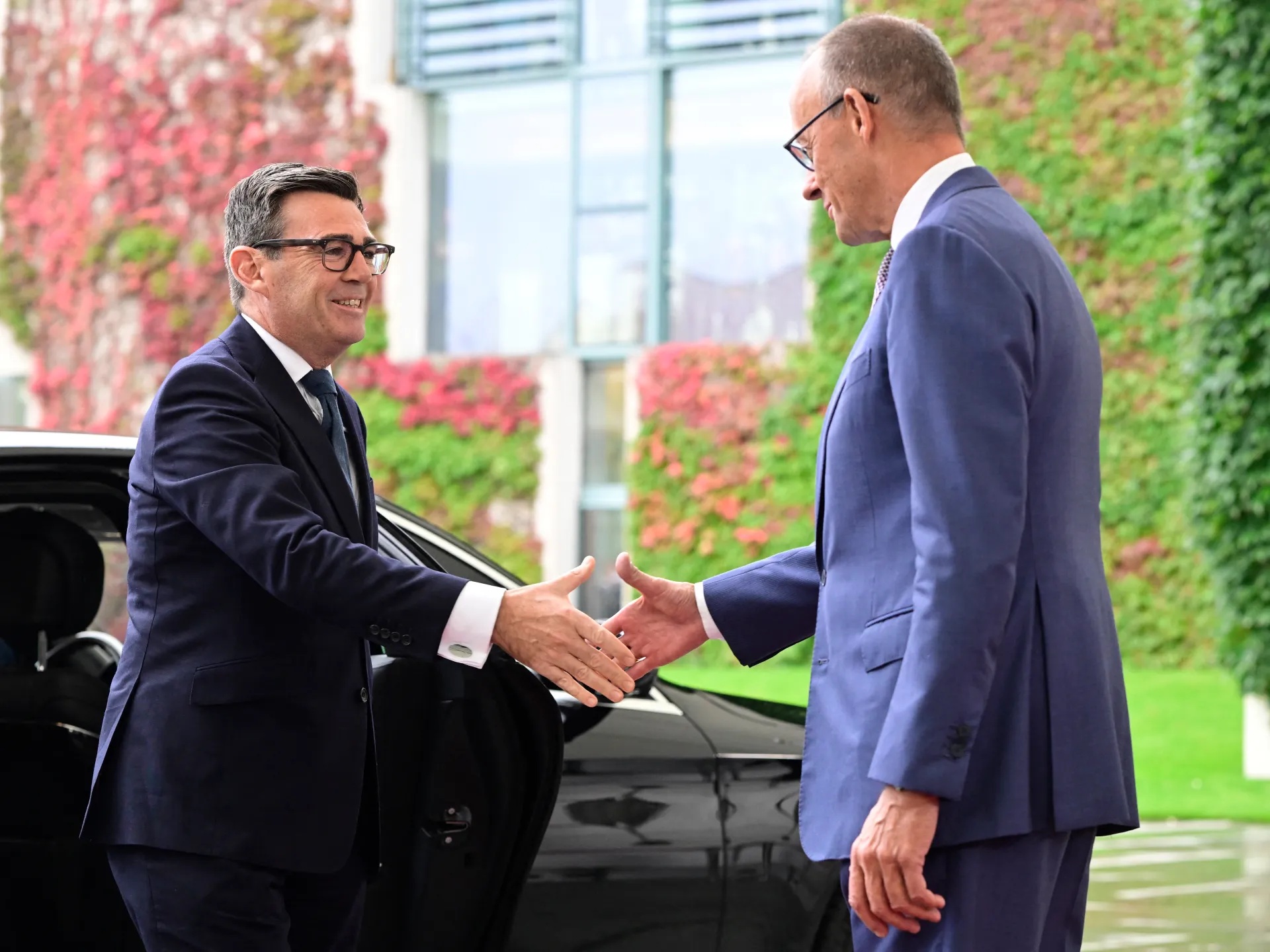
Prime Minister Andy Burnham has said the UK is open to Germany joining the Global Combat Air Programme (GCAP), the fighter-jet partnership between Britain, Italy and Japan.
Mr Burnham made the comments after meeting German Chancellor Friedrich Merz in Berlin during his first official visit to Germany since becoming prime minister in July.
“I’ve indicated to the Chancellor … our openness to Germany joining GCAP,” Mr Burnham told a news conference.
He added: “That is something that we seek to progress in the coming period, working with our other partners, Italy and Japan.”
The three founding countries have agreed to develop a sixth-generation fighter jet equipped with artificial intelligence, advanced sensors and other next-generation technology.
Speculation has grown that Germany could join the programme after a rival Franco-German fighter project collapsed in June. Canada was welcomed as an “observer nation” by the GCAP partners in July.
UK-Germany security partnership
Mr Burnham and Mr Merz are also expected to confirm a new UK-Germany security partnership focused on sabotage, cyber attacks and other hybrid threats.
The agreement is expected to include the sharing of security information and joint efforts to monitor, deter and disrupt threats, regardless of where they originate. Mr Burnham’s office specifically highlighted the threat posed by Russia.
“Attacks on our infrastructure, our businesses and our democracies are not a distant threat. They reach into people’s homes and workplaces and they are designed to make us weaker and more divided,” Mr Burnham said ahead of the visit.
Britain and Germany have both expressed concern over the threat from Moscow. The German authorities last month accused Russia of being behind a failed drone attack at Leipzig/Halle Airport, while Moscow denies any involvement.
The leaders are expected to discuss continued support for Ukraine in its war against Russia, disruption to global trade routes including the Strait of Hormuz, and the formal ratification of the 2025 Kensington Treaty.
The treaty commits the two countries to closer cooperation in science, technology, defence, security and economic growth.
