


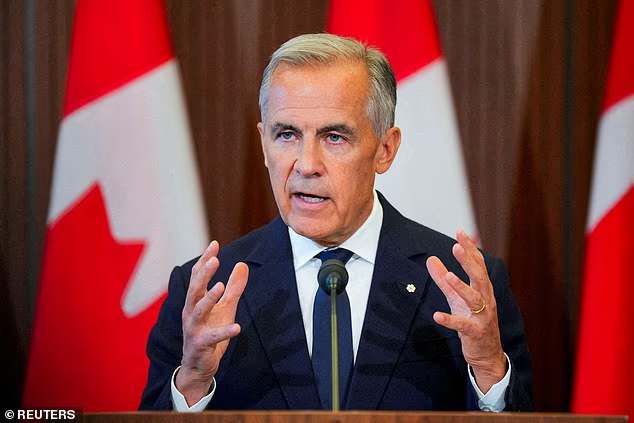
Canadian Prime Minister Mark Carney is exploring closer integration with the European Union, including a possible associate membership arrangement, as relations with the United States deteriorate over trade.
People close to Mr Carney told the Wall Street Journal that the Canadian leader has spent several months considering how Canada and its 41 million residents could be more closely linked to the EU.
The proposal could include allowing Canadians to live and work in EU countries without visas. Mr Carney has reportedly discussed the idea with several European leaders, particularly French President Emmanuel Macron.
Canada and the European Union
The EU is said to be open to creating an associate membership status for Canada, although no such arrangement currently exists and full membership is not guaranteed.
Officials in Canada and the EU were cited as saying the plan could bring economic and political benefits. However, closer ties would risk further angering US President Donald Trump and could place the relationship between Ottawa and Washington under greater strain.
Negotiations between the long-standing allies have already broken down, with tariffs affecting tens of billions of dollars in cross-border trade. Mr Trump has threatened to raise tariffs on Canadian cars, lorries, automotive parts and steel to 50 per cent by 2027 in an effort to bring more manufacturing to the United States.
Mr Carney has said Canada would respond to American measures “dollar for dollar”. Mr Trump, meanwhile, has accused Canada of relying on US military protection without adequately compensating Washington.
The EU itself has previously proved difficult to deal with on trade. More than a decade after a trade agreement with Canada was struck, and nine years after it provisionally came into force, several EU countries have still not ratified it.
Tensions between Ottawa and Washington have also been reflected in a dispute over the name of Lake Ontario. Mr Trump signed an executive order directing the US Interior Department to use “Lake America” for federal purposes, and Google Maps adopted the name for users in the United States.
The order does not bind Canada or international organisations, and Canadian officials have rejected the change. Mr Carney pointed to the lake’s indigenous roots, saying the name Ontario came from a Wendat word meaning “the lake is beautiful, the lake is great”.
Mr Trump has said the dispute with Ottawa extends well beyond the lake’s name. “The whole Canadian thing has to come to a stop,” he said while discussing proposed tariffs on Canadian vehicles and other goods.
Relations were further strained in July when smoke from Canadian wildfires drifted into northern US states. Mr Trump accused Canada of failing to maintain its forests and said the United States was being “unnecessarily invaded by filthy, polluted, and unhealthy air”.
