


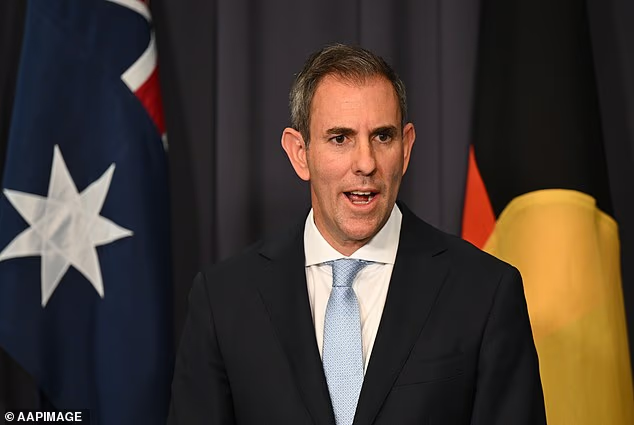
Australia’s Intergenerational Report will test whether the country can deliver stronger productivity and control rising debt as Treasurer Jim Chalmers sets out Treasury’s long-term projections on Monday.
The seventh report will examine Australia’s economic and fiscal position through to 2066. Although such forecasts are not predictions of the future, they are intended to show how decisions taken today could affect successive generations.
At the centre of the report will be Treasury’s assumption about productivity growth – the rate at which the economy produces more value for each hour worked. The figure is crucial because weaker productivity would reduce projected incomes, economic growth and government revenue.
Productivity at the centre of Australia’s Intergenerational Report
A previous report, released by then-treasurer Peter Costello in 2002, came close to forecasting the economy’s total size over the following two decades. However, the result was driven by net overseas migration being roughly twice as high as expected and by a rise in workforce participation.
Productivity growth was significantly weaker than forecast, meaning the economy expanded largely through a larger population and more hours worked. GDP per person was about 10 per cent below the projection.
Recent figures indicate a similar pattern. The economy grew by 0.4 per cent in the June quarter, while GDP per person was flat, real disposable income per person fell by 0.4 per cent and output per hour was lower than a year earlier.
The Productivity Commission has estimated that Australian productivity is only marginally above its 2015-19 average. In the non-market sector, it has fallen below 2007 levels.
Three years ago, Treasury lowered its long-term productivity assumption from 1.5 per cent to 1.2 per cent. That apparently modest change reduced the projected size of the economy in 2063 by 9.5 per cent.
Chalmers now faces a choice between retaining the 1.2 per cent assumption, which would require a substantial recovery in productivity, or lowering it and acknowledging that future incomes and public finances are likely to be weaker than previously forecast.
The report is also expected to highlight the scale of Australia’s debt challenge. Chalmers has pointed to public debt being lower than in many other advanced economies, but gross debt has risen sharply since Australia’s net debt position in 2007.
The country currently has a deficit of $31.5 billion and more than $1 trillion in gross debt on which interest must be paid. There is no indication of a return to surplus for at least a decade.
Treasury’s projections are expected to show gross debt in the early 2060s hundreds of billions of dollars lower than previously forecast. But that improvement would represent a difference between two long-term estimates rather than money already saved.
The projected reduction of more than $500 billion in just three years also demonstrates how sensitive the figures are to changes in assumptions. The more favourable outlook depends on future governments restraining spending, achieving difficult savings in the National Disability Insurance Scheme and maintaining enough economic growth to prevent continuing deficits from pushing debt higher as a share of GDP.
Australia has experienced a global financial crisis, a pandemic and repeated spending increases since the first report was published in 2002. Those events underline the uncertainty attached to projections extending four decades into the future.
Reform, migration and living standards
Chalmers has argued that improving productivity will require a series of smaller reforms rather than a single reforming programme on the scale associated with the Hawke and Keating governments.
Critics of the Government’s economic approach say promised regulatory savings have been outweighed by complex workplace laws, higher public spending and expanding subsidies, making it harder for businesses to invest and employ workers.
Richard Holden, professor of economics at UNSW, said: “The government has thrown sand in the gears of the industrial relations system.”
The report is also expected to identify one more favourable development: the cost of the age pension is projected to fall significantly by 2066. That reflects the impact of compulsory superannuation, introduced under former prime minister Paul Keating and later increased by Labor.
Chalmers is expected to use the finding to oppose One Nation’s proposal to allow workers to redirect three percentage points of their superannuation contributions into wages for up to three years. The proposal is intended to give people more immediate help with housing and cost-of-living pressures, but its merits remain contested.
Migration will form another part of the debate. Skilled migration can increase the economy’s capacity, but population growth is more difficult to sustain when housing, transport and hospitals fail to keep pace.
The central warning from the projections is that a larger economy does not necessarily mean higher living standards. For the long-term figures to improve, Australia will need stronger productivity, spending discipline and reforms capable of lifting output per person rather than relying chiefly on population growth.
