


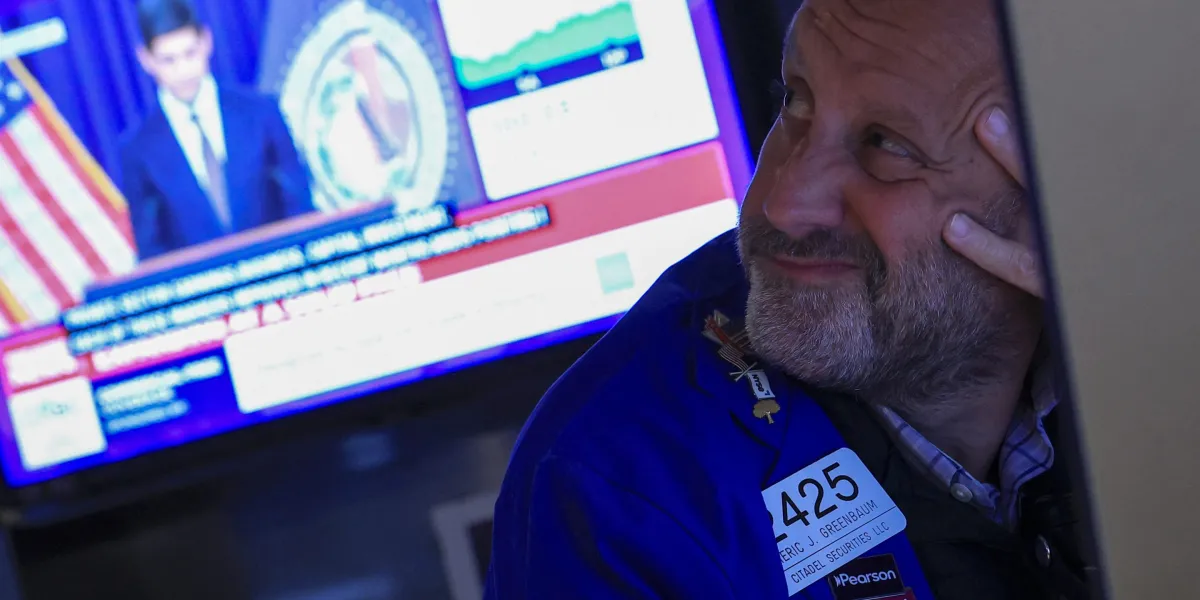
US stocks fell sharply after Federal Reserve chair Kevin Warsh signalled that the central bank’s first interest-rate increase in three years could be followed by further rises.
The S&P 500 was down 1% on Wednesday afternoon and was heading towards its lowest close since July. The Dow Jones Industrial Average dropped 1.7%, or more than 700 points, while the Nasdaq Composite slipped 0.8%.
Financial shares led the decline as the 10-year Treasury yield remained close to 5%, a day after reaching its highest level since 2007. The dollar index rose 0.6% to its strongest point since late July.
Markets had already anticipated the quarter-point increase and initially reacted calmly. All three major share indexes were higher before the Federal Reserve’s 2pm decision, with the sell-off beginning during Mr Warsh’s press conference.
The chair adopted a more hawkish tone than investors had expected, suggesting that interest rates may not yet be high enough to restrain the economy. “I would be hard pressed to describe broad financial conditions as restrictive,” he said in his opening remarks. “This view was widely shared by the committee, so we removed a dose of accommodation.”
The comments indicated that the Fed may believe rates of between 3.5% and 3.75% are not yet sufficiently restrictive. Asked whether monetary policy was now restrictive, Mr Warsh declined to say.
He also distanced himself from the central bank’s published projections, which indicate one more increase this year followed by a pause through 2027. “Those aren’t my forecasts,” he said. “Those are the forecasts of my 18 colleagues.”
Asked whether Wednesday’s decision would be followed by a sequence of increases, Mr Warsh said: “I’m not in the forward guidance business.”
The shift in tone unsettled markets that had been hoping for a limited increase followed by a period of stability. Jeffrey Roach, chief economist at LPL Financial, said the outlook meant that “we may not see a cut until 2028”, adding that “another hike may be on its way”.
Chris Zaccarelli, chief investment officer at Northlight Asset Management, said the historical pattern was that “once the Fed begins raising rates, they do it multiple times”. Fed funds futures showed traders divided over whether the next increase would come in October.
Michael Pearce, chief US economist at Oxford Economics, offered a less aggressive assessment. He expects one further increase followed by a pause, writing that the move was not the beginning of “another major tightening cycle” and that markets had priced in too much tightening over the coming year.
