


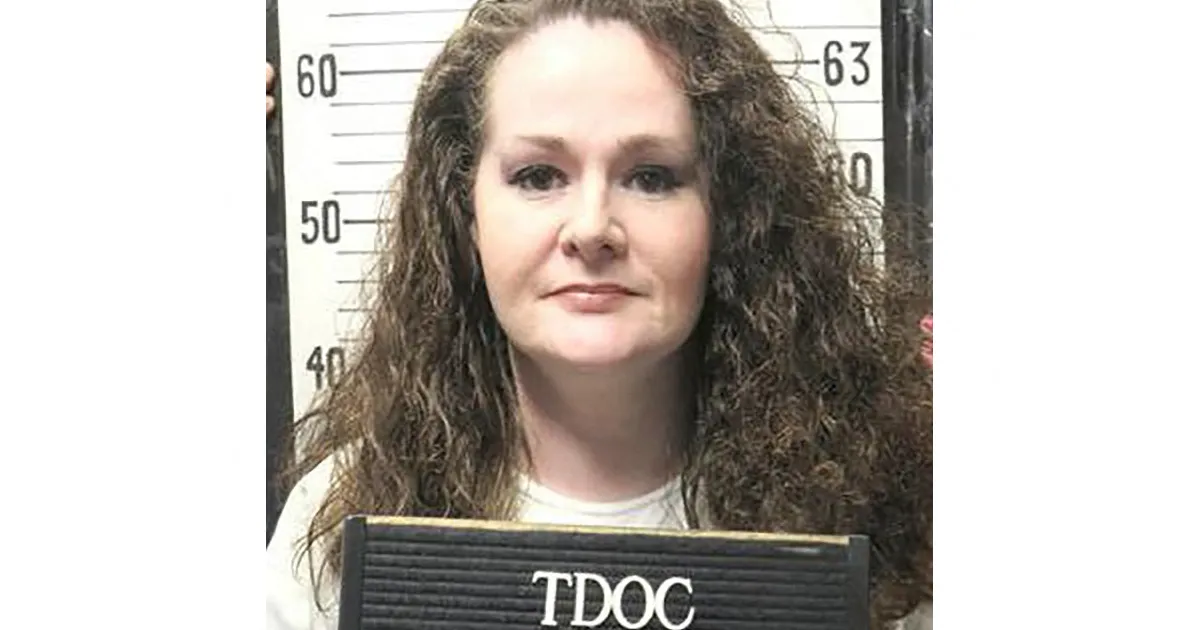
Christa Gail Pike survived a botched lethal injection in Tennessee after two doses of pentobarbital failed to stop her heart, forcing prison officials to take the 50-year-old woman to hospital.
Pike had been due to die at Riverbend Maximum Security Institution in Nashville on Wednesday evening. She would have been the first woman executed in Tennessee for more than 200 years and the only woman on the state’s death row.
The execution went ahead after the US Supreme Court overturned a last-minute stay issued by a federal appeals court. The lower court had temporarily halted the procedure on legal and technical grounds, but the Supreme Court’s decision came about an hour before the midnight deadline for carrying it out.
Witnesses said Pike appeared to remain conscious after the injections. Kim Chandler, an Associated Press journalist who witnessed events from outside the prison, said the blinds to the execution chamber opened briefly after the first injections were administered.
“Her mouth fell open a few times, and she began to loudly snore. She gasped a few times,” Chandler said.
The curtain was closed again shortly afterwards, but Pike could still be heard snoring. Chandler said she remained “clearly very alive” until media witnesses were told to leave the area at about 8.53pm local time.
Pike’s lawyers filed an emergency motion in federal court during the procedure, citing witness accounts that both syringes had been used while their client remained alive and audibly snoring.
They said: “Ms Pike has not lost consciousness and still has a heartbeat and is audibly snoring.” Her lawyers later said she required immediate medical care while being treated in hospital.
The Tennessee Department of Correction did not initially explain why the execution had not been completed. In a statement issued later, the department said officials had “followed every step of the state’s lawful, established execution protocol approved by the Attorney General’s Office”.
It added: “The lethal injection chemical in the protocol has consistently been effective, and the protocol does not allow for additional procedures beyond what was carried out this evening. Christa Pike has been transported to an off-site medical facility.”
Why the lethal injection failed
Tennessee authorities have not said what caused the procedure to fail. Human rights lawyer Clive Stafford Smith suggested two possible explanations, while stressing that the details remained uncertain.
He said the drugs may have been out of date, pointing to the difficulty US states face in obtaining medicines from manufacturers opposed to their use in executions.
Stafford Smith also said Pike’s history of abuse and drug use may have made it difficult to locate a vein. Doctors are not permitted to take part in executions in the United States, he said, raising the possibility that the injection was administered unsuccessfully.
Pike had asked to be executed by an all-female firing squad instead of lethal injection, saying she feared the injection would be too painful. Her lawyers argued that the process could be particularly torturous because she had “small veins”, but the request was rejected.
What happens to Christa Pike now?
Tennessee Governor Bill Lee has paused all remaining executions scheduled in the state for 2026 and ordered a comprehensive review by an independent third party.
Pike remains in hospital. It is not yet clear whether she will be returned to death row or what further legal steps will follow.
Her lawyers had argued that she should not be executed because she was 18 when she took part in the killing and had endured severe abuse during her childhood, including two rapes when she was 11 and 17.
Pike was convicted of first-degree murder in 1996 over the killing of 19-year-old Colleen Slemmer, a fellow student at a Job Corps vocational centre in Knoxville.
Prosecutors said Pike, her 17-year-old boyfriend Tadaryl Shipp and 18-year-old Shadolla Peterson lured Slemmer into woodland in January 1995, where she was tortured and killed. The case attracted widespread attention after it emerged that a pentagram had been carved into the victim’s chest.
Pike and Shipp confessed. Pike was sentenced to death, while Shipp, who was 17 at the time and therefore not eligible for execution, received life in prison with the possibility of parole.
Pike’s lawyers described her as a remorseful 50-year-old who understood her actions and had become a different person since the crime. Slemmer’s mother, May Martinez, has spoken in support of Pike’s execution.
Previous botched executions
Botched executions have occurred under several methods in the United States, although the frequency varies. Data compiled by legal scholar Austin Sarat and the Death Penalty Information Center recorded 276 flawed executions among 8,776 carried out between 1890 and 2010.
Lethal injection had the highest rate of botched executions during that period, at 7.2 per cent.
One previous case involved Alva Campbell in Ohio in 2017. An execution team spent about 30 minutes attempting to access veins in both arms before trying his right leg. The procedure was eventually abandoned after about 80 minutes because officials could not establish reliable access.
Campbell later died on death row from terminal medical conditions.
Stafford Smith, who has attended executions involving six of his clients, said the process was rarely as clinical as authorities suggested.
“I’ve been in the execution chamber with six of my clients and it’s never the clinical process they’d have you believe. And it’s always a desperate midnight struggle to stop it,” he said.
Before Pike’s scheduled execution, Morris Tidball-Binz, the UN special rapporteur on arbitrary executions, warned that putting her to death would amount to torture and a serious violation of human rights.
Stafford Smith said: “In the end, you have to question whether this makes the world a better, more civilised place. Why, indeed, do we kill people to prove that killing people is wrong?”
