


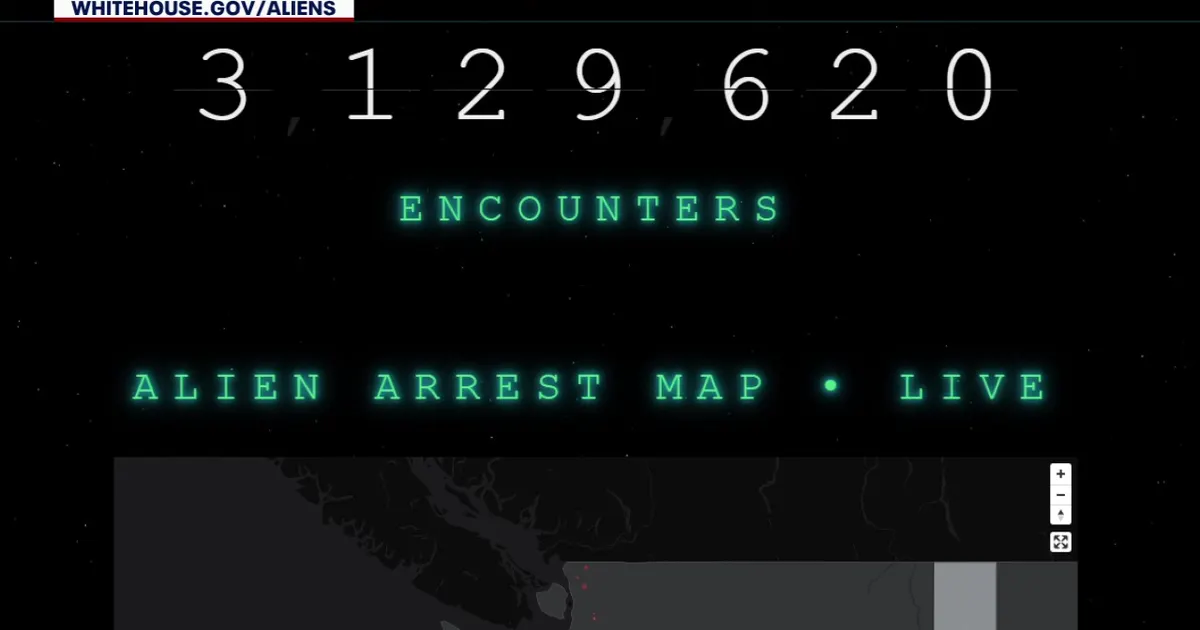
A White House alien website describing undocumented migrants as people who “walk among us” has prompted a backlash from civil rights advocates, who accuse the Trump administration of using dehumanising language to promote immigration enforcement.
The site, launched on 28 May, uses science-fiction imagery and presents a live map of immigration arrests across the United States. It lists figures for several Washington state locations, including 542 arrests in Seattle, 487 in Tukwila and 716 in Yakima.
Although the online interface labels the figures as Immigration and Customs Enforcement (ICE) statistics, federal officials told FOX 13 Seattle that the numbers cover more than ICE operations alone and referred questions about the data to the White House.
The website also directs visitors to an ICE tip line to report “suspicious aliens”. Its closing message says that anyone apprehended is in “good hands” and will be returned to their place of origin.
White House alien website criticised as dehumanising
David Montes, a staff attorney with the American Civil Liberties Union of Washington, said the presentation was part of a wider pattern of inflammatory language from the administration.
“Honestly, it’s the same sort of dehumanizing rhetoric that we’ve seen from this administration over and over again, and it’s disgusting and incredibly troubling,” he said.
“Immigrants make up an integral part of our community and are important members of the fabric of our society, and they should not be dehumanized by this.”
Mr Montes said the language was intended to portray non-citizens as fundamentally separate from the rest of the population, despite their role in communities across the country.
“They’re trying to make it seem like these folks are just totally different than people who are citizens, and it’s just not true at all,” he said. “Immigrants are an important part of our community who have the same values as all of us.”
The White House has defended the concept, saying the design was intended to attract public attention to immigration enforcement and to what the administration describes as failures by the previous government to secure the border.
Questions over immigration arrest figures
The website presents arrest figures alongside language linking immigration enforcement with criminality. But Mr Montes said a large proportion of those detained for immigration violations had no criminal history.
“We know that 60 or 70% of the people that they have arrested for immigration violations do not have any criminal history,” he said, arguing that some arrests had taken place in administrative settings, including near immigration courts.
Research by the University of Washington’s Center for Human Rights found that immigration arrests in the Pacific Northwest rose sharply between October and December 2025, reaching nearly 2,250 cases. The centre said most of those targeted during the surge had no previous criminal record.
Legal advocates have warned that publishing localised arrest figures and encouraging public reports could fuel racial profiling and vigilantism, particularly if members of the public treat ethnicity, language or appearance as evidence of immigration status.
Mr Montes said the website risked making an aggressive enforcement campaign more acceptable to the public while obscuring concerns about conditions in immigration detention centres.
“They’re trying to reach an arbitrary quota, and this is a piece of, frankly, propaganda that’s meant to make that more palatable to people,” he said.
