


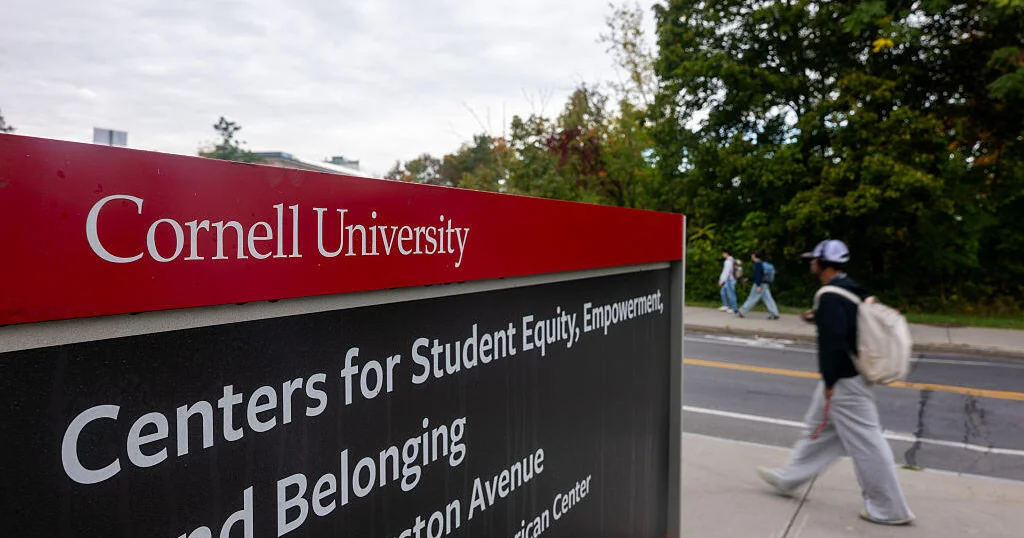
Newly obtained transcripts from Cornell University’s Title IX investigation have revealed fresh details about allegations that a former student was drugged and sexually assaulted by several men at a fraternity house in October 2024.
The 565 pages of records include the woman’s two-day interview with Cornell police, conducted in November 2024, around three weeks after the alleged incident. She was 20 at the time and has been identified in the documents as Jane Doe.
No criminal charges have been brought. However, Tompkins County district attorney Matthew Van Houten has said he will reopen the investigation after learning more about the interview, while New York Governor Kathy Hochul has appointed attorney general Letitia James as a special prosecutor.
Cornell has said it supports the governor’s decision. The university’s own Title IX inquiry, conducted in 2025, involved about 50 interviews with 32 witnesses.
What the Cornell Title IX investigation heard
Jane Doe told investigators that the night began on October 19, 2024, during a sorority “date night”. She said she had barely eaten, drank at her sorority house and later at a bar in downtown Ithaca, and became heavily intoxicated before going to the Chi Pi fraternity house.
She initially described a sexual encounter with two men as consensual, although she told investigators she was “super drunk” and felt “really off-guard the entire night”.
One of the men, identified in the transcripts as Male 2, told campus police that ketamine was found in the room. He said he and Male 1 took the drug, while Jane Doe initially declined.
The situation allegedly changed after a message was sent to a Snapchat group used by fraternity members at 1.42am on October 20. The lawsuit filed by Jane Doe says the message suggested a woman was available at the fraternity house for sex.
One fraternity member replied, “Shop still open?” and received the response, “Yea.” Another witness said around 50 members were included in the Snapchat thread. A further witness told investigators that Male 1 had sent the first message, adding that members initially thought it might have been “just crude humor”.
Cornell has said its police department gave the district attorney’s office Jane Doe’s sworn six-page statement and a screenshot of the Snapchat exchange. Mr Van Houten has said he was not shown the full interview transcripts.
As more men entered the room, Jane Doe told investigators she felt “cornered”. She said: “I was like literally cornered. … I’m a naked woman and they are getting in bed with me.”
She also said she was taken to a closet and given ketamine. Recalling the end of the night, she told investigators: “I didn’t remember the very end of the event where I was raped. I can say with 100% confidence I was raped.”
Mr Van Houten said that statement had not been provided to him and described it as “a legal conclusion”. He added: “If she had said those words, we certainly would want to have explored that more.”
Investigation reopened after lawsuit
Jane Doe said she visited Cornell Health two days later and told a doctor she had contracted a urinary tract infection in a “traumatic way”. Her lawyer said the doctor advised her to speak to someone, but she did not follow up.
She told investigators that she had kept the dress she wore that night unwashed because she regarded it as potential evidence. She also said she later saw a comment beneath a fraternity listing online which led her to believe she had been sexually assaulted by several men.
Jane Doe said three men from the night, including Male 1 and Male 2, later sent her apologetic text messages. A sorority sister told investigators that Jane Doe had described remembering parts of the night intermittently.
Jane Doe has since left Cornell without graduating and last month filed a lawsuit against the university and seven members of Chi Pi. Lawyers for two of the defendants have denied the allegations.
Cornell later shut down its Chi Pi chapter. At a meeting on September 29, university president Michael I Kotlikoff said two of the accused men had been expelled, two suspended for at least two semesters, one had graduated before disciplinary action could be taken, and two had been found not responsible for sexual misconduct.
