


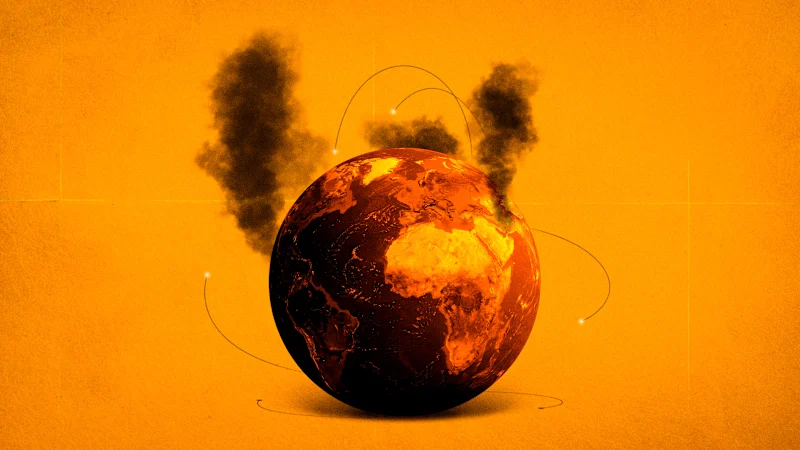
World War III has become a serious question for analysts as conflicts involving Iran and Ukraine continue to affect wider parts of the world, although experts differ sharply over whether the threshold of a global war has been crossed.
Professor Robert Pape, a political science expert at the University of Chicago, said the question was “fair” given that two major wars were taking place simultaneously and had consequences well beyond their immediate battlefields.
“Because we have two major wars that are impacting big parts of the world happening at the same time [in Iran and Ukraine],” he said.
The concern is that a fresh incident could transform existing conflicts into a much wider confrontation. The possibility of disruption to energy supplies, economic retaliation and military miscalculation has prompted commentators in the United States, Britain and Japan to ask whether the world is already in an undeclared third world war.
James Der Derian, director of the University of Sydney’s Centre for International Security Studies, said the current situation carried echoes of earlier conflicts in which economic pressure and strategic calculations helped drive states towards war.
He pointed to the Strait of Hormuz, through which about 20 per cent of the world’s oil is said to pass, as a potential source of wider instability if access were disrupted. A sustained interruption could affect the price of oil, fertiliser and other goods, while placing further pressure on governments and financial markets.
Der Derian said China could become more involved if its economy were threatened by an uncertain flow of oil and other resources, although he acknowledged that Beijing had so far shown no comparable projection of power in the region.
China has been described as riding out the fuel crisis, while the United States has exercised caution in imposing sanctions that might directly damage Chinese interests. Chinese banks were not targeted in the sanctions regime announced by Scott Bessent, the US Treasury secretary, last month.
At the same time, the conflict involving Iran has continued beyond the timetable predicted by Donald Trump, who initially said it would be over within weeks. A new front opened in the Red Sea in early August when the Houthi rebels, an Iranian ally, began striking oil refineries in Saudi Arabia.
The Houthis were also said to have taken control of a strategically important island, raising concerns about another threat to oil exports. Israel’s continuing military presence in Gaza and Lebanon, and Benjamin Netanyahu’s refusal to accept demands for a withdrawal, have further complicated efforts to broker peace with Hamas and Hezbollah.
Why experts reject the description of a world war
Graham Allison, a Harvard professor and former US defence official, said the current conflicts did not amount to World War III and were not necessarily on the brink of becoming one.
He said the term should be reserved for a global conflict with consequences on the scale of the two world wars, which together claimed tens of millions of lives.
“So I reserve ‘World War III’ for the catastrophe that is catastrophic beyond imagination,” Allison said.
For many historians, he added, the phrase also implied the danger of a nuclear conflict or direct battlefield warfare between two major powers, with smaller countries forced to choose sides.
That does not mean Allison believes the danger of a future great-power conflict has disappeared. In his 2017 book, Destined For War: Can America and China Escape Thucydides’ Trap?, he argued that the world was moving towards a confrontation unlike anything seen since the Second World War.
He still believes that trend is present, particularly in the growing rivalry between the United States and China.
Allison described China as a rising power seeking greater influence and the US as an established power increasingly anxious about its position. He pointed to Chinese activity in the South China Sea and its military threats around Taiwan, which Beijing regards as an integral part of China.
“The rising power is continuing to rise and to feel its oats, and to become more assertive,” he said, adding that China was demanding “more say and more sway” in the international order.
The danger, in his view, lies in a chain of decisions that begins with economic confrontation but ends in military action. He recalled the tariff dispute between Washington and Beijing, which intensified after Trump imposed a 145 per cent tariff on China before later backing down.
Allison said a prolonged confrontation could have placed severe pressure on American industry, including manufacturers involved in trucks, Tomahawk missiles and F-35 aircraft. If a president concluded that inflicting further pain was necessary, he said, “could one thing lead to another and with a little bit of miscalculation you get to a war?”
He estimates the chance of China and the US becoming embroiled in a full-scale war at 75 per cent over the next decade or longer, while stressing that this did not mean war was imminent.
“No, over the [next] decade or more,” he said when asked whether conflict was likely to happen soon. “Not tomorrow. But it could happen anytime because something crazy could happen in Taiwan tomorrow.”
Potential triggers for a wider conflict
A crisis over Taiwan is one possible route to direct confrontation, particularly if US forces were to fire on Chinese ships or aircraft and other countries joined either side.
Another possible trigger, according to Der Derian, would be a mass-casualty terrorist attack. The killing of American service personnel in an attack involving Iran could also lead to pressure for retaliation and a broader war.
He said both Vladimir Putin in Ukraine and Trump in Iran had so far shown restraint in certain respects. The US had not attacked the oil infrastructure on Kharg Island, which processes about 90 per cent of Iran’s crude oil exports, while Putin’s threats to use tactical nuclear weapons against Ukraine had diminished since late 2022.
But Der Derian warned that an attack on a US warship, or the deaths of American soldiers in a drone strike, could alter the situation rapidly. An accident or miscalculation involving Iran, Russia, Ukraine, Israel, China or the US could produce a chain of events that leaders had not anticipated.
Allison cited the assassination of Archduke Franz Ferdinand in Sarajevo in 1914 as a reminder of how a seemingly limited incident can trigger a catastrophe. Within weeks, the killing had helped set Europe on the path to the First World War.
The risks are more severe in the nuclear age. The Cuban Missile Crisis of 1962 is often regarded as the closest the world has come to a third world war, but only four countries possessed nuclear weapons at that time. Nine powers now have them, fuelling concern about a new arms race.
Allison said Trump’s unpredictability made him a risk factor, because it was difficult to rule out almost any statement or action. However, he also argued that Trump was frightened of nuclear war and was not instinctively hawkish towards China.
“So is he a risk factor? Yes,” Allison said. But he added that Trump respected China’s strength and understood that the US would have to coexist with it, potentially reducing the risk of escalation.
Former Australian prime minister Paul Keating has similarly argued that Trump’s engagement with Russia and China is driven above all by a desire to avoid a third world war.
There have been moments when individual decisions prevented nuclear catastrophe. During the Cuban Missile Crisis, Soviet officer Vasili Arkhipov refused to approve the launch of a nuclear torpedo after a US warship dropped a non-lethal charge near his submarine.
Der Derian said that episode showed how the choices of people far from the centres of power could determine whether a crisis escalated or ended.
He also suggested that public tolerance for disruption and disorder could eventually influence the leaders responsible for prolonged conflicts.
For now, the experts’ broad conclusion is that the world is facing several dangerous confrontations rather than a conventional world war. The risk lies in the possibility that one incident, accident or act of retaliation could connect those conflicts and create a far larger crisis.
