


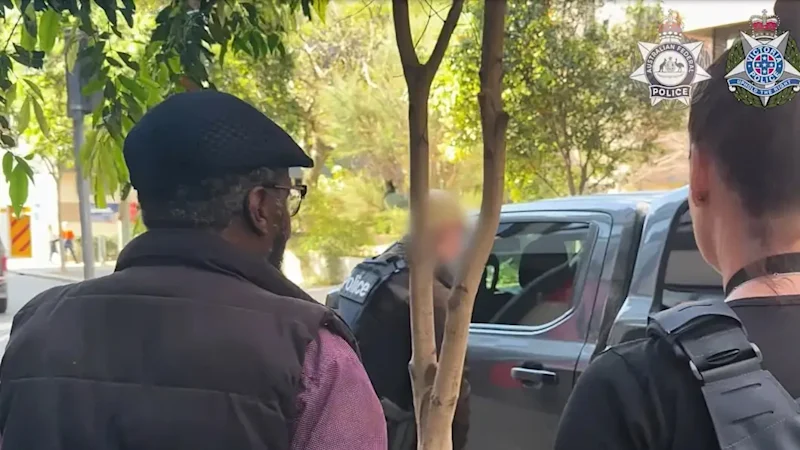
A Queensland doctor who left Australia to join Islamic State fighters in Syria supplied extremist material to a Melbourne man accused of being an influential propagandist for the terrorist organisation, a court has heard.
Details of the alleged relationship between Dr Omer Elamin and 65-year-old Mohamed Musse Bakit emerged during a bail hearing at Melbourne Magistrates’ Court. Bakit was charged last week after a lengthy counter-terrorism investigation into material he allegedly distributed through WhatsApp.
Police allege Bakit sent almost 10,000 files to a group chat between November 2015 and July 2020, including Islamic State propaganda, battlefield footage, speeches, executions and other violent extremist content.
Counter-terrorism detective Katharine Dillon told the court that Bakit accounted for 67 per cent of the chat’s content. His alleged output included 9,754 messages, 391 images, 1,609 audio files, 811 videos and more than 400 documents.
The court heard Elamin met Bakit at the Kuraby mosque in Queensland and gave him a yellow USB drive containing extremist material. Bakit allegedly told authorities that he then distributed the files to other members of the group.
Elamin was said to have travelled to Libya in 2016 intending to join Islamic State fighters in Syria. Detective Dillon said investigations into his whereabouts were continuing, but authorities did not know whether he had reached Syria.
Police allege Elamin also created the WhatsApp group used by Bakit to share the material. Some members were understood to live in Queensland, although the court was told they were not suspects and had not been charged with belonging to a terrorist organisation.
Material allegedly circulated by Bakit included Islamic State’s weekly magazine, al-Naba, as well as its English-language edition aimed at Western supporters. Investigators also found material about evading law enforcement and guides concerning mass-casualty attacks, the court heard.
Detective Dillon said Bakit appeared to have status within the group. Elamin allegedly referred to him as “our esteemed river”, while other participants described him as “the voice that shouts the truth” and “the hero”.
The prosecution also referred to material allegedly recovered from Bakit’s mobile phone during a 2024 raid, including a video showing the killing of American businessman Nick Berg, who was abducted by Islamist militants in 2004.
Bakit was also said to have been a passive member of 12 related WhatsApp groups. He was interviewed voluntarily by police in August 2025 and again in January this year.
During those interviews, Bakit denied knowing about the group chat, rejected having pledged allegiance to Islamic State and denied sending the messages. He said he had suffered memory loss after a stroke in 2023.
His barrister, Michael McGrath, argued that Bakit was not a danger to the community, pointing to his poor health and the fact that the alleged offending ended years ago. The court heard Bakit is permanently disabled and receives more than three hours of daily assistance with tasks including showering and dressing.
Magistrate Gerard Lethbridge will deliver his decision on bail at a later date.
