


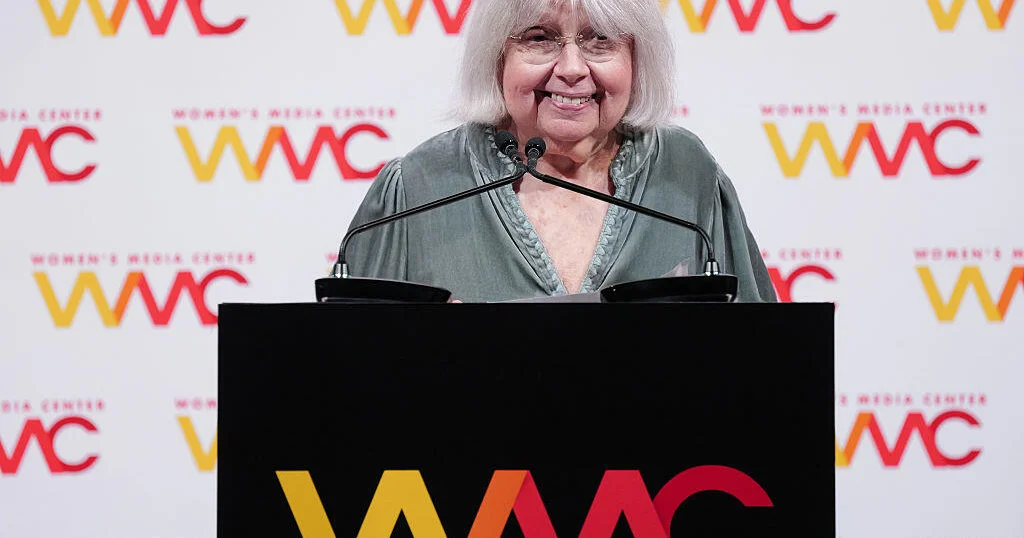
Robin Morgan, the poet, writer and feminist activist who helped shape the second wave of the women’s movement in the United States, has died aged 85.
Morgan died in New York on Saturday after a series of health problems in recent weeks, her son Blake Morgan said. Her death was confirmed by the Women’s Media Center, the organisation she co-founded with Jane Fonda and Gloria Steinem, who died earlier this week.
Julie Burton, president of the Women’s Media Center, described Morgan as “one of the architects of the contemporary women’s movement”, praising her writing and her “global leadership for justice and equality”.
Morgan was a prominent organiser, editor and author during the political upheavals of the 1960s and 1970s. She was among those who staged the first protest against the Miss America pageant in 1968, when demonstrators threw bras and other objects into what they called a “Freedom Trash Can”.
Two years later, she edited Sisterhood Is Powerful, an anthology that became one of the defining texts of modern feminism. She went on to publish more than 20 books, including The Word of a Woman: Feminist Dispatches, the memoir Saturday’s Child and the poetry collections Monster and Dark Matter.
Although best known for her activism, Morgan regarded herself primarily as a poet. Her son said her ability to compress complex political ideas into memorable language was central to her influence.
“She was someone who was able to take very big ideas and distill them succinctly, like a poet, into a few words,” he said, citing one of her maxims: “hate generalizes, love specifies.”
Morgan is widely credited with popularising the term “herstory”, a feminist reworking of “history”, and with helping establish the clenched-fist and female-symbol image associated with the women’s liberation movement. Her poem Monster was frequently quoted at feminist demonstrations.
She also helped found New York Radical Women and the group known as W.I.T.C.H. – the Women’s International Terrorist Conspiracy from Hell. In 1970, she was arrested and jailed after joining a protest occupation of the offices of Grove Press during a dispute over workers’ unionisation.
Morgan challenged figures on both the political left and right. In her widely circulated essay Goodbye to All That, she criticised the male dominance of the counterculture and attacked the treatment of women by activists including Abbie Hoffman and entertainers such as Hugh Hefner.
Her political work continued through the Sisterhood Is Global Institute, which she helped establish in 1984, and the Women’s Media Center, launched with Fonda and Steinem in 2005. The organisation campaigns to increase the visibility and influence of women and girls in the media.
She remained active in later life, hosting the syndicated programme Women’s Media Center Live with Robin Morgan. She was diagnosed with Parkinson’s disease 16 years ago and drew on the experience in poems and in a TEDWomen talk in 2015.
Morgan’s public life began long before her feminist work. Born in Lake Worth, Florida, in 1941 and raised in New York, she was modelling by the age of three and had her own radio programme, Little Robin Morgan, at five.
She became a familiar face on radio and television, appearing on the game show Juvenile Jury and in the domestic comedy series Mama between 1949 and 1957. Her image was marketed as that of the courteous, wholesome “ideal girl next door”.
Behind that public persona was a child who had already begun questioning authority. During one broadcast, Morgan rejected a suggested joke about a boy being physically punished and instead said that hitting children was wrong. In her memoir, she later described the incident as the first political act she remembered taking.
In her late teens she attended classes at Columbia University, joined poetry workshops and marched for civil rights and against the Vietnam War. She later married the gay poet Kenneth Pitchford, with whom she had her son, and described their relationship as a “two member commune”.
Writing in Saturday’s Child, Morgan reflected on a life that had moved from child stardom to radical politics, literature and international feminism. She retained, she said, “a threadbare, somewhat surreal sense of humour” – an attitude summed up in another of her lines: “Put that in your apple pie and smoke it.”
