


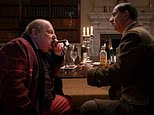
Peter Hitchens has welcomed a new French film for presenting Winston Churchill as a flawed and uncertain politician rather than the faultless wartime hero often seen on screen.
The film is Antonin Baudry’s two-part biopic about Charles de Gaulle, covering the French general’s flight to London after France’s collapse in June 1940 and the creation of the Free French movement.
British actor Simon Russell Beale plays Churchill, while Simon Abkarian portrays de Gaulle. The story centres on the uneasy relationship between the two men as they attempt to continue the fight against Nazi Germany.
Hitchens has criticised the tendency of modern cinema to turn Churchill into a permanently smiling figure of reassurance, chatting cheerfully with Londoners on the Tube while German aircraft attack the capital.
Instead, the French production shows a more complicated wartime leader: forceful and charismatic, but also capable of doubt, irritation and political uncertainty. Churchill’s support for de Gaulle is portrayed as both personal and strategic, as Britain seeks to challenge the authority of the Vichy regime.
A more complicated Churchill on screen
Reviews of the film have highlighted Beale’s performance and the prominence given to Churchill’s relationship with de Gaulle. The two men are shown as fellow national figures whose partnership is marked by affection, exasperation and occasional fury.
The first instalment follows de Gaulle’s arrival in Britain, his broadcasts from London and his efforts to assemble a Free French administration. It also depicts the formation of resistance forces in Africa and the campaign at Bir Hakeim, where Free French troops held out against a much larger German force.
The production is based on Julian Jackson’s biography A Certain Idea of France: The Life of Charles de Gaulle. The second film continues the story through to the liberation of France.
The biopic has become a surprise success in France, attracting a large young audience and prompting renewed interest in de Gaulle’s wartime role. In Britain and Ireland, the film’s first instalment went on general release on August 28.
For Hitchens, its importance lies not in diminishing Churchill’s achievements, but in making him recognisably human. The film rejects the polished legend and presents the prime minister as a man operating under immense pressure, uncertain of the outcome but still determined to resist.
