


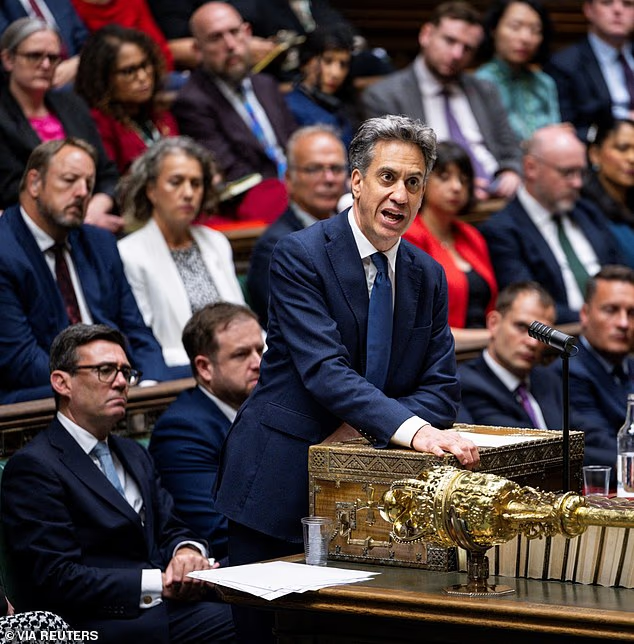
Ed Miliband’s sanctions on Israeli settlements in the West Bank have been criticised as counterproductive, with the central argument being that they will do little to advance a two-state solution and could instead strengthen opposition to the idea inside Israel.
The criticism rests heavily on Israel’s 2005 withdrawal from Gaza, when about 8,500 Jewish settlers were removed and their homes demolished. Responsibility for the territory was then transferred to the Palestinians, with Hamas subsequently taking control.
Supporters of a Palestinian state might have expected Gaza to become a model for self-government and economic development. Its young population, Mediterranean coastline and offshore gas reserves were seen as potential foundations for prosperity.
Instead, the argument goes, Hamas prioritised weapons and military infrastructure over public services, jobs and growth. Billions of pounds in international assistance were allegedly squandered or diverted towards arms and tunnels used to attack Israel.
Gaza withdrawal shapes Israeli opposition to two-state plan
One episode cited as emblematic of Hamas’s rule is the closure and subsequent destruction of the Crazy Water Aqua Fun Park, which opened in 2010 and employed more than 100 people.
The park was closed after objections from Hamas over mixed bathing and what it considered inappropriate clothing. It was later set alight by about 40 masked men, according to the account.
The episode is presented as a symbol of an administration that suppressed private enterprise rather than developing Gaza’s economy. The argument is that the territory’s experience has made Israeli voters deeply unwilling to repeat the same experiment in the West Bank.
Hamas’s assault on Israel on October 7 2023 is also cited as the decisive reason for that reluctance. The attack, in which militants emerged from hiding places using motorbikes and microlights, is described in the criticism as the most horrific atrocity against Jewish people since the Holocaust.
On that basis, the case against the sanctions is that they cannot persuade Israel to accept an armed Palestinian entity responsible for its own security. The position of the Israeli government and opposition is portrayed as unlikely to change unless Hamas renounces violence and gives up its weapons.
The sanctions announced by the Foreign Secretary are described as the seventh package imposed by Labour since the October 7 attack, with each measure directed at Israel. Critics argue that the Government is applying pressure to one side while failing to exert comparable pressure on Hamas.
They also claim the policy is driven less by the practical aim of securing peace than by pressure from Labour’s left wing and the desire to retain support in constituencies with sizeable Muslim populations. The same criticism links the Government’s approach to its proposed laws concerning Islamophobia and to competition from the Greens, led by Zack Polanski.
Those claims are accompanied by a warning that further concessions will be demanded, including the possibility of the Government describing Israel as guilty of genocide. The argument rejects that description as an abuse of the term and an insult to Holocaust victims.
The sanctions’ likely effect on Palestinians is also questioned. Rather than helping farmers or supporting businesses in the occupied territories, critics say, the measures could damage employment and leave Palestinian economic prospects even weaker.
At the same time, the policy is said to risk strengthening Israel’s political right and reinforcing the view among moderates that Britain can no longer be trusted. The overall conclusion is that sanctions against Israeli settlements will not bring the two sides closer to a peace agreement unless Hamas first abandons violence and disarms.
