


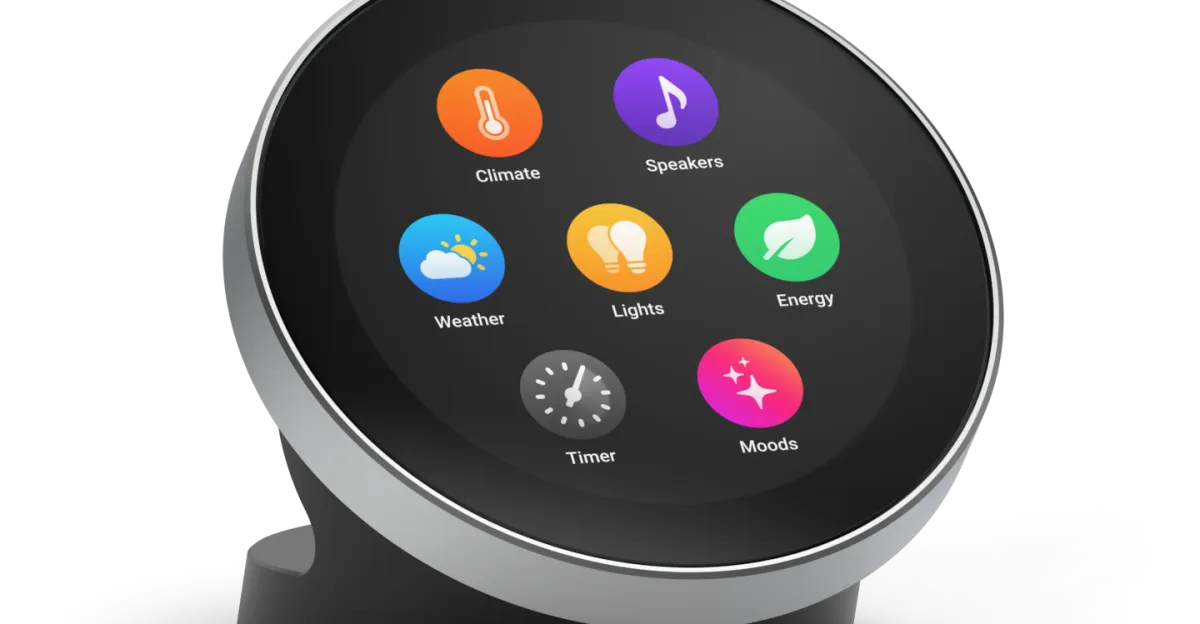
LG-owned smart home platform Homey has launched the Homey Portal, a compact touchscreen controller designed to give households a physical way to manage connected devices without relying on a smartphone app.
Pre-orders opened at an introductory price of $249 or €249, with deliveries expected in December. The price is set to rise to $299 or €299 after the launch offer ends.
The Portal has a 2.8in circular display surrounded by a stainless-steel dial. It can be placed on a desk or fixed to a wall, and is powered through USB-C.
Users can tap the display to operate lights, speakers, thermostats and blinds, while the rotary control can be used to alter settings such as brightness, volume and temperature. The interface changes according to the selected function, with dedicated screens for lighting, weather forecasts and timers.
Homey says the device supports more than 70,000 products made by over 2,000 brands. It is also compatible with major smart home standards including Matter, Zigbee, Z-Wave and Thread, addressing one of the biggest frustrations for users trying to connect equipment from different manufacturers.
The Portal can be configured for particular areas of a house, such as a kitchen, living room or bedroom. Alongside local controls, it can display energy use and trigger scenes and automations through Homey’s Flow system.
In one demonstration, a doorbell camera feed appeared on the Portal when the bell was pressed, accompanied by an option to unlock a connected door. The device has no microphone, meaning it does not offer built-in voice control, although Homey works with Amazon Alexa, Google Home and Siri Shortcuts.
Homey Portal requires a separate hub
Despite being designed as a central control point, the Portal is not itself a smart home hub. It must connect to a Homey platform, including Homey Cloud, the Homey Pro Mini, a Homey Pro released in 2023 or later, or a self-hosted Homey server running on the owner’s hardware.
Homey Cloud costs $3.99 a month, although the company says it is free for up to five connected devices. The Pro Mini hub costs $249, while the 2023-or-newer Homey Pro costs $449.
That additional hardware could make a multi-room installation expensive. Buying three Portals at the standard $299 price would cost almost $900 before the cost of a compatible hub or subscription is included.
Homey says the advantage of using its hubs is that compatible devices can continue communicating locally if the internet connection fails. A new update feature also allows Matter, Z-Wave and Zigbee devices to receive software updates through Homey, without needing to use the manufacturer’s hub or app.
Founded in the Netherlands in 2014, Homey operates as a closed-source platform and remains independent from LG’s own AI Home system, while integrating with it for functions including household energy management. The company’s plug-and-play approach places it between simpler mainstream systems and more technically demanding open-source platforms such as Home Assistant.
