


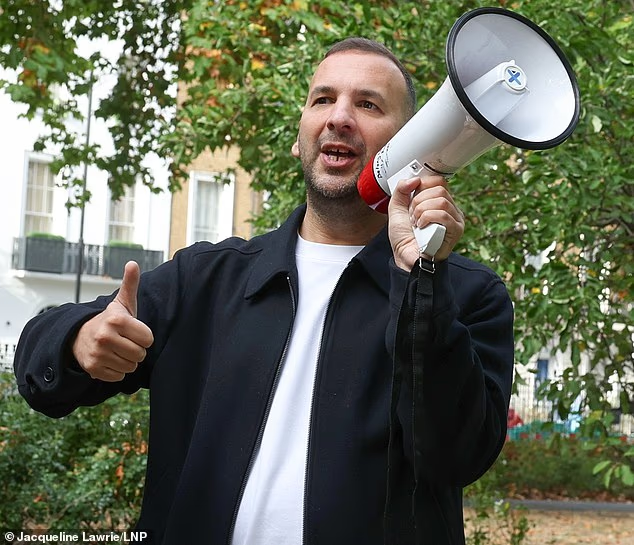
Israel has barred Green Party leader Zack Polanski from entering the country after party members voted to adopt a formal position opposing Zionism.
Israel’s foreign minister, Gideon Sa’ar, announced the decision after the motion was passed at the Green Party conference in Brighton, where 1,022 members voted in favour and 813 against.
Israel’s foreign ministry said the policy had given “legitimacy to terrorism” and described it as “a stain” on Britain’s history.
In a statement announcing the ban, the ministry said: “As a first step, foreign minister Gideon Sa’ar has decided this evening to declare Green Party leader Zack Polanski barred from entering Israel.”
The motion states that the party is opposed to Zionism, described as a movement supporting a Jewish state in Israel. It also calls for the creation of “a single democratic Palestinian state in all of historic Palestine, with Jerusalem as its capital”.
During the conference, members rejected a clause that would have prevented the policy being used to “pressure, proscribe or discipline” members because of their links to Zionist synagogues or other Jewish groups.
Israel’s foreign ministry said: “The Green Party in Britain ceased to act as a political party and became a body that gives legitimacy to terrorism.”
It added: “The Greens have adopted not only the green of Hamas, but also its ideology – the elimination of the State of Israel through armed struggle.”
Mr Polanski was not present for the vote, instead campaigning in Holborn and St Pancras ahead of Thursday’s by-election. He later issued a statement with the Green Party’s five MPs and his deputies, saying there was “no conflict between supporting the rights of Palestinians and the rights of Jewish people”.
The decision has exposed divisions within the party. Former co-leader Carla Denyer said the resolution risked “alienating a significant proportion of Jewish people”, including those who “vehemently disagree” with Israel.
Her former co-leader, Adrian Ramsay, and Caroline Lucas, the party’s first MP, also voiced opposition. Shahrar Ali, a former deputy leader, said he was “deeply ashamed” and claimed the policy had made the Greens “the first openly anti-Semitic party in the UK”.
The party has rejected that characterisation, with a spokesman saying it opposed “racism in all its forms”.
A safe room was set up for Jewish Green members during the Brighton conference, while two members had their passes revoked. One was a Zionist who had silently protested at a Palestine fringe meeting, and the other was a Jewish Green member who filmed the protest.
The resolution has drawn criticism from outside the party. Shadow home secretary Chris Philp described the Greens as “toxic to its core”, while Labour chairman Bridget Phillipson called the policy “shameful”.
The Campaign Against Antisemitism described it as “racism in its clearest form”, and Luciana Berger, who left Labour in 2019 after saying it was “institutionally anti-Semitic” under Jeremy Corbyn, said the Greens “should be shunned”.
There have also been suggestions that the motion could breach the Equality Act, with Adam Wagner KC writing that it may “discriminate against” Jews.
