


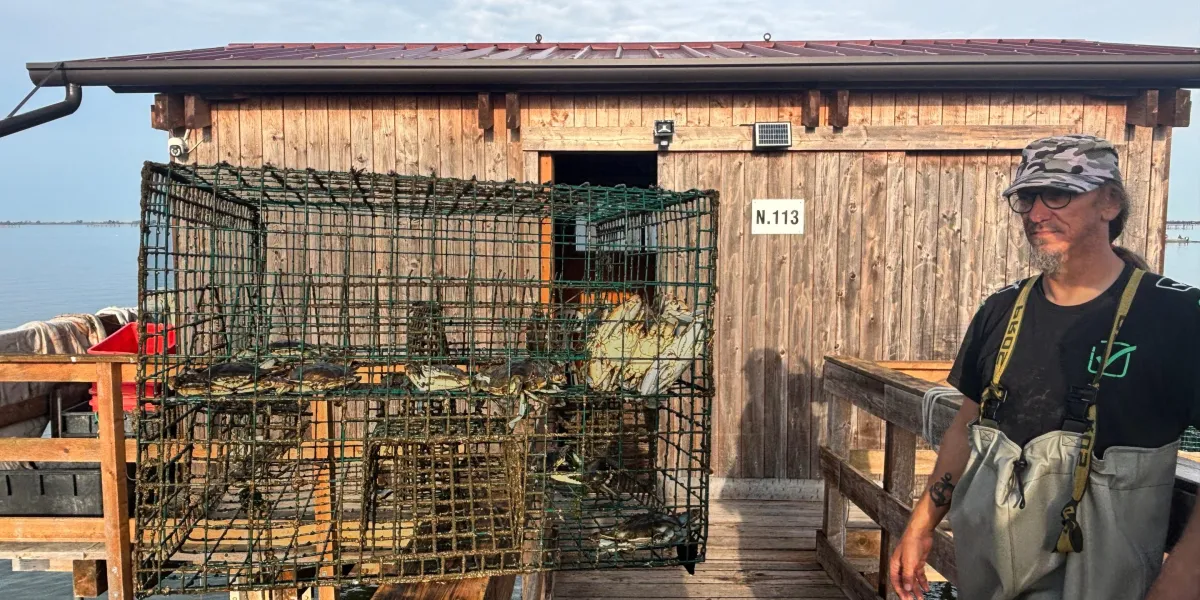
Italian fishermen in the Po Delta are turning an invasive blue crab blamed for wrecking the region’s shellfish industry into an export business, after two years in which much of the catch was destroyed by incineration.
The shift has given some fishing communities a route out of an economic crisis, even as scientists and officials continue to search for ways to limit the crab’s spread through the Adriatic.
Blue crab exports offer lifeline to Po Delta fishermen
In Scardovari, south of Venice, the Polesine Fishermen’s Cooperative Consortium has sold every blue crab caught so far this year. It expects turnover to reach €20 million (£17.2 million), with the majority coming from the once-unwanted species.
The cooperative’s revenues fell by 75 per cent to €15 million in 2024 and 2025, while its active membership dropped from 1,500 to 850. Fishermen who once relied on Manila clams and mussels have instead begun filling cages with crabs from the shallow waters of the lagoon.
“We needed to change strategy, and create an opportunity from this disaster,” said Paolo Mancin, president of the consortium.
Federico Zago, a second-generation fisherman, said the new market offered a chance to adapt to a problem that was unlikely to disappear.
“Since we’re going to have to live with these crabs, I hope they become an opportunity,” he said. “I hope the market continues to grow.”
The business has been supported by a new processing venture, Granchio Blu Trading, established in Porto Tolle in October 2025 by the Scardovari consortium, Sri Lankan seafood company Taprobane Seafoods and Singapore-based Atman Holdings. The facility is intended to prepare the catch for international markets and create a commercial use for an alien species that has inflicted serious damage on local fisheries.
Veneto’s regional authorities have also approved nearly €195,300 in public funding for a project to develop the processing and transformation of alien species, including blue crab.
Climate conditions fuelled the invasion
Atlantic blue crabs have been recorded in the Adriatic since at least the 1940s, having probably arrived in ballast water from commercial shipping. Their numbers remained limited until 2023, when fishermen began reporting a dramatic increase.
The crabs damage nets and consume molluscs, threatening the Manila clam farms that once provided most of the income for communities in Veneto and neighbouring Emilia-Romagna. They have also competed with the native green crab, traditionally used in local soft-shell dishes.
Piero Genovesi, an invasive-species specialist at Italy’s environmental protection institute, said warmer waters had probably helped the crab reproduce. Drought also lowered the level of the Po, allowing seawater to push further into tributaries, lagoons and deltas where food was plentiful.
“Climate change may therefore have favoured reproduction through both temperature and salinity, because it changed the salinity of the water,” he said.
Italy launched an eradication programme in 2024, paying fishermen in the Po Delta and elsewhere to catch and destroy the crabs. Nearly 2.3 million kilograms were incinerated in two years, but the effort made little visible difference to the population.
Female blue crabs can produce as many as eight million eggs in a season. Enrico Caterino, the government’s extraordinary commissioner for the emergency, said the eradication project had been shelved.
A separate attempt to use a natural predator has also attracted scepticism. Researchers from the University of Bologna released 150,000 young octopuses into the Adriatic this summer, but most are not expected to survive. Experts have questioned whether octopuses, which generally favour rocky habitats, can control crabs in the sandy lagoons.
“If an animal with such high reproductive potential finds suitable environmental conditions, predators may not be able to keep it under control,” Genovesi said.
Crabs shipped to Sri Lanka for processing
Fishermen now deliver between 100kg and 150kg of live crabs each morning. The catch is steamed, frozen and sent to Sri Lanka, where workers remove the meat by hand before it is turned into claw meat, fillets and mixed-meat products.
Most of the output is sold overseas, with only a small amount returning to Italy. Taprobane Seafoods is preparing to expand into Italian and wider European retail markets.
The financial return remains far below that of the former clam trade. Blue crab pays about €1.30 per kilogram, compared with €10 for clams, which once accounted for 90 per cent of the fishermen’s income but now provide roughly 10 per cent.
Mancin hopes packaged crab meat will persuade Italians to reconsider a species many still regard as a symbol of ecological damage. A campaign urging consumers to “eat ’em” if they could not defeat the invaders has so far made limited progress.
Blue crab remains largely absent from leading restaurants around Venice, where chefs continue to favour the native green crab. The labour required to prepare the invader and its poor reputation have both held back demand, according to the FIPE Venice restaurant federation.
One notable exception is Yogi restaurant and bar in Porto Tolle, run by former professional fisherman Stefania Marchesini. She buys directly from local fishermen, including soft-shell crabs known locally as moeche, and serves dishes ranging from fried crab balls to crab with polenta and whole crab in the shell.
“At first, the customer is very sceptical. But then the reaction is completely positive, and they want to try the entire range of products,” Marchesini said.
She has also set up a workshop supplying prepared crab to other restaurants, although sales have been disappointing. Marchesini said she remained determined to change attitudes towards the species.
“We are all angry because it invaded our seas,” she said. “But we also have to eat. Once people understand how it should be prepared, they will realise it is an excellent product.”
