


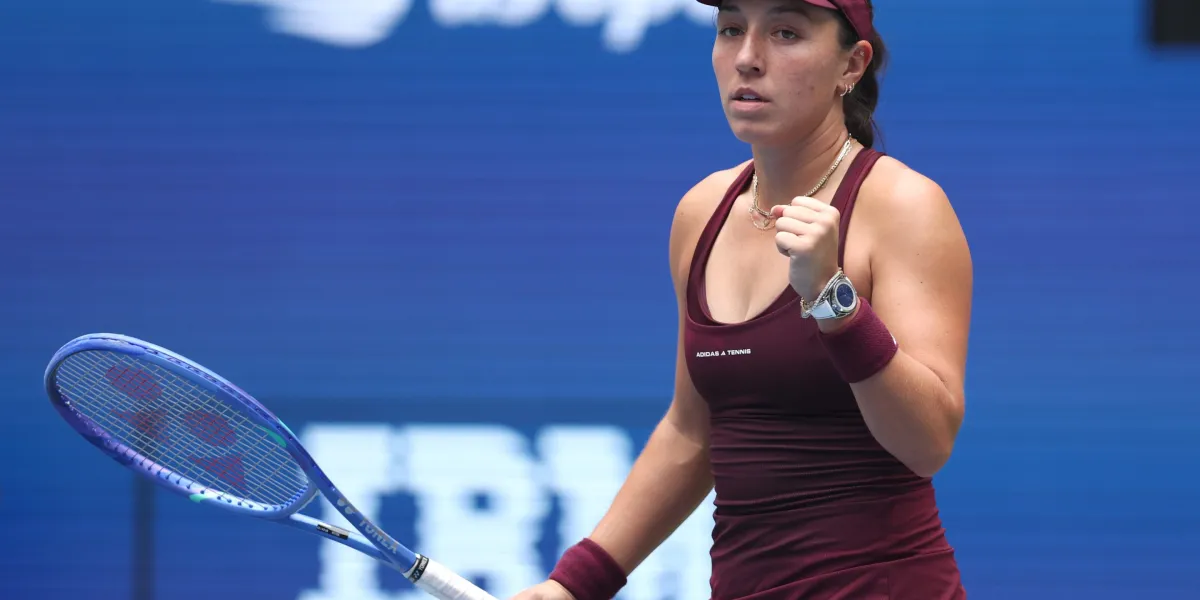
Jessica Pegula has kept her bid for a first Grand Slam title and the world No 1 ranking alive after fighting back to defeat Leylah Fernandez at the US Open.
The third-seeded American recovered from a poor opening set to beat the 31st seed from Canada 1-6, 6-4, 6-3 in the third round at Arthur Ashe Stadium on Friday, September 4.
Pegula, 32, will face Romania’s 16th seed Sorana Cirstea in the fourth round. The victory was her 48th of the season and extended her run of reaching at least the last 16 at each of her past five US Open appearances.
She remains one of four players with a mathematical chance of taking the top spot after the tournament. To become world No 1 for the first time, Pegula must win the title and hope Elena Rybakina, currently ranked second, fails to reach the semi-finals.
“I like to think I’m one of the harder workers out there,” Pegula said before the tournament. “I definitely am at the point where my coaches have to tell me to stop.”
Pegula’s US Open run brings family fortune back into focus
Pegula’s rise has unfolded in the shadow of her family’s immense wealth. Her father, Terry Pegula, built an oil and gas business after borrowing $7,500 from relatives and friends to establish East Resources in 1983.
The company, which operated across the Appalachian Basin, grew into one of the largest privately owned energy businesses in the United States. Royal Dutch Shell bought the bulk of East Resources for $4.7 billion in 2010, while a further $1.75 billion in assets was sold in 2014.
Terry Pegula later became a major figure in American sport. He bought the Buffalo Sabres for $189 million in 2011 before purchasing the Buffalo Bills for $1.4 billion in 2014, outbidding groups that included Jon Bon Jovi and Donald Trump.
He and his wife, Kim Pegula, remain the principal owners of both franchises. Their combined wealth has been estimated at about $9.3 billion.
Jessica Pegula has consistently acknowledged the advantages that came with her upbringing while rejecting the idea that money alone explains her career. She has said her family did not become wealthy until she was 17 or 18, by which point she had already committed herself to tennis.
“My dad is super blue-collar,” she told The Times. “He grew up with nothing and built his way up, and that mindset was instilled in my family from a young age.”
She began playing tennis at seven, received a wildcard for the US Open doubles draw at 17 and made her singles debut four years later. Her progress has been gradual by the standards of the women’s game, with her breakthrough at the top of the rankings coming later than that of many of her rivals.
Pegula has earned more than $26 million in tournament prize money and has endorsement deals with brands including IBM, Hyatt and The Farmer’s Dog. Yet she has repeatedly framed her career around the discipline expected of any elite athlete.
“Everyone who knows sports, or is an athlete, or is highly competitive, or has made it very far, I think, knows that you’re not really going to get there unless you work hard, are talented, and are really driven to get there,” she said in 2023.
Her father’s advice to his children has been similarly direct: work hard, take satisfaction in what you do and treat people properly.
Pegula’s next test against Cirstea will be their fifth meeting. Victory would take her into the quarter-finals and leave her three wins from a maiden major title — and potentially the first American woman to become world No 1 since Serena Williams.
