


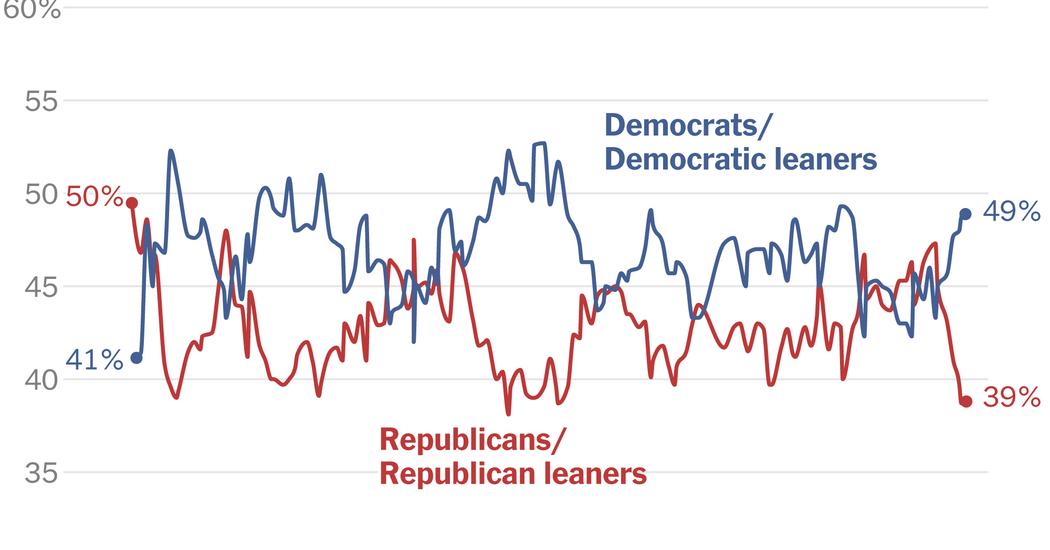
Democrats have opened their biggest lead in party identification since 2008, according to new Gallup figures, signalling a sharp shift in the political mood ahead of the 2026 US midterm elections.
The party holds a 10-point advantage when independent voters who lean towards one of the two parties are included. The findings represent a marked reversal from 2024, when Republicans and Republican-leaning independents held a narrow lead.
The movement comes as Donald Trump’s approval rating has remained below 40 per cent for months and Democrats have become competitive in a number of Senate contests in states that strongly backed the president in previous elections.
It does not, however, guarantee Democratic victories in November. Independent voters tend to be less politically engaged than committed partisans, and are less likely to turn out in midterm elections.
Democratic support strengthens among younger and Hispanic voters
The change is also reflected in polling by the Pew Research Centre, which found Democrats holding a six-point advantage over Republicans on a generic congressional ballot among registered voters several months before polling day. Pew’s figures showed 43 per cent backing a Democratic candidate, compared with 37 per cent for a Republican. ([pewresearch.org](https://www.pewresearch.org/politics/2026/07/23/midterm-voting-preferences-by-race-and-ethnicity-age-and-other-demographics/?utm_source=openai))
Young voters have moved particularly sharply towards the Democrats. Among those aged 18 to 29, 47 per cent said they would support a Democratic congressional candidate, against 24 per cent for a Republican, although a sizeable proportion remained undecided or preferred another candidate. ([pewresearch.org](https://www.pewresearch.org/politics/2026/07/23/midterm-voting-preferences-by-race-and-ethnicity-age-and-other-demographics/?utm_source=openai))
Hispanic voters, who shifted towards Mr Trump in the 2024 presidential election, also currently favour the Democrats by 49 per cent to 26 per cent on the congressional ballot. ([pewresearch.org](https://www.pewresearch.org/politics/2026/07/23/midterm-voting-preferences-by-race-and-ethnicity-age-and-other-demographics/?utm_source=openai))
Gallup’s annual figures published earlier this year similarly showed Democrats or Democratic-leaning independents ahead of Republicans by 47 per cent to 42 per cent in 2025, after Republicans had enjoyed small advantages for the previous three years. The pollster said the change was driven largely by independents moving away from the party in power. ([news.gallup.com](https://news.gallup.com/poll/700499/new-high-identify-political-independents.aspx?utm_source=openai))
Jeffrey Jones, a senior editor at Gallup, said party identification tended to move in cycles, following public perceptions of the country’s condition and the performance of the governing party.
“When things are going well in the country, party identification shifts in the direction of the party in charge,” he said. “When things are going poorly, like they are now with an unpopular Republican president and people unhappy with the state of the nation, people are moving away from the party in charge.”
Political scientists refer to the pattern as “thermostatic” public opinion: voters react against a governing party when they believe the country has moved too far in one direction.
Mr Jones compared the current shift with the final years of George W Bush’s presidency, when low approval ratings were followed by a strong Democratic lead in party identification and major gains for the party in the 2006 and 2008 elections.
The Democrats also recorded a similar level of support during the final quarter of the 2018 midterm cycle, when they gained more than 40 seats in the House of Representatives.
Gallup’s historical data show the party’s strongest periods came in 2006 and 2008, when 52 per cent of Americans identified with or leaned towards the Democrats. Barack Obama won the presidency in 2008, while Democrats made gains in both chambers of Congress.
Despite the favourable numbers, the party faces the usual midterm challenge of turning broad public sentiment into turnout. The electorate in congressional elections is typically smaller and older than in presidential contests, meaning the final result may depend less on national party identification than on which side succeeds in mobilising its supporters.
