


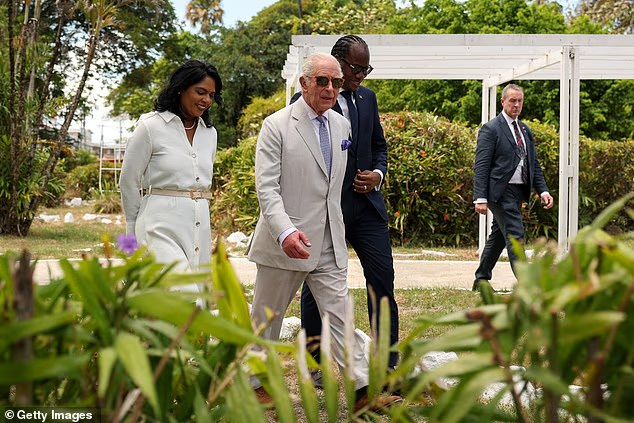
King Charles has acknowledged the painful legacy of slavery during a visit to the site of public executions carried out after the brutal suppression of Guyana’s Demerara Slave Rebellion.
The King, 77, stood in Independence Park in Georgetown, where dozens of enslaved people were hanged following the 1823 uprising, one of the largest rebellions in the history of the British Empire.
Charles did not give a speech during his two-day state visit and Buckingham Palace has made clear that he will neither apologise for Britain’s role in the slave trade nor discuss reparations, in line with Government policy.
But his visit to the former Parade Ground offered a public acknowledgement of what he has previously described as the “great suffering and injustices of the past” and the more “shameful” aspects of British history.
King Charles visits site of Demerara Slave Rebellion executions
Steven Jacobs, Guyana’s Minister of Culture, accompanied the King to the park and showed him a plaque commemorating those condemned to death and hanged from gallows erected at the site.
Thousands of enslaved men and women across the Demerara plantations rose in protest in 1823. The rebellion was crushed with force, hundreds were killed and the bodies of those executed were displayed as a warning to others.
President Mohamed Irfaan Ali has previously called for an official apology and reparations from Britain, although he has a warm relationship with the King. He is understood to want the visit to focus on the future, with Guyana being Britain’s most significant trading partner in the Caribbean.
About two dozen demonstrators gathered as Charles met indigenous leaders. Their placards read “The time has come, make it count” and “Face the history, commit to repair”.
One protester said: “We don’t want an apology from King Charles, we want reparations. This is as much about our government as it is him.”
The demonstrator also described modern Guyana as a “neo-plantation”, alleging that the country’s wealth benefited only “the top one per cent”, and said colonialism and slavery had “taken new shape and new form”.
The protesters shouted as the King’s car passed, but were outnumbered by well-wishers calling out: “Guyana is a lovely country, a beautiful country. Welcome to Guyana.”
Charles later spoke to groups of children in the park, joking: “I hope they have given you the day off school to be here! Are they giving you a lot of homework instead?”
His programme in Georgetown also included a visit to the Commonwealth War Graves, where he paid tribute to Commonwealth service and sacrifice and met veterans of the pre-independence British Guiana defence forces.
The Police Band played the Last Post before the King and Prime Minister Mark Anthony Phillips laid wreaths. Charles met Donald Grant, 99, who will turn 100 next week, and James Samuel, 100, who served in the British Guiana Volunteer Force.
Samuel told the King that, after moving to London following his military career, he struggled to find work because of prejudice. Charles frowned and shook his head as he listened.
The King also visited Georgetown’s Promenade Gardens, where he heard about conservation projects including a children’s book about a green sea turtle hatchling and a collaboration between Kew Gardens and Guyana to preserve seeds from the Victoria amazonica, Guyana’s national flower.
He was briefed on plans by the King’s Foundation to help reimagine Georgetown as a sustainable “Garden City”. Members of Glasgow’s National Piping Centre performed alongside Guyanese drummers as part of a cultural exchange.
At a reception hosted by President Ali, Charles sampled a specially blended “Royal Welcome” rum, taking a sip before declaring: “Very good!” The visit is taking place to mark 60 years of bilateral relations between Britain and Guyana.
Charles will next travel to Antigua for the Commonwealth Heads of Government meeting, the final stop on his Caribbean tour.
