


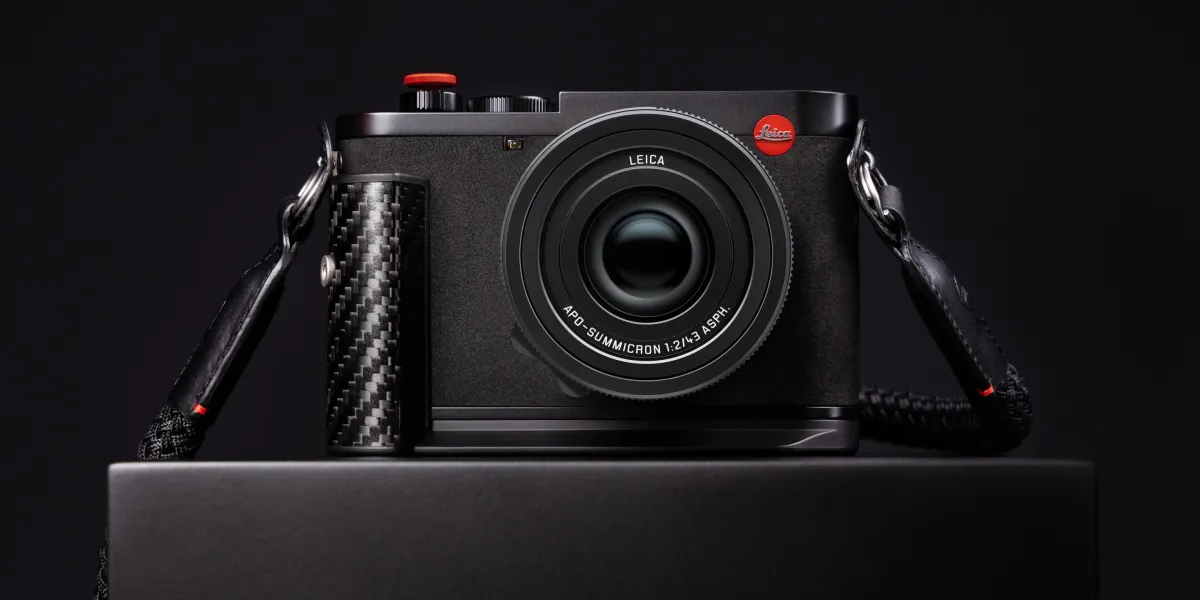
Leica Camera has announced its first official Formula 1 partnership, a global licensing agreement that will include a special-edition camera, a gallery exhibition in Los Angeles and events at this weekend’s United States Grand Prix in Austin.
The deal covers Formula 1 as a whole rather than an individual team. It also reflects an existing interest among several drivers: Lewis Hamilton and Lando Norris have both been seen using Leica cameras, while Norris runs a separate Instagram account dedicated to his photography.
Mike Giannattasio, president of Leica Camera North America, said the relationship between the two brands was rooted in a shared appeal to collectors and enthusiasts.
“There is such synergy between people who collect cameras and people who collect cars,” he said. “If you see people who are passionate about vintage cars or racing cars, and if they have anything other than a passenger in the seat next to them, eight out of 10 times it’s going to be a Leica camera.”
The Leica Formula 1 partnership and the ‘decisive moment’
Giannattasio said the connection extended beyond the drivers and owners to the engineering behind both cars and cameras. Each depends on numerous precisely made components working together, whether at the instant a shutter is released or during a high-speed race.
“When you look at the mechanics of a camera and you look at an M system, inside just a rangefinder, there are over 150 pieces that make the camera work,” he said.
He compared the preparation required by an F1 team with the split-second readiness associated with photography, drawing on Henri Cartier-Bresson’s idea of “the decisive moment”.
“Both photography and racing depend so much on preparation,” Giannattasio said. “While Formula 1 goes at incredible speed, and it may be really hard to stop the moment, photography helps someone who loves that craftsmanship and excellence stop the moment, so that it can be examined, remembered, celebrated.”
Both organisations also draw on long histories. Formula 1 has been racing since 1950, while Leica continues to make film cameras, including the MP and M-A models, which contain no digital components.
Giannattasio said the company’s history was intended to support innovation rather than exist simply as a celebration of the past.
“It’s heritage, but it’s not heritage for heritage’s sake,” he said. “It’s heritage for innovation’s sake.”
Leica Q3 43 Formula 1 Edition
The centrepiece of the partnership is the Leica Q3 43 Formula 1 Edition, priced at $9,950. It is the first Leica camera to use carbon fibre, a material associated with modern racing cars because it is both light and rigid.
Carbon fibre has been used on the areas most frequently touched by photographers, including the grip, thumb rest and soft-release button. The camera’s black covering is modelled on a racing steering wheel, while red controls echo the colour coding used on F1 steering wheels to help drivers locate functions quickly.
Giannattasio said the design had to incorporate Formula 1 cues without losing the appearance and handling associated with Leica.
“We had to make a product that was quintessentially iconic, immediately recognizable as a Leica camera,” he said. “But yet we had to take the design cues and materials that are big in the world of F1.”
He said the renewed interest in film cameras and other analogue products reflected a desire for slower, more deliberate experiences as technology advances.
“In a world that continues to advance with artificial intelligence, I think [there is a] need to slow down to celebrate and be in the moment,” he said. “Whether it’s film, whether it’s books, whether it’s a writing instrument, there’s a real resurgence for things that are real and deliberate.”
