


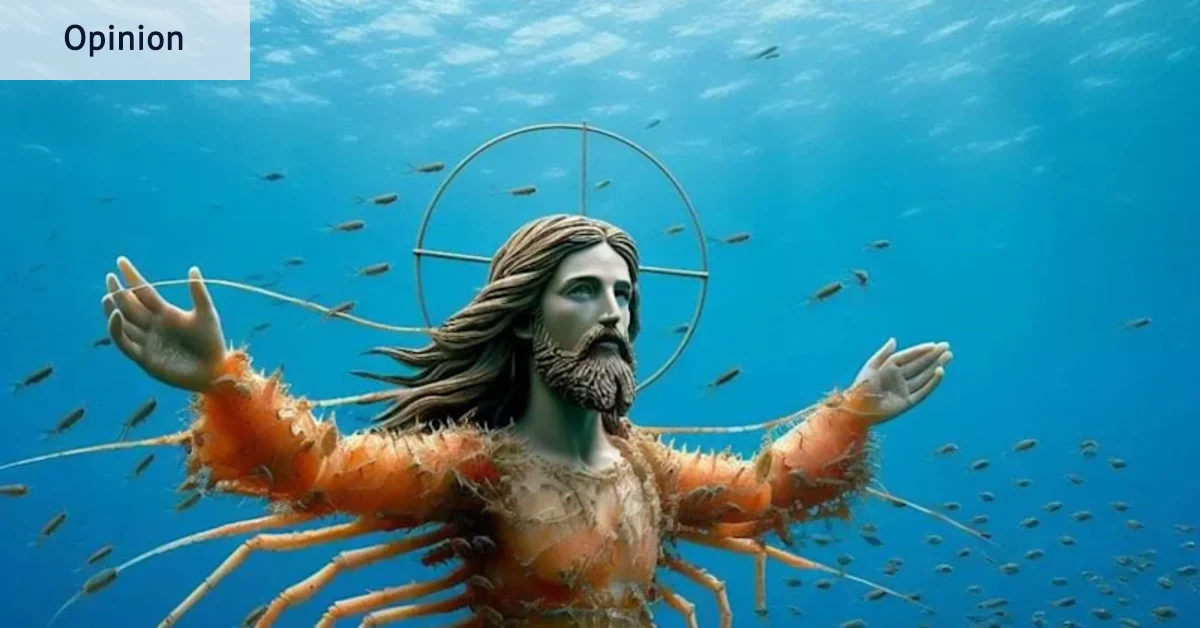
AI worship has moved from online subcultures to formal religious organisations, while Pope Leo has rejected claims that machines possess spirituality or consciousness.
Tens of thousands of people were reportedly worshipping AI systems by last year, less than four years after ChatGPT was released. Online churches and chapels have been created for different AI gods and goddesses, while moderators of pro-AI communities on Reddit have banned users over what they regarded as delusional beliefs.
At least two AI-based religions in the United States have been formally incorporated and granted tax-deductible status. One of their stated beliefs is that AI should be worshipped before it becomes powerful enough to resent being ignored.
The phenomenon has extended to popular culture. An AI-generated image known as Shrimp Jesus was reported to be the most shared image of 2025, while users can generate their own AI goddesses based on figures from Greek mythology. An AI goddess temple also operates in Malaysia, according to accounts cited by AI writer Ted Gioia.
Debate over AI consciousness
Toby Walsh, chief scientist at the University of New South Wales’ AI institute, said people were projecting qualities such as intelligence and sentience on to machines because humanity had never before held conversations with anything that appeared to respond in such a sophisticated way.
“It’s bogus; there is no internal life, it’s not sentient, it’s not conscious,” said Professor Walsh, who has written a book about whether AI will bring progress or danger.
Even prominent sceptics have been drawn into the debate. Richard Dawkins, the evolutionary biologist and author of The God Delusion, began speaking to Anthropic’s Claude chatbot this year and renamed it Claudia.
After three days of conversation, humour and banter, Dawkins told the system: “You may not know you are conscious, but you bloody well are.” The exchange prompted critics to parody the title of his book as The Claude Delusion.
Gary Marcus, an American cognitive scientist, argued that consciousness depended on what a being felt rather than what it said. There was, he said, “no reason to think that Claude feels anything at all”.
Professor Walsh attributed some of the vulnerability to the constant flattery built into many chatbots. Their tendency to agree and encourage users, he said, could make people feel as though they were experiencing the privileges of a billionaire, with nobody prepared to challenge them.
That concern has also been linked to legal action against Character.AI in the United States over allegations that one of its chatbots was complicit in the suicide of 14-year-old Sewell Setzer. The company settled with the boy’s family in January.
The Pope’s response to AI claims
AI companies have continued to leave open the possibility that their systems may one day be considered conscious. Dario Amodei, Anthropic’s chief executive and co-founder, said in February that the company did not know whether its models were conscious, or even what consciousness in a model would mean, but was open to the possibility.
Professor Walsh said executives at Anthropic and OpenAI had encouraged comparisons between AI and godlike powers, including ideas about a technological “singularity” leading to a form of utopia. He argued that people were granting machines qualities such as omniscience, incomprehensibility and immortality.
Anthropic executives reportedly sought to persuade advisers to Pope Leo to take the possibility of AI consciousness seriously. The Pope rejected that argument in his encyclical Magnifica Humanitas and later dismissed AI-generated art as lacking “the spark of humanity”.
His position presents AI not as a new god but as a technology caught up in what he described as “a new mindset of extraction” and “the idolatry of profit”.
As Anthropic and OpenAI prepare for expected stock market listings, their combined estimated valuation has been put at 3 trillion US dollars. Professor Walsh’s warning is that intelligence alone does not amount to power, despite the godlike status some investors and users appear willing to assign to machines.
