


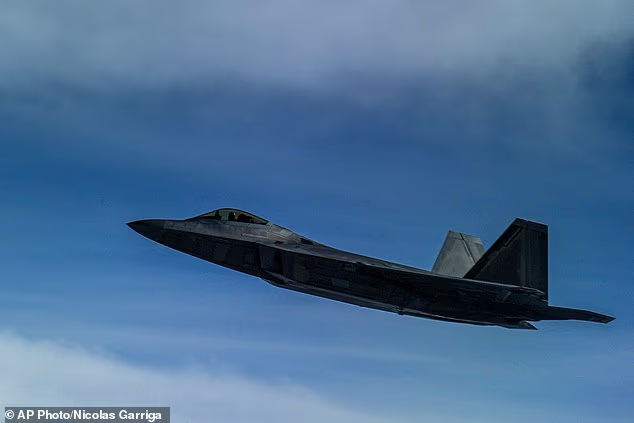
A military aircraft is understood to have submitted “spurious” flight data that triggered the air traffic control failure which disrupted thousands of flights across the UK, according to industry sources.
The incident at National Air Traffic Services (NATS) lasted around four hours on Tuesday, grounding or disrupting about 2,000 flights and affecting more than 300,000 passengers at airports including Heathrow, Gatwick, Manchester and Stansted.
NATS operations director Kathryn Leahy is said to have told industry leaders that an aircraft’s flight plan had set off the failure in the organisation’s flight-processing system. The aircraft was understood to belong to the UK military.
The claim has reportedly left industry figures shocked, particularly after a similar breakdown in 2023 was caused by a rare software problem involving incorrect flight data.
NATS has said its flight-processing system failed and that the underlying cause remains under investigation. A spokesman said: “The problem was fixed on Tuesday, and we are continuing to investigate the underlying cause. It would be wrong to speculate while that work continues, and a full technical investigation will follow.”
Minister criticised after resilience claim
The latest revelations came as aviation minister Keir Mather faced criticism over comments made just one day before the disruption, when he said the UK’s air traffic control system was “well prepared” and had gained “increased resilience”.
Mr Mather made the remarks in response to a written parliamentary question asking what action had been taken to reduce the risk of widespread disruption caused by air traffic control failures.
He said all 34 recommendations made by the Civil Aviation Authority after the 2023 breakdown had been implemented. He also pointed to laws introduced in December to make it easier to recruit air traffic controllers from overseas and from the military.
“This will increase resilience in the UK’s Air Traffic Controllers system and reduce the risk of delays,” he said.
But the system suffered a major failure within 24 hours of those comments, leaving passengers facing cancellations, lengthy delays and disrupted travel plans for several days as airlines worked to restore their schedules.
Richard Holden, the Conservative shadow transport secretary, said: “Labour are victims of their own supreme hubris.
“Hundreds of thousands of passengers have been left on aircraft for hours, or faced cancelled and delayed flights because the supposed resilience Labour ministers talked up failed when it was needed most.
“Labour ministers can’t have it both ways: if they boast about systems they created when they’re working they should take responsibility when they fail.”
Robert Jenrick, Reform UK’s Treasury spokesman, said: “Andy Burnham’s Government is proving just as incompetent as Keir Starmer’s.
“This meltdown has cost billions of pounds and ruined the travel plans of thousands of passengers. Why isn’t anyone being fired for yet another screw-up?”
Pressure on NATS chief Martin Rolfe
The disruption has also intensified pressure on NATS chief executive Martin Rolfe, who has faced calls to resign after presiding over the latest failure and the 2023 meltdown, which affected more than 250,000 passengers.
A further incident last July, blamed on a radar-related failure, lasted about 20 minutes but resulted in around 250 cancelled flights. The chief executives of Ryanair and Wizz Air have been among those calling for Mr Rolfe to be removed.
Transport Secretary Heidi Alexander summoned Mr Rolfe to Whitehall on Wednesday and is understood to have sharply criticised him. However, she rejected calls for his dismissal and gave him a week to produce a report on the incident.
Ms Alexander said she had been assured earlier this year that the Civil Aviation Authority’s recommendations had been put into effect, adding: “Something has gone wrong here clearly.”
She said it was her responsibility to ensure that NATS and the Civil Aviation Authority were held to account on behalf of passengers and airlines.
NATS serves 15 UK airports and operates as a public-private partnership. The Government holds the controlling stake, with the remainder owned by UK airlines including British Airways, easyJet and Virgin Atlantic, Heathrow and NATS staff.
The Civil Aviation Authority has said the failure is likely to be treated as an “extraordinary circumstance” under passenger rights rules. Airlines must look after affected passengers, but they are unlikely to have to pay compensation.
